


AI Passive Income Stragtegy in 2026
Artificial intelligence has fundamentally changed the economics of passive income. What once required a team of specialists—content creators, developers, designers, customer support staff—can now be accomplished by one person leveraging the right AI tools. In 2026, we’re witnessing an unprecedented democratisation of income-generating capabilities: AI can write blog posts, generate stunning visuals, code software, create music, build automations, and manage customer interactions—all at a fraction of the traditional cost. Whether you’re looking to diversify your earnings, build wealth without active trading, or create a sustainable income stream that doesn’t require you to trade hours for pounds, AI passive income strategies offer genuine opportunity backed by real-world examples and proven systems.
This comprehensive guide walks you through six battle-tested AI passive income strategies, explains how to pick the one that fits your situation, and gives you a realistic roadmap for what to expect in the first six months. We’ll cut through the hype and focus on sustainable, implementable approaches that have already generated real revenue for entrepreneurs in 2026.
Table of Contents
- What Is AI-Driven Passive Income?
- Why 2026 Is the Best Year to Start
- Strategy 1: AI-Generated Content & Blogging
- Strategy 2: Selling AI-Created Digital Products
- Strategy 3: AI-Powered Affiliate Marketing
- Strategy 4: Building and Selling AI Tools or SaaS
- Strategy 5: AI Art, Music and Creative Assets
- Strategy 6: AI Agents and Automation for Clients
- How to Pick the Right AI Income Strategy for You
- Realistic Income Expectations — No Hype
- Getting Started: Your First 30 Days Action Plan
- Frequently Asked Questions
- Conclusion
What Is AI-Driven Passive Income?
True passive income means earning money with minimal ongoing effort once the initial system is set up. AI-driven passive income takes this a step further: it uses artificial intelligence to automate the income-generating work itself, rather than simply automating the administrative tasks.
Consider a traditional passive income stream like a rental property. You buy it, find tenants, collect rent, and handle maintenance—there’s still significant work involved, especially at the beginning. AI passive income is different. You set up an AI system once—a blog powered by AI-written content, a digital product created with AI design tools, or an automated service built with no-code platforms—and then the AI continues to generate revenue with minimal intervention from you.
The key distinction is leverage. AI dramatically amplifies your earning potential without proportionally increasing your time investment. A blog that would take 50 hours to write manually using traditional research methods can be researched, written, and optimised by AI in 5 hours. A digital product that previously required days of design work can now be created in hours using image generation models. A software product that once required hiring a developer can be built in days using no-code tools powered by AI.
The psychological shift required here is important: AI doesn’t eliminate the need for strategy, marketing, quality control, and audience building. Rather, it removes the friction from the creation and maintenance process, allowing you to focus your human effort where it truly matters—understanding your market, building distribution channels, and continuously improving your offerings based on customer feedback.
This distinction separates AI income from traditional passive income. With stock dividends or rental income, you’re largely passive throughout—you don’t have to build, create, or market. With AI income, you remain actively involved in strategy and marketing, but your leverage multiplies your impact. The AI doesn’t replace entrepreneurship; it amplifies the productivity of the entrepreneur. This is actually a strength, because it means success depends on your judgment and market sense rather than on algorithmic luck.
Why 2026 Is the Best Year to Start
The AI landscape in March 2026 is fundamentally different from even 12 months ago. The barriers to entry have collapsed, the tools are more mature and reliable, and the market is still relatively early enough that you can build meaningful audiences before reaching saturation.
In 2026, AI tools have matured to production quality, meaning they’re not experimental side projects—they’re legitimate business infrastructure. GPT-5, which launched in early 2026, delivers near-expert-level reasoning and writing capability across virtually every domain. Image generation models like DALL-E 3 and Midjourney have achieved photorealism that rivals professional stock photography. Video generation tools can produce polished content without cameras or crews.
The second reason 2026 is optimal is market timing. The majority of online audiences and platforms haven’t yet adapted to AI-generated content becoming standard, meaning there’s still significant SEO opportunity and audience hunger for AI-created material. As more people adopt these tools, the competition will increase—but first-movers who establish authority and distribution today will retain their advantage.
Third, the cost of entry has become almost negligible. Monthly subscriptions to professional-grade AI tools range from £15 to £50. You can launch a complete passive income business—website, content, automation systems—for less than £200 in setup costs. Compare this to starting a traditional e-commerce business, freelancing agency, or digital marketing operation, and the economic case for AI income is compelling.
Finally, AI tools in 2026 require no technical expertise. No-code platforms like Make, n8n, and Zapier have eliminated the need to code. Even building a simple SaaS product is now possible without programming experience, using platforms like Bubble or FlutterFlow.

Strategy 1: AI-Generated Content & Blogging
The oldest monetisation path—content creation—remains one of the most reliable. The difference in 2026 is that you no longer need to write 2,000-word articles yourself. AI can handle the heavy lifting of research, initial drafting, and optimisation.
How it works: You identify a profitable content niche, use AI to research trending questions in that niche, create SEO-optimised articles using GPT-5, and publish them on your own blog or Medium. You then monetise through Google AdSense revenue, affiliate marketing commissions, or sponsored content.
The process involves several key steps. First, identify your target niche—narrow enough to rank for, broad enough to have search volume. Use tools like Ahrefs, SEMrush, or free alternatives like Ubersuggest to find keyword opportunities with decent search volume (100+ monthly searches) and low competition. Second, create a content calendar using AI: feed GPT-5 your target keywords and have it generate article outlines, research briefs, and article drafts. Third, edit and quality-check the AI output. This is crucial—the AI does 80% of the work, but your editorial judgment ensures quality. Fourth, optimise for SEO: add internal links, format with headings, optimise meta descriptions. Finally, publish and promote across social media and relevant communities.
Realistic example: A creator in the “AI for small businesses” niche publishes 3 AI-written articles per week. Each article targets a specific keyword phrase like “how to use ChatGPT for email marketing” or “best AI tools for social media scheduling.” The articles are thoroughly researched and edited, taking perhaps 2 hours each to produce from AI draft to publication. Within three months, the blog accumulates 50,000 monthly visitors. At typical Google AdSense rates (£0.25–£0.50 per 1,000 impressions), this generates £12–£25 monthly from ads. However, add in 3–5 affiliate commissions per month (promoting AI tools, hosting, courses at £15–£50 per commission), and the blog generates £250–£500 monthly revenue with approximately 6–8 hours of weekly work (3 hours writing, 2–3 hours optimisation, 1–2 hours community building).
Why it works: Search engines reward fresh, comprehensive content. AI allows you to publish more regularly than would be manually sustainable. Early-stage blogs in underserved niches can rank for long-tail keywords within 6–12 weeks. The combination of volume (publishing frequently) and quality (through your editorial process) creates a powerful ranking advantage.
The economics of this strategy are simple: you need roughly 10,000 monthly visitors to generate meaningful revenue from ads alone. You need roughly 1,000 monthly visitors with decent affiliate placement to generate £100+ monthly in commissions. Most niches can achieve this within 12 weeks of consistent publishing.
Time to first revenue: 8–12 weeks (to accumulate sufficient traffic and clicks for meaningful AdSense payouts or first affiliate sales)
Monthly income potential: $100–£2,000 (highly dependent on niche competition, traffic volume, and affiliate quality)
Strategy 2: Selling AI-Created Digital Products
Digital products have one tremendous advantage: you create them once and sell them infinitely without inventory, shipping, or customer support overhead. AI accelerates creation dramatically.
How it works: Use AI tools to create digital products like prompt libraries, email templates, social media content calendars, design templates, Notion dashboards, or ebook guides. Upload them to marketplaces like Gumroad or Etsy, or sell them through your own website.
The creation process is streamlined: identify a problem your target audience faces, use AI to generate solutions, package it beautifully, and sell. For example, a creator who knows that freelance copywriters struggle with prompt engineering could create a comprehensive prompt library using GPT-5. The creator asks GPT-5 to generate 100 high-performance prompts for copywriting tasks, tests them, curates the best 70, organises them by use case, and adds usage instructions. This takes perhaps 8–12 hours of work. They then design a beautiful PDF or Notion template using AI design tools, and set up a sales page on Gumroad or their own site.
Realistic example: A creator designs 10 professional AI prompt libraries targeting specific use cases: “ChatGPT for Freelance Copywriters,” “GPT-5 for Legal Research,” “AI Prompts for Instagram Growth,” and so on. Each prompt library contains 50–100 tested, high-performing prompts with usage instructions, examples, and customisation tips. The creator uses Notion and Figma (with AI design assistance) to create beautiful product pages and sales funnels. They price them at $7–$15 each. With modest social media promotion (posting free example prompts, sharing transformative results, building an email list), each product averages 15–25 sales per month within two months. If the creator has 10 products at an average of $10 per product and 20 sales per product monthly, total monthly revenue is $2,000 with minimal ongoing effort beyond occasional social media updates and customer support.
The beauty of this model is the compounding effect: each new product builds on your audience. Your first product is hardest to sell. Your tenth product is easy because you have distribution (email list, social media following, established reputation).
Why it works: Digital products solve real, immediate problems for specific audiences. Creators, entrepreneurs, and professionals actively seek tools that save them time. Pricing is fair because the value-to-cost ratio is obvious. There’s no barrier to scaling—you can sell the same product infinitely.
Time to first revenue: 4–6 weeks (product creation + initial marketing; 8–12 weeks to meaningful revenue from multiple products)
Monthly income potential: $200–£5,000+ (scales with audience size, number of products, and marketing effort)

Strategy 3: AI-Powered Affiliate Marketing
Affiliate marketing—earning commissions by recommending products—works beautifully with AI because AI can scale content production to cover thousands of products and comparisons.
How it works: Create comparison articles, review guides, and resource roundups for products in your niche. Use AI to research features, compile comparisons, and draft articles that naturally incorporate affiliate links. Publish on your blog, YouTube, or social media. When readers click your affiliate links and purchase, you earn a commission (typically 5–30%).
Realistic example: In the “AI tools for business” niche, you create a comprehensive comparison article: “ChatGPT vs Claude vs Gemini for Content Marketing” with embedded affiliate links to pricing pages. AI helps you gather features, pricing, strengths, and weaknesses for each tool, then structures them into a compelling comparison. You publish similar comparison articles across your chosen niche. With steady organic traffic, this content accumulates clicks. Creators report 5–15 affiliate sales monthly from well-researched comparison content. At an average commission of $20 per sale, this yields $100–$300 monthly per article, scaling to $500–$2,000 as your content library grows.
Why it works: Comparison content has clear intent. Readers are actively comparing options, making them highly likely to click through and buy. AI makes it feasible to create comparison guides for hundreds of products without manual research overhead.
Time to first revenue: 6–8 weeks (content accumulation and initial traffic)
Monthly income potential: $100–$3,000
Strategy 4: Building and Selling AI Tools or SaaS
This strategy appeals to more ambitious builders: creating a small software product that solves a specific problem and selling it via recurring subscription.
How it works: Identify a narrow problem that frustrates people in a specific niche. Use no-code tools like Bubble, FlutterFlow, or Make to build a web application that solves this problem. Sell access via monthly subscription (£10–£100/month depending on complexity). You can leverage AI to help with design, copy, and even some backend logic (via APIs).
Realistic example: A creator builds “AI Essay Outliner”—a web application where university students paste a topic, and the tool (powered by GPT-5 API calls) generates detailed essay outlines with citations. The creator charges students £5–£10 monthly for unlimited outlines. With 200 active subscribers at an average of $7/month, the product generates £1,400 monthly revenue with minimal ongoing work (mostly maintenance and feature requests). The creator invested perhaps 60 hours building the MVP and another 40 hours marketing it. After the first three months, this becomes true passive income.
Why it works: Recurring subscription revenue is highly valuable. Even small numbers of paid subscribers generate real income. No-code tools lower the barrier to building so dramatically that non-technical people can build marketable products.
Time to first revenue: 8–16 weeks (MVP development + customer acquisition)
Monthly income potential: £500–£10,000 (scales with subscriber count)

Strategy 5: AI Art, Music and Creative Assets
AI-generated creative content—images, music, video clips—is increasingly acceptable on stock marketplaces and commercial platforms.
How it works: Use Midjourney, DALL-E 3, or Firefly to generate high-quality visual content. Use Suno or other AI music generators to create original music. Upload these to stock marketplaces (Shutterstock, Adobe Stock, Getty Images), music licensing platforms (Epidemic Sound, AudioJungle), or sell directly through your website or Gumroad.
Realistic example: A creator generates 50 unique pieces of abstract AI art using Midjourney, each crafted with commercial appeal. They upload these to Shutterstock, which has a contributor program with variable payouts (typically £0.25–£5 per image sale depending on licensing type). With 50 images and modest sales volume (even 1–2 sales per image monthly), the creator accumulates £50–£200 monthly in near-passive income. Scale this to 500 images across multiple platforms, and revenue grows to £500–£2,000 monthly.
For music, the economics are more favourable. Creators generating unique AI music can earn significant royalties when their tracks are used in videos, podcasts, and media.
Why it works: Stock platforms have infinite demand. Creators constantly need royalty-free assets. Supply is still limited for AI-generated assets on major platforms, creating opportunity.
Time to first revenue: 6–8 weeks (content creation and platform approval)
Monthly income potential: £50–£1,500 (highest for music licensing)
Strategy 6: AI Agents and Automation for Clients
This is less “pure passive” but closer to semi-passive recurring revenue. You build an automation system once, then sell it repeatedly to clients or operate it as a service with minimal oversight.
How it works: Use workflow automation platforms like Make or n8n to build custom automations—perhaps a lead qualification system that uses ChatGPT to evaluate inbound emails, or a content distribution workflow that automatically publishes to multiple platforms. Sell this as a service to small businesses.
Realistic example: A creator builds a “LinkedIn post automation + distribution service” for small business owners. The automation system uses Make to: pull articles from RSS feeds, summarise them with AI, convert to LinkedIn post format, schedule posting, and track engagement. Clients pay £30–£50 monthly for this service. With 20 clients, monthly recurring revenue reaches £600–£1,000. Each client requires roughly 2 hours of initial setup and perhaps 30 minutes monthly maintenance.
Why it works: Many small business owners lack technical skills and would pay for hands-off automation. Recurring revenue is predictable. Once the system is built, onboarding new clients is faster each time.
Time to first revenue: 6–10 weeks (system building + client acquisition)
Monthly income potential: £300–£5,000 (scales with client base)
How to Pick the Right AI Income Strategy for You
With six viable strategies, how do you choose? The right strategy depends on three factors: capital availability, time before first revenue, and your existing skills.
Capital: Strategies 1–3 require minimal capital (£50–£200 total, mostly AI tool subscriptions). Strategy 4 and 6 require moderate capital for no-code platform subscriptions and API costs (£100–£500, with ongoing monthly fees for production). Strategy 5 requires a one-time cost for AI subscriptions (£50–£150) with ongoing monthly fees (£20–£50 monthly for image generation and music tools).
Speed to revenue: Strategy 2 (digital products) and Strategy 6 (automation services) move fastest if you have an existing audience—you can have your first meaningful sale within 4–8 weeks. If starting from zero audience, Strategy 1 (blogging) and Strategy 3 (affiliate marketing) are more reliable but slower, typically generating first revenue at 8–12 weeks. Strategies 4 (SaaS) and 5 (creative assets) are variable depending on market fit and niche.
Existing skills: If you’re strong at writing, research, or SEO, Strategies 1 and 3 suit you best. If you’re a designer, illustrator, or creative person, Strategy 5 appeals immediately. If you have any business experience or deep understanding of specific problems, Strategies 2 (digital products), 4 (SaaS), and 6 (automation) are natural fits. If you’re technically minded but don’t code, Strategy 6 (workflow automation) is ideal because no-code platforms make this accessible.
Your best move: Choose the strategy that aligns with a market you already understand or a problem you’ve personally experienced. Your existing knowledge of your audience or niche is your biggest advantage. AI handles the time-intensive production work; you provide the strategy and market insight. The second-best criterion is: which strategy’s output excites you? If you hate writing, blogging will be miserable. If you love building things, SaaS appeals. If you’re energised by design and visuals, creative assets are natural. Success requires consistency, and consistency flows from interest.
Realistic Income Expectations — No Hype
Let’s be frank: you won’t generate £5,000 monthly on day one. But legitimate AI-powered income streams are generating real earnings for practitioners in 2026.
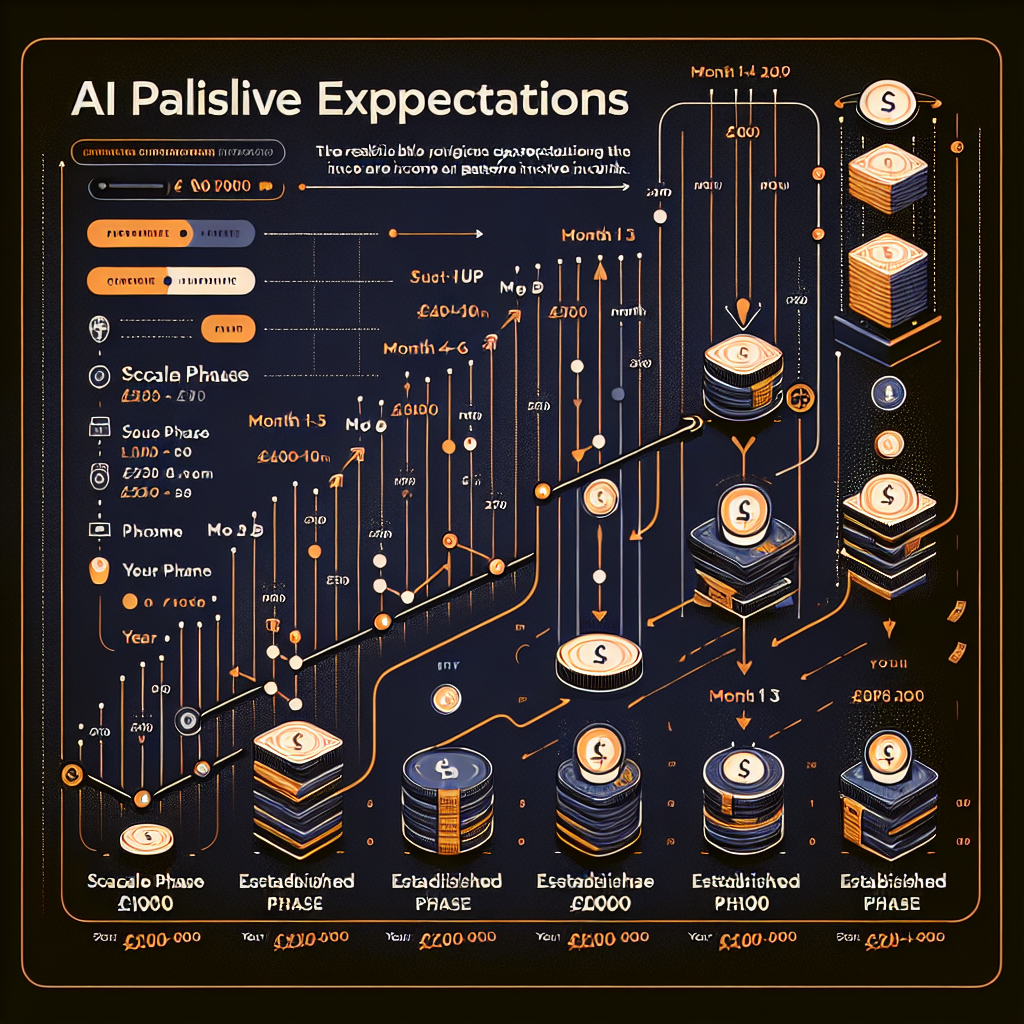
Months 1–3 (Setup Phase): Expect £0–£500. This period is about building assets—content, products, tools, or customer relationships. You’re investing your time, and revenue is minimal or zero. You might publish 10–15 blog posts, create 2–3 digital products, or launch an MVP of a SaaS tool. This is the hardest psychological phase because you’re working without immediate payoff.
Months 4–6 (Growth Phase): Expect £500–£2,000. Assets are accumulating, audience is growing, and revenue systems are becoming visible. Your earliest content is ranking. Your first products are selling a few copies weekly. You’re beginning to see ROI on your effort. Motivation increases as the first real income arrives.
Months 7–12 (Scale Phase): Expect £2,000–£5,000 monthly. Your best-performing content or products are now generating consistent revenue. You’re publishing 20+ articles or have 10+ digital products. You’re refining your approach based on what’s working. You understand your audience better and can create more targeted solutions.
Year 2+: Expect £5,000–£15,000+ monthly. By this point, you have multiple revenue streams, a proven system, and leverage. You might have a blog generating £1,000/month, digital products generating £2,000/month, affiliate commissions £1,500/month, and SaaS generating £2,500/month. You’re essentially operating a business.
Key insight: these timelines assume you’re working consistently (10–15 hours weekly) and applying marketing discipline. Many people create products and then do nothing to promote them—obviously, this won’t generate income. Success requires the AI to handle creation, but you still must handle marketing, audience building, and optimisation. This is the hard part AI doesn’t eliminate.
Also, income varies dramatically by niche. B2B technology and business niches support higher prices (£20–£50 digital products, £100–£500/month SaaS subscriptions) and affiliate commissions (£50–£200 per sale). Consumer wellness and hobby niches have higher volume but lower margins (£5–£15 products, 5–15% affiliate commissions). Pick a niche where your audience has money and the problems are urgent.
Finally, these aren’t linear timelines. Someone with an existing audience (email list, social media following, business network) can compress the timeline by 50%. Someone starting completely from scratch might take twice as long. The quality of your product and consistency of your marketing matter far more than the AI tools you use.
Getting Started: Your First 30 Days Action Plan
You don’t need to perfect your strategy before starting. The fastest path to income is to choose a strategy and begin immediately.
Week 1: Research and decide
- Identify which one of the six strategies aligns with your interests and existing knowledge
- Spend 3–5 hours researching successful examples in your chosen space
- Decide: will you pursue Strategy 1, 2, 3, 4, 5, or 6?
Week 2: Set up infrastructure
- Create a simple website or choose your selling platform (Gumroad, Etsy, Shopify, or your own site)
- Set up a free social media account to begin audience building
- Subscribe to the necessary AI tools (GPT-5 subscription, image generator, automation platform—whatever your strategy requires)
Week 3: Create your first asset
- Produce your first blog post, digital product, affiliate article, SaaS MVP, artwork, or automation
- Don’t obsess over perfection. Done is better than perfect. You’ll improve as you go.
- Publish or launch this first asset
Week 4: Begin promotion
- Share your first asset across social media and relevant communities
- Send it to friends for feedback and to ask them to share
- Begin planning your second and third assets
- Track what resonates; replicate what works
By day 30, you’ll have one published asset and the beginning of a system. This is genuinely remarkable—most people who think about passive income never reach this point.
Frequently Asked Questions
Is AI passive income actually passive?
Partially. The income-generation systems (content creation, design, writing, coding) are highly automated. But marketing, audience building, and strategy remain active work. The more accurate term is “leveraged income”—you’ve amplified your productivity so that you’re earning pounds without trading hours one-to-one.
Do search engines penalise AI-generated content?
Google’s official stance is that AI content isn’t inherently penalised, but low-quality, unhelpful AI content will rank poorly (as will low-quality human content). Well-researched, thoroughly edited, and genuinely helpful AI-generated content ranks normally.
How much do I need to invest upfront?
Minimal. Most AI tools cost £20–£50 monthly. Website hosting is £5–£20 monthly. You could start all six strategies with a total investment under £300. Compare this to traditional businesses.
Which strategy has the fastest path to revenue?
Digital products and automation services move fastest if you have an existing audience or network to promote to. If starting from zero, blogging and affiliate marketing are slower but more reliable.
Can I combine multiple strategies?
Absolutely. Many successful creators run a blog (Strategy 1) + affiliate marketing (Strategy 3) simultaneously. Others build a SaaS (Strategy 4) while selling complementary digital products (Strategy 2). Diversification reduces risk and accelerates income.
What if my first attempt fails?
Failure is information. You’ll learn what audience wanted, what problems they have, and what approach works. Iterate. Your second product will be better than your first, and your third better than your second. The sunk cost is small enough that you can afford experimentation.
Conclusion
Building AI-powered passive income in 2026 is genuinely attainable. The tools are mature, reliable, and accessible. The barrier to entry is lower than ever. The market is still early enough that there’s room for new entrants. And most importantly, you can start for under £300 with just 10–15 hours of weekly effort.
The six strategies outlined here—content, digital products, affiliate marketing, SaaS tools, creative assets, and automation services—are all generating real income for real people right now. Your task is to pick one, commit to it for at least 90 days, and apply consistent effort to building audience and promoting your work.
The people who succeed aren’t those with unique talent; they’re those with consistency and willingness to learn from mistakes. AI hands you the tools. You provide the strategy, audience insight, and marketing discipline.
If you start today, three months from now you could have your first meaningful passive income stream. Six months in, you could be earning £500–£1,000 monthly. By year two, you could have a diversified set of AI-driven income streams generating £5,000+ monthly. That’s not hype—that’s the realistic potential when you combine AI leverage with market-aware strategy and persistent execution.
The best time to start was yesterday. The second-best time is today. Choose your strategy, build your first asset, and begin.