


AI Development Agency Business: How to Start and Scale in 2026
⏱ 28 min read · Category: Make Money with AI
Introduction
The demand for AI development services has exploded. Companies worldwide are scrambling to build AI capabilities but lack the expertise. The global AI services market reached $47.6 billion in 2026 and is projected to grow at 26.7% annually through 2033.
Building an AI development agency is one of the highest-leverage ways to monetize AI expertise in 2026. Unlike SaaS (which requires years to build), an AI agency generates revenue within weeks. Unlike consulting (which doesn’t scale), an agency can hire and multiply its output.
The best part? Barriers to entry are low. You don’t need a fancy office, funding, or massive upfront investment. A solo founder with deep AI knowledge can land clients immediately and scale to $50K+/month in revenue within 12 months.
This guide walks you through starting an AI development agency from zero: finding clients, pricing your services, building a team, delivering projects, and scaling to multiple six figures.
Key insight: AI development agencies are more profitable than consulting because you deliver concrete, measurable projects instead of nebulous advice. Clients see ROI immediately, making retention and referrals extremely high.
Table of Contents
- Why AI Development Agencies Win in 2026
- Types of AI Services to Offer
- Pricing Your AI Services: A Framework
- Finding Your First Clients
- Building Repeatable Processes
- Assembling Your Team
- Tools and Infrastructure
- Case Study: From Solo to $15K/Month
- Common Pitfalls and How to Avoid Them
- Scaling Beyond $100K/Month
- FAQ
Why AI Development Agencies Win in 2026
Three forces have created an unprecedented opportunity for AI development agencies.
Force 1: Massive Demand Gap
Every company now wants AI. But most lack the expertise internally. They need outside help. Agencies fill this gap.
Market data:
– 78% of enterprise companies are investing in AI development in 2026 (up from 42% in 2023)
– Average AI project budget: $50K–$250K
– Time to hire AI engineers: 4–6 months
– Cost of full-time AI engineer: $150K–$250K/year
An AI agency solves both problems: clients get expertise quickly without permanent hiring costs.
Force 2: AI Tools Are Democratized
You don’t need a Stanford PhD to build AI anymore. Frameworks like LangChain, pre-trained models from Hugging Face, and APIs like OpenAI mean any competent developer can build sophisticated AI systems.
This democratization is a blessing for agencies: your delivery costs drop while your competitive advantage (understanding which tools to use and how to integrate them) stays high.
Force 3: AI Projects Have Predictable Scope
Unlike custom software (which balloons in complexity), AI projects are relatively bounded:
- Chatbots: 4–8 weeks
- Recommendation engines: 6–12 weeks
- Document processing: 3–6 weeks
- Predictive analytics: 8–16 weeks
Predictable scope means predictable pricing, better margins, and easier to scale.
Key takeaway: Starting an AI agency in 2026 has never been easier or more profitable.
Types of AI Services to Offer
You don’t have to offer everything. Focus on 2–3 high-demand services. Here are the most profitable:
Service 1: LLM-Powered Applications
Build chatbots, Q&A systems, and document processors using language models.
Typical project: Custom chatbot for a company’s internal knowledge base.
Timeline: 6–10 weeks
Pricing: $25K–$50K
Tools: LangChain, OpenAI API, Pinecone (vector DB), FastAPI
Margins: 70–80% (mostly your time, low infrastructure cost)
Demand: Very High
Service 2: Automation & Integration
Automate repetitive tasks using AI. Build workflows connecting AI to existing business systems.
Typical project: Automate sales CRM updates using AI email parsing.
Timeline: 4–8 weeks
Pricing: $15K–$35K
Tools: Make, Zapier, n8n, custom Python scripts
Margins: 75–85% (low infrastructure, repeatable patterns)
Demand: Very High
Service 3: Predictive Analytics & Data AI
Build models that forecast demand, predict churn, identify anomalies.
Typical project: Churn prediction model for an e-commerce platform.
Timeline: 8–16 weeks
Pricing: $30K–$75K
Tools: Python (scikit-learn, XGBoost), Databricks, AWS SageMaker
Margins: 60–70% (requires more specialized expertise)
Demand: High
Service 4: Computer Vision Solutions
Build image recognition, document scanning, and visual inspection systems.
Typical project: Defect detection in manufacturing.
Timeline: 10–20 weeks
Pricing: $40K–$100K
Tools: PyTorch, OpenCV, AWS Rekognition, Roboflow
Margins: 50–70% (more complex, requires GPU infrastructure)
Demand: Medium-High
Recommended Starting Point
Pick LLM applications + automation. They have:
– High demand
– Predictable scope
– Fast delivery (quick revenue)
– Excellent margins
– Repeatable processes
Build expertise here first. Expand to analytics or vision once you have case studies.
Key takeaway: Specialize in 2 services. Become the best in your niche. Expand after establishing reputation.
Pricing Your AI Services: A Framework

Pricing is the difference between profitable and broke. Here’s the framework top agencies use.
Pricing Model: Project-Based with Value Pricing
Don’t charge hourly. You’ll be tempted—it’s simple to calculate. But it aligns your incentives wrong. You get paid more for working slowly, not for delivering value.
Instead: Value-based pricing.
You charge based on the value you deliver, not hours worked. A chatbot that saves a company 20 hours/week has huge value. Price accordingly.
Framework:
Project Price = ROI to Client × 20% + (Dev Cost × 3)

Example:
- Client saves 2,000 hours/year with AI chatbot
- Labor cost: $25/hour = $50,000 annual savings
- Value-based price: $50,000 × 20% = $10,000
- Plus dev cost: (400 hours × $150/hour = $60,000) ÷ 3 = $20,000 overhead
- Total price: $30,000 project fee
This pricing:
– Aligns incentives (client benefits when you deliver fast)
– Captures value you create
– Remains competitive (client pays $10K, saves $50K)
Service Packages
Don’t quote per-project. Offer packages:
Starter Package: $15,000
– Consultation (20 hours)
– AI solution design
– First prototype
– 2 weeks support
Standard Package: $35,000
– Everything in Starter
– Full development + testing
– 4 weeks deployment support
– 3 months free maintenance
Enterprise Package: Custom ($75K+)
– Everything in Standard
– Custom integrations
– Dedicated team
– 6 months support + optimization
Packages are easier to sell than custom quotes.
Pricing by Experience Level
First client (case study rate): $5K–$15K
(You’re desperate for a portfolio piece. Accept lower rates to build case study.)
Repeat clients (market rate): $25K–$50K
(You have proven track record. Charge normal market rates.)
Enterprise clients (premium rate): $50K–$150K+
(Large companies, high ROI projects, can absorb premium pricing.)
Key takeaway: Start with case study clients. Build portfolio. Raise rates 50–100% within 6 months.
Finding Your First Clients

The hardest part isn’t building AI. It’s finding companies that will pay for it.
Channel 1: Direct Outreach (Most Effective Early On)
Make a list of companies in your target industry that would benefit from AI. Reach out personally.
Process:
1. Identify 50 companies
2. Find founder/CEO email (LinkedIn, Clearbit, Apollo)
3. Send personalized email: Problem you solve + proof (case study or stats)
4. Follow up every 5 days
5. Expect 2–5% response rate (1–3 meetings from 50 emails)
Sample email:
Subject: AI to cut [Company Name]’s support costs by 40%
Hi [Founder Name],
I notice [Company] handles a lot of customer support inquiries. Most companies like you save 12+ hours/week with AI chatbots.
I helped [Similar Company] reduce support tickets by 40% in 8 weeks. Cost: $30K. Annual savings: $150K.
Curious if this is relevant for [Company Name]?
[Your Name]
Expected response: 2–5% (1–3 meetings per 50 outreach)
Channel 2: Referral Networks
After your first client, ask for introductions.
Process:
– Client finishes project happy
– Ask: “Do you know other companies that could benefit?”
– Get introduction
– Expect 30–50% close rate on warm intros
Referral is the best channel once you have happy clients.
Channel 3: Content & Inbound Marketing
Write about your expertise. Attract inbound leads.
Strategy:
– Write 2 posts/month on AI + your specialty
– Share on LinkedIn, Twitter, DEV
– Rank for keywords like “AI chatbot for [industry]”
– Expect 1–3 inbound leads/month (slow but high quality)
Examples:
– “How to Build an AI Customer Support System for SaaS”
– “Predictive Churn Models: Step-by-Step for E-Commerce”
Channel 4: Platforms & Marketplaces
Get on Upwork, Toptal, Gun.io where clients seek AI contractors.
Pros: Passive lead flow, built-in payment
Cons: High fees (20–30%), low prices, low-quality clients
Recommendation: Use to fill gaps in your pipeline, not as primary channel.
Expected Client Acquisition Timeline
Month 1–2: Direct outreach, find 1–2 initial clients
Month 3–4: Referrals from happy clients + content starting to help
Month 5–6: Inbound leads + team members bringing referrals
Month 6+: Mostly referrals + inbound (don’t need to outreach)
Key takeaway: Direct outreach works fastest. Start there. Build referral loop as you scale.
Building Repeatable Processes
Once you land clients, systems determine whether you profit or fail.
Project Delivery Process (8-Week Standard Project)
Week 1–2: Discovery & Requirements
– Kickoff call (understand problem, success metrics)
– Research client’s industry + competitors
– Define scope + deliverables
– Get stakeholder buy-in
Deliverable: Project brief, timeline, acceptance criteria
Week 3–4: Design & Planning
– Architect the AI solution
– Choose tools and technologies
– Design data flows and integrations
– Get client approval on technical approach
Deliverable: Technical specification document
Week 5–7: Development
– Build AI model/system
– Integrate with client’s systems
– Automated testing
– Client reviews at 50%, 80%, 100% complete
Deliverable: Working system, test results
Week 8: Deployment & Support
– Deploy to production
– Training for client’s team
– 2 weeks of support/bug fixes
– Handoff documentation
Deliverable: Live system + documentation
Cost breakdown for $35K project:
– Your time: 200 hours @ $75/hour = $15,000
– Hosting/APIs: $500/month × 3 = $1,500
– Tools/software: $500
– Gross profit: $18,000 (51%)
Internal Process Documentation
Create templates for every repeatable task:
– Project brief template
– Discovery questionnaire
– Technical spec template
– Testing checklist
– Deployment guide
Reduce friction. Reuse templates. Scale faster.
Quality Assurance
Never deliver broken software. Quality = reputation = referrals.
QA checklist per project:
– ✓ All acceptance criteria met
– ✓ Automated tests passing
– ✓ Edge cases handled
– ✓ Security review complete
– ✓ Performance tested
– ✓ Documentation complete
– ✓ Client review passed
Spend 10% of project time on QA. Worth it.
Assembling Your Team
Solo won’t scale beyond $15K/month. Here’s how to hire.
Phase 1: Solo (Months 1–3)
You: Do everything. Sales, delivery, support.
Revenue: $5K–$15K/month
Time investment: 60+ hours/week
This is temporary. Build reputation. Save cash.
Phase 2: First Hire (Months 4–8)
Hire a junior developer ($3K–$5K/month, part-time or full-time).
Their role: Help with development. Take routine tasks off your plate.
Your role: Sales + project management + complex technical work.
Revenue: $20K–$40K/month
This frees you to focus on business growth.
Phase 3: Scale Team (Months 9–18)
Hire:
– Project manager ($2K–$4K/month): Manage client relationships, timelines, scope
– Second developer ($4K–$6K/month): Handle another project in parallel
– Intern/Junior ($1K–$2K/month): Training, documentation, small tasks
Your role: Sales, strategy, quality, team management.
Revenue: $50K–$100K/month
Hiring Strategy
Hire slowly. Only hire when you’re turning down work due to capacity constraints.
Where to hire:
– Expensive but fast: Upwork, Toptal (vet, test, hire)
– Cheap but slow: Reddit communities, local university CS programs
– Best long-term: Referrals from existing team
Tip: Hire people with strong foundations (good at learning), not necessarily people with specific AI experience. Good developers learn frameworks quickly.
Tools and Infrastructure
You don’t need much.
Software (Per Month)
| Tool | Purpose | Cost |
|---|---|---|
| GitHub | Code management | Free |
| AWS/Google Cloud | Hosting AI models | $100–$500 |
| Notion | Project docs | $10 |
| Slack | Team communication | $8–12 |
| HubSpot | CRM for clients | $45 |
| Stripe | Payments | 2.9% + $0.30 |
| Linear | Issue tracking | Free |
Total: $200–$600/month for initial team
Hardware
- Laptop: Decent (MacBook Pro or similar). $2K one-time.
- If doing computer vision: GPU laptop or cloud GPU. $500–$2000.
Cloud Infrastructure
For client projects, use pay-as-you-go services:
– AWS Lambda for serverless APIs
– Google Cloud Run for containerized services
– Pinecone for vector databases
– OpenAI/Anthropic APIs for LLMs
Bill 2x the cost back to clients. Example: If infrastructure costs $500, bill $1000.
Case Study: From Solo to $15K/Month
Timeline: 6 months
Month 1–2
Action: Outreach + first client
- Send 200 cold emails
- Get 5 meetings
- Close 1 client: chatbot project, $20K
- Start building
Result: 1 project locked in
Month 2–3
Action: Deliver first project + get testimonial
- Finish chatbot (on time, on budget)
- Get glowing testimonial + permission to use as case study
- Outreach to 200 more companies
Result: Happy client, case study, pipeline building
Month 3–4
Action: Close second project + referral
- Close 2 clients via mix of outreach + referral
- Revenue this month: $15K (2 new projects)
- Start month 1 of Project #2 + #3
Result: $15K/month run-rate
Month 4–6
Action: Hire part-time developer
- Projects now running in parallel (you + developer)
- Can take 3 simultaneous projects
- Revenue: $40K/month
- Profit after developer salary: $30K/month personal take-home
Result: $30K/month take-home, sustainable business
Key Moves That Made This Work
- Case study obsession: First project was at reduced rate to get proof of concept
- Referral focus: Every happy client = 2–3 warm introductions
- Quick hiring: Added capacity before turning down revenue
- Clear positioning: “AI chatbots for [industry]” not just “AI services”
- Operations focus: Templates + processes meant new developer could contribute immediately
Common Pitfalls and How to Avoid Them
Pitfall 1: Taking on Projects Outside Your Specialty
Problem: You get asked to build computer vision. You have no experience. You accept anyway.
Result: Project runs over schedule. Client unhappy. Reputation damaged.
Solution: Say no to projects outside your core. Refer to other agencies. Build referral network.
Phrase: “We specialize in LLM applications, not computer vision. I know a great team for this. Want an intro?”
This builds trust, not resentment.
Pitfall 2: Under-Pricing and Under-Estimating Scope
Problem: You quote $20K for a project that takes 300 hours. You only planned for 200 hours.
Result: You lose $15K on the project. Burnout.
Solution: Build in scope padding. If you estimate 200 hours, quote for 250 hours. Use slack time for quality + buffer.
Formula: (Estimated Hours × 1.25) × Hourly Rate + Infrastructure = Quote
Pitfall 3: Scope Creep
Problem: Client keeps asking for “one more feature.” Project that was 200 hours becomes 350.
Result: Unprofitable. Team burns out.
Solution: Scope agreement + change order process.
Process:
– Define scope in writing (Project Brief)
– Client signs off
– Any changes = Change Order (+ payment)
– No surprises
Pitfall 4: Poor Team Fit
Problem: You hire a developer who doesn’t mesh with your culture or can’t deliver quality.
Result: Constant conflicts. Bad client work. Having to redo their code.
Solution: Better hiring process + probation period.
Process:
– Trial project (1–2 weeks paid)
– Test on small, non-critical task
– Evaluate: Code quality, communication, reliability
– If good fit, hire. If not, part ways no hard feelings.
Pitfall 5: Not Tracking Profitability
Problem: You’re busy. Revenue is growing. But you’re not profitable.
Why? Scope creep, infrastructure costs, team overhead.
Solution: Track project profitability from day 1.
Spreadsheet:
| Project | Budget | Actual Hours | Infrastructure | Actual Cost | Profit | Margin |
|———|——–|————–|—————–|————-|——–|——–|
| Chatbot | $30K | 220 hrs | $1.5K | $33.5K | -$3.5K | -12% |
| Automation | $25K | 180 hrs | $0.8K | $27.3K | -$2.3K | -9% |
This shows you’re losing money. Adjust pricing/scope.
Scaling Beyond $100K/Month
Once you’ve hit $50K/month, scaling to $100K requires shifts in thinking.
Shift 1: Productize Your Services
Instead of custom projects, offer semi-standardized packages.
Example:
Instead of: “AI chatbots, fully custom, $15K–$50K depending on scope”
Shift to: “Chatbot Platform Starter ($25K), Standard ($40K), Enterprise ($60K)”
The platform handles 80% of the work. You customize 20%. Margins skyrocket.
Shift 2: Build Recurring Revenue
Projects are lumpy. Some months you land 3 projects. Some months zero.
Build recurring revenue to smooth it out.
Options:
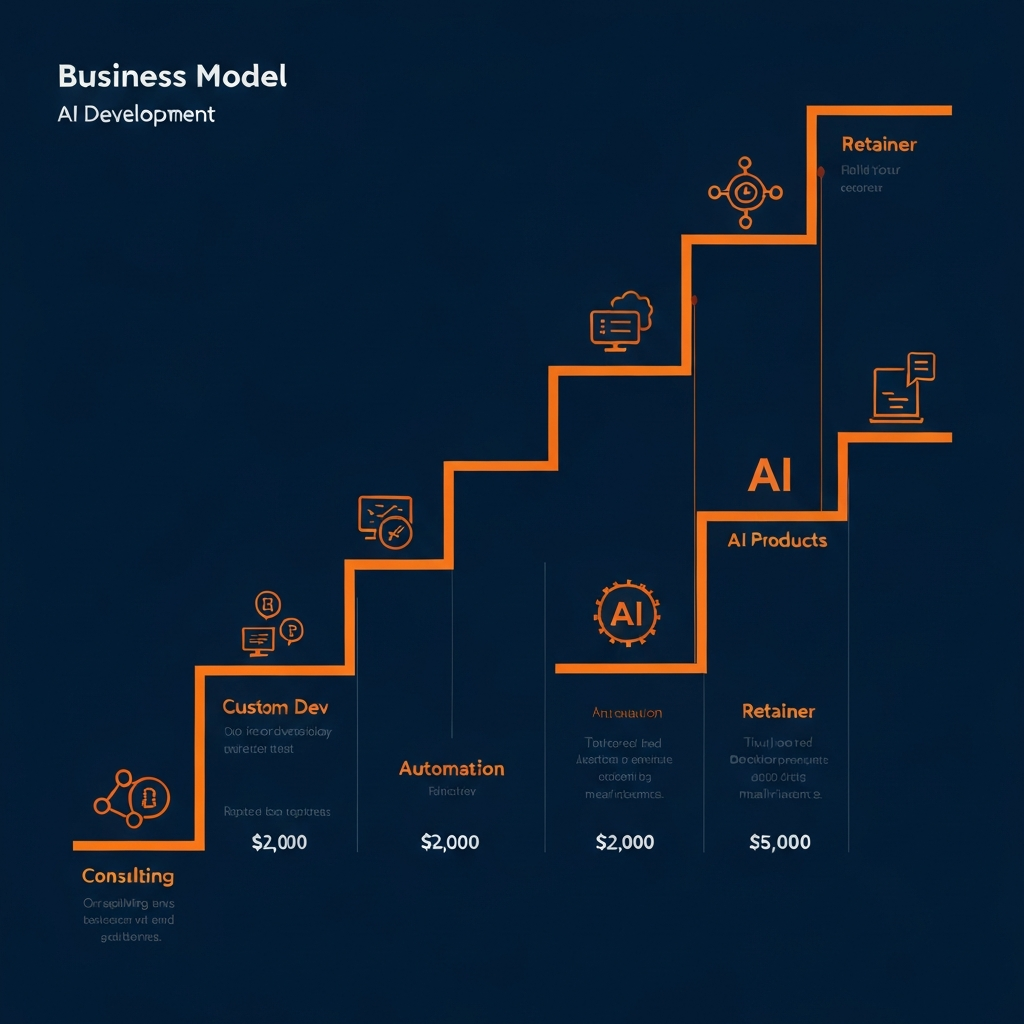
– Support/maintenance contracts: $2K–$5K/month per client
– AI operations: Manage client’s AI systems, optimize, iterate. $3K–$10K/month
– Retainer: “We’re your AI development team.” $10K–$20K/month
Target: 30–40% of revenue from recurring. Cuts churn risk.
Shift 3: Specialize Even Further
Pick one niche. Own it.
Examples:
– “AI chatbots for healthcare providers”
– “Predictive analytics for e-commerce”
– “Document processing for legal firms”
Specialization means:
– Higher prices (you’re the expert)
– Faster sales (they seek you out)
– Repeatable projects (same problems, different clients)
– Better content marketing (solve the same problem repeatedly)
Shift 4: Build Strategic Partnerships
Partner with agencies/consultancies that sell AI services but don’t build them. You build. They sell. Revenue share 30–50%.
Example:
– Accenture sells “AI transformation project” to Fortune 500
– You build it (cheaper than Accenture hiring AI developers)
– You get $300K, Accenture gets $700K, client happy
Shift 5: Create Leverage Through Team
By $100K/month, you should have:
– 2–3 developers
– 1 project manager
– 1 sales person (you or hire)
Each person multiplies your output. You focus on strategy, team, client relationships. Execution happens below you.
Operations: Making It Work Day-to-Day
Project Management Tools and Workflow
As your agency grows, discipline in operations multiplies your output. Set up systems from day one.
Tools:
– Linear or Jira: Track development tasks
– Notion: Document processes, standards, knowledge base
– Asana or Monday: Client project tracking, timelines
– Slack: Team communication
– Google Suite or Office: Docs, spreadsheets, shared knowledge
Workflow for new project:
1. Sales closes deal → Kickoff meeting
2. PM creates project in Asana with timeline
3. Team creates tasks in Linear
4. Daily standup (15 min): What’s done, what’s next, blockers
5. Weekly client check-in (30 min): Progress demo, feedback
6. EOW (end of week): Update client, demo new features
Financial Management
Track profitability obsessively. You can’t optimize what you don’t measure.
Monthly P&L spreadsheet:
| Line Item | Value |
|———–|——-|
| Revenue (invoiced) | $X |
| Cost of goods (infrastructure, APIs) | $Y |
| Team salaries | $Z |
| Overhead (tools, marketing) | $W |
| Gross profit | $X – Y – Z – W |
Monthly targets:
– Revenue growth: +20% month-over-month (first 12 months)
– Gross margin: 50%+ (after team costs)
– Project completion on-time: 95%+
– Client satisfaction (NPS): 50+
Track these. When one slips, investigate.
Building Your Reputation
Your reputation is your best marketing asset.
Reputation builders:
1. Deliver on time and on budget (always)
2. Over-communicate with clients (weekly updates, proactive issues)
3. Publish case studies (quantified results: time saved, revenue gained)
4. Ask for testimonials (video if possible)
5. Refer clients to other agencies (builds goodwill, they refer back)
6. Invest in team (good people → good work → good reputation)
Reputation destroyers:
1. Missed deadlines
2. Scope creep you can’t handle
3. Poor communication
4. Underbilling (cheap work suggests low quality)
5. Overpromising
Protect reputation religiously.
Why Some AI Agencies Fail (And How to Avoid It)
Reason 1: Choosing the Wrong Service
Problem: You offer “anything AI” instead of a niche.
Result: You compete on price. Margins compress. Unsustainable.
Solution: Pick one service + one industry vertical. Own it.
Example: “AI chatbots for healthcare” not “AI services.”
Reason 2: Building Before Selling
Problem: You build the “perfect” AI solution. Spend 3 months. Client says “not quite what we need.”
Result: Rework. Margin evaporates.
Solution: Sell before building. Get customer sign-off on requirements before development. Use sprints + demos.
Reason 3: Not Hiring in Time
Problem: You’re solo, buried in work, turning down revenue.
Result: You burn out. Agency fails.
Solution: Hire first junior (part-time okay) when you’re consistently turning down work. Hire full-time when you have 3 simultaneous projects.
Reason 4: Competing on Price
Problem: You’re cheapest option. Margins terrible.
Result: You work harder for less profit. Can’t afford team. Stuck solo.
Solution: Specialize + charge premium. Get better clients. Work on fewer, higher-value projects.
Reason 5: Inconsistent Quality
Problem: Your first project is amazing. Second is mediocre. Referrals dry up.
Result: Can’t build on momentum.
Solution: Systems + processes. Use same playbook every project. Train team. QA everything.
Metrics That Matter
Track these religiously:
Revenue metrics:
– Monthly recurring revenue (MRR)
– Average project size
– Revenue per team member
– Customer acquisition cost
– Customer lifetime value
Operational metrics:
– Projects on-time: target 95%+
– Client satisfaction (NPS): target 50+
– Utilization rate (billable hours / total hours): target 70%+
– Time to onboard new developer: target < 2 weeks
Growth metrics:
– Month-over-month revenue growth: target 15–25%
– Number of referral clients: target 50%+
– Repeat client rate: target 40%+
– Team size growth: gradual, measured
Monitor monthly. Celebrate wins. Address shortfalls.
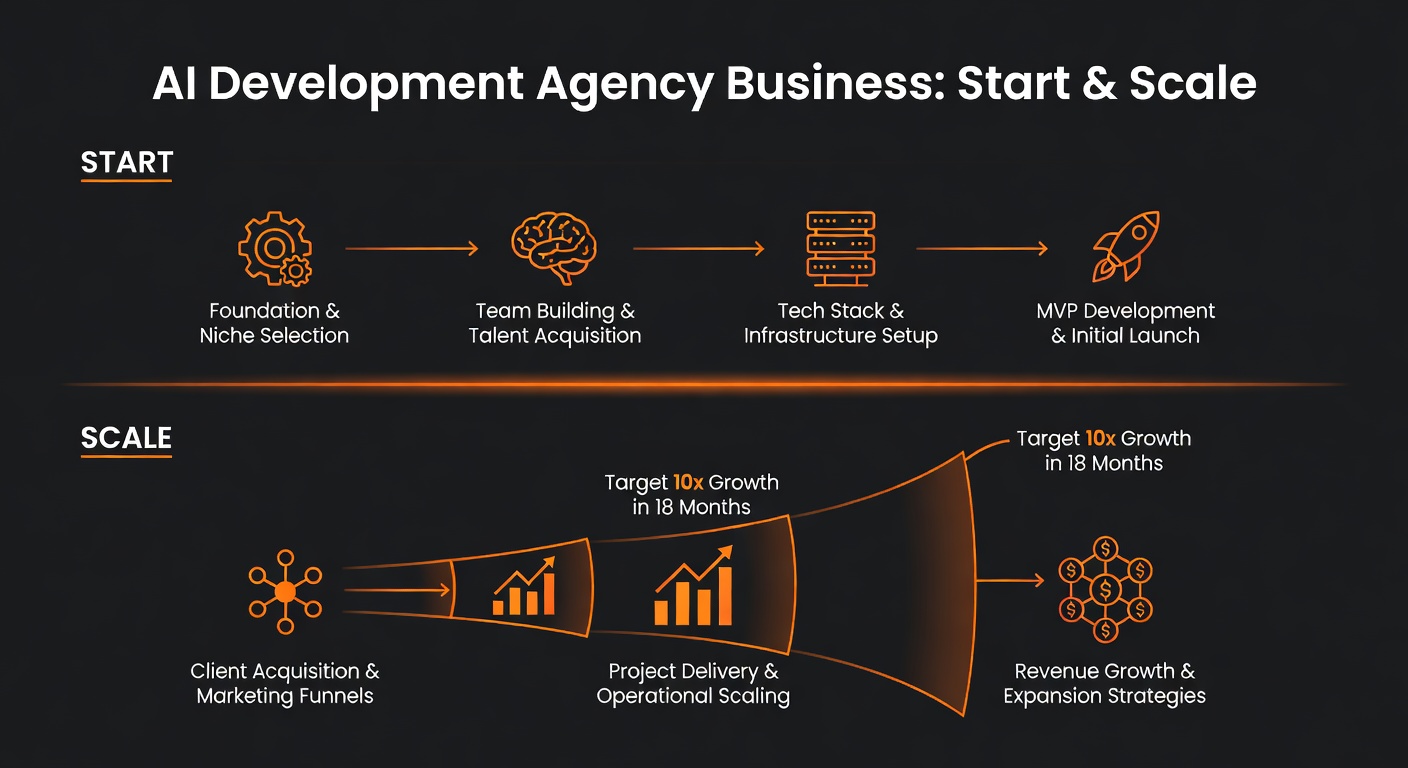
The 18-Month AI Agency Roadmap
Months 1–3: Foundation
– Solo, building portfolio
– Land first paid client
– Revenue: $5K–$15K
Months 4–6: Traction
– 2–3 simultaneous projects
– Getting referrals
– Revenue: $15K–$35K
Months 7–9: Team Building
– Hire first developer
– Can take 4–5 projects in parallel
– Revenue: $35K–$50K
Months 10–12: Systems & Scale
– Hire project manager
– Documented processes
– Repeatable quality
– Revenue: $50K–$75K
Months 13–15: Specialization
– Deep expertise in niche
– Premium pricing
– Predictable referrals
– Revenue: $75K–$100K
Months 16–18: Optimization
– Recurring revenue (support contracts)
– Team humming
– Strategic partnerships
– Revenue: $100K+/month
This progression works if you execute consistently.
FAQ
Q1: Do I need AI expertise to start an AI development agency?
A: Yes. You need to understand AI tools, have shipped AI projects, and know how to solve business problems with AI. You don’t need a PhD, but you need hands-on experience. Build 2–3 projects yourself first. Then start the agency.
Q2: Should I specialize or offer all AI services?
A: Specialize. Pick one service (chatbots, automation, analytics). Become the best. Generalists compete on price. Specialists compete on expertise and command premium rates.
Q3: What’s a realistic timeline from launch to $50K/month?
A: 9–18 months if you’re full-time, experienced, and execute well. Timeline:
– Months 1–3: Build portfolio ($5K–$15K/month)
– Months 4–6: Referral flywheel ($15K–$35K/month)
– Months 7–12: Add team, raise rates ($35K–$50K/month)
Q4: Should I start solo or hire immediately?
A: Start solo. Build reputation. Land 3–5 clients. Hire when you’re turning down work. Hiring too early = overhead you can’t afford.
Conclusion
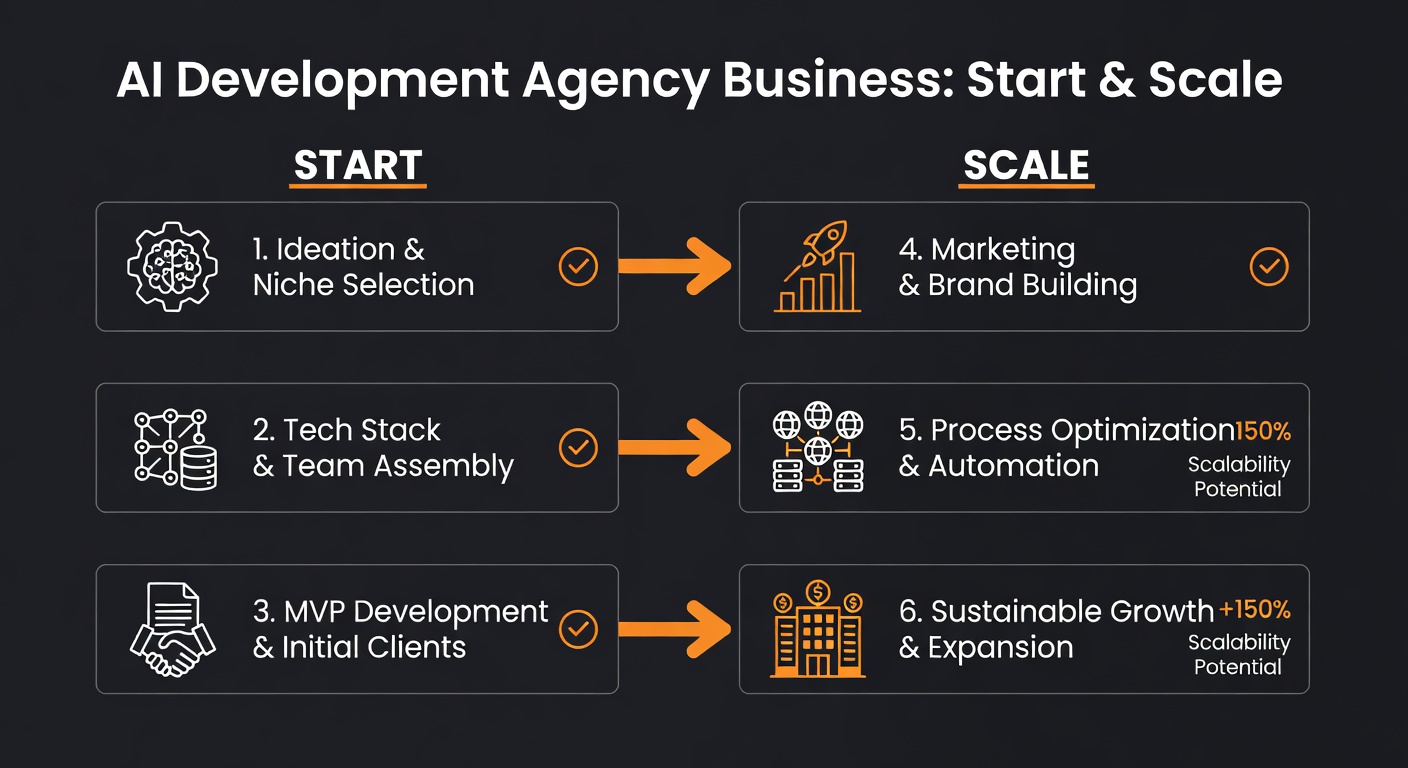
Starting an AI development agency is the fastest path from AI expertise to significant income. In 2026, demand far exceeds supply. Companies will pay well for skilled execution.
The 18-month roadmap is proven. Master one service. Charge premium rates. Hire only when you’re turning down work. Build reputation relentlessly.
The agencies making $100K+/month are those that:
1. Specialized ruthlessly (owned their niche)
2. Delivered exceptional quality (reputation)
3. Hired aggressively (scaled output)
4. Focused on profit per hour (not revenue)
5. Built recurring revenue (smoothed lumpy cash flow)
You can do this. Start today.
Ready to start your AI agency? Join the learnAI community → learnAI Skool Community
Q5: How do I compete against huge consulting firms like Deloitte and Accenture?
A: You don’t. You operate in different markets. They chase $5M enterprise deals. You chase $25K–$75K projects that larger firms ignore. As you scale, you can become a partner to them (they sell, you build).