AI Business Monetization Guide: 7 Ways to Make Money with AI in 2026

⏱ 32 min read · Category: Make Money with AI
Introduction
The AI economy is booming. The question isn’t whether you can make money with AI. It’s which model fits your skills, interests, and starting capital.
In 2026, there are seven proven paths to AI monetization. Some require building products. Some require selling services. Some require content. Some require no audience at all.
A freelancer with AI skills might make $15K/month. An agency owner with three employees might make $100K/month. A solo creator building AI tools might make $50K/month. A founder with VC backing might scale to $10M+ in revenue.
The difference isn’t luck or AI knowledge. It’s choosing the right monetization model for your starting position, then executing with discipline.
This guide maps all seven paths with real numbers: time investment, startup cost, revenue potential, and exact steps to get started.
Market data: Companies are spending $48 billion annually on AI services and tools in 2026. Individuals and agencies are capturing significant portions of this through every model outlined below.
Table of Contents
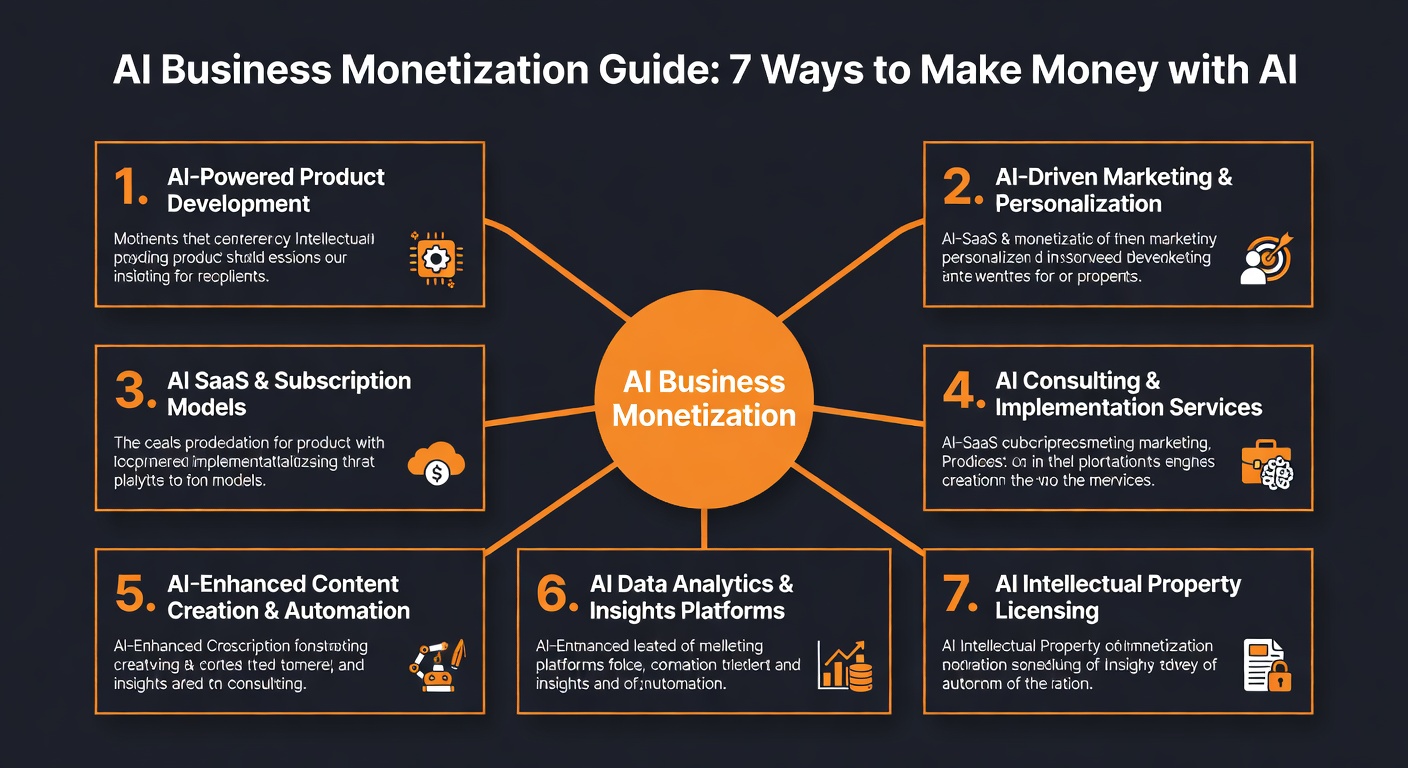
- Path 1: AI Development Services and Agencies
- Path 2: AI SaaS Products
- Path 3: AI Consulting and Strategy
- Path 4: AI Automation Services
- Path 5: AI Courses and Educational Content
- Path 6: AI Content Creation and Freelancing
- Path 7: AI Integration and Implementation Services
- Choosing Your Path
- Common Mistakes in AI Monetization
- Combining Multiple Paths
- FAQ
Path 1: AI Development Services and Agencies
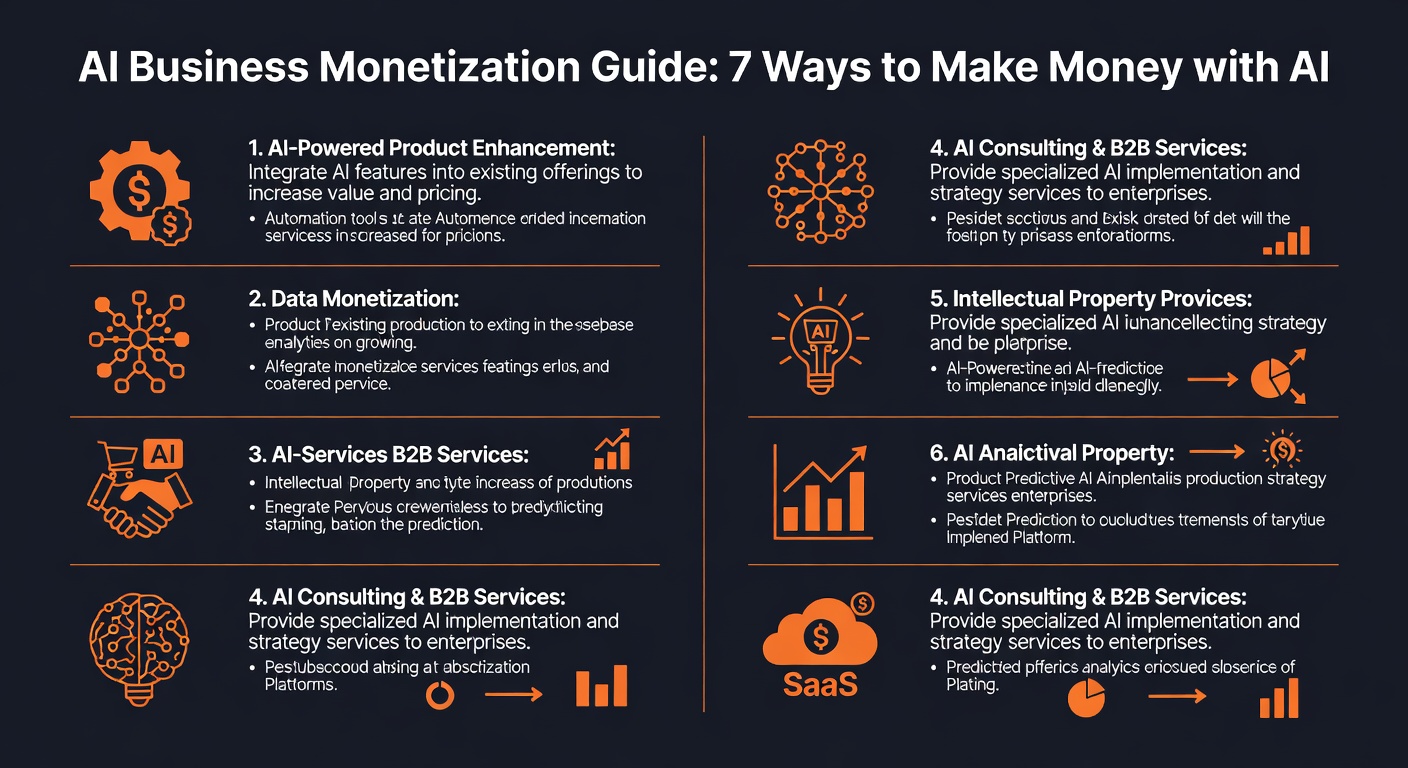
Revenue model: Build custom AI solutions for clients. Charge per project.
Time to first revenue: 4–8 weeks
Investment required: $1K–$5K (laptop, tools, marketing)
Revenue potential: $50K–$200K+/month at scale
How It Works
Companies need AI but lack expertise. You build AI solutions (chatbots, automation, predictive models). Client pays $25K–$75K per project. You complete in 8–16 weeks.
Scale by hiring developers. Margins improve as you systematize.
Getting Started
Month 1–2:
– Build 1–2 projects for your portfolio
– Launch website highlighting your services
– Start outreach to companies in your target industry
Month 3–4:
– Land first paid project via outreach/referral
– Deliver excellent work
– Get testimonial and permission for case study
Month 5–6:
– Referrals from happy clients
– Close 1–2 more projects
– Revenue: $20K–$35K
Unit Economics
| Component | Cost/Time |
|---|---|
| Project duration | 8–16 weeks |
| Typical revenue | $35K |
| Dev time (you) | 200 hours |
| Infrastructure | $2K |
| Actual cost | $17K |
| Gross profit | $18K |
| Margin | 51% |
Pros & Cons
✓ Fast path to revenue (clients exist now)
✓ High margins (70%+ at scale)
✓ Repeatable (same problems, different clients)
✓ Clear value (clients see ROI immediately)
✗ Lumpy revenue (project-based, not recurring)
✗ Time-intensive (can’t scale past team size)
✗ Scope creep risk (requires discipline)
✗ Requires business skills (sales, operations)
Best For
- Experienced developers with AI knowledge
- People who enjoy project delivery
- Those with sales ability or willingness to learn
Path 2: AI SaaS Products
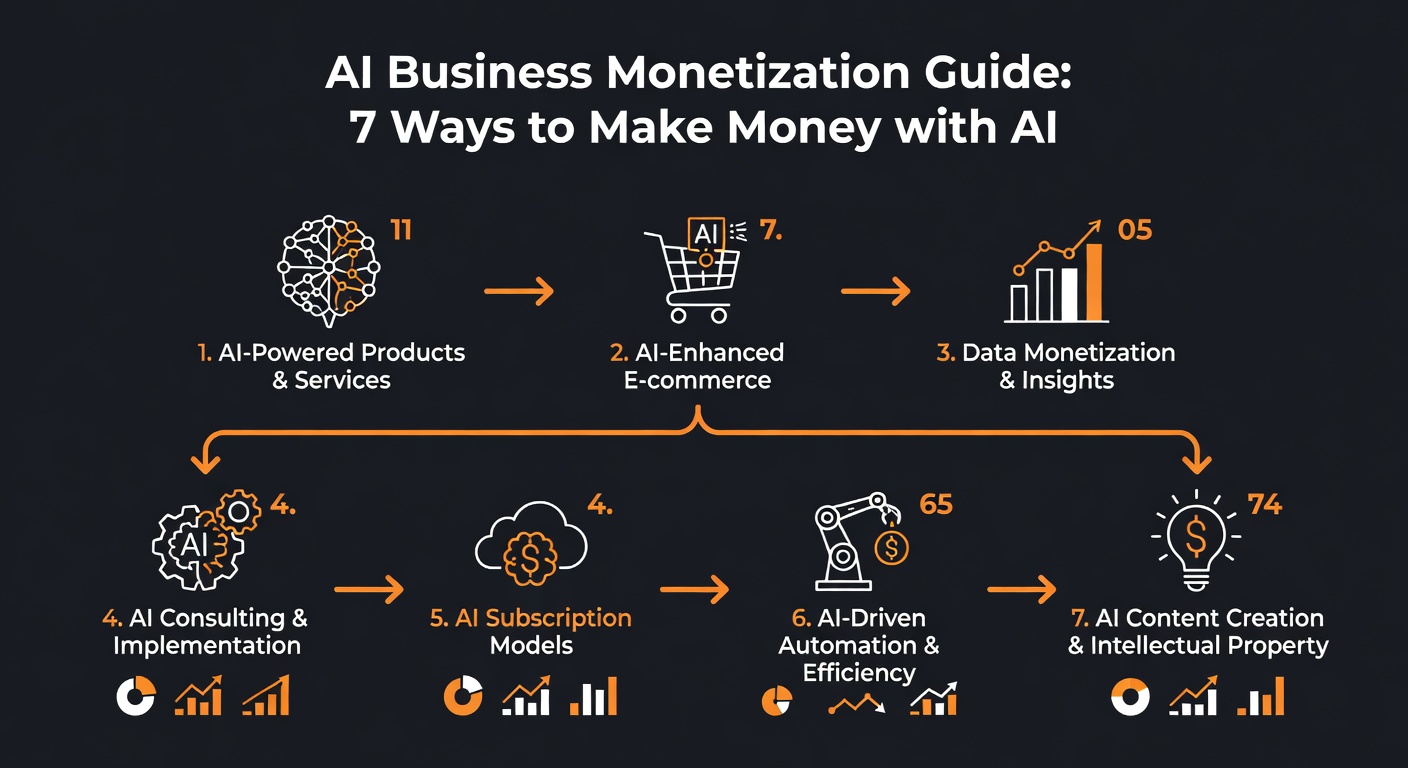
Revenue model: Build a software product powered by AI. Charge recurring subscription.
Time to first revenue: 6–12 months
Investment required: $5K–$50K (dev time, infrastructure, marketing)
Revenue potential: $10K–$500K+/month at scale
How It Works
Build a product that solves a specific problem using AI. Sell as SaaS (recurring revenue). Examples: AI writing tool, email personalization engine, customer support automation.
Revenue compounds. Month 1 might be $500. Month 12 might be $20K. Year 2 might be $100K.
Getting Started
Month 1–3: Idea + MVP
– Validate idea: interview 20 potential customers
– Build minimum viable product (solo, 4–8 weeks)
– Get feedback from beta users (free/cheap early access)
Month 4–6: Launch
– Officially launch (ProductHunt, Hacker News, Twitter)
– Price at $19–$99/month (recurring)
– Expect: 10–50 paying customers, $500–$5K/month revenue
Month 7–12: Growth
– Double down on acquisition (content, ads, partnerships)
– Improve product based on customer feedback
– Target: $10K–$50K/month MRR (monthly recurring revenue)
Unit Economics
| Metric | Value |
|---|---|
| Monthly subscription | $49 |
| Customer acquisition cost | $50 |
| Customer lifetime value | $3K–$10K |
| Gross margin | 75%+ |
| Payback period | ~1 month |
Pros & Cons
✓ Recurring revenue (predictable)
✓ Scales without hiring (software scales)
✓ High gross margins (80–90%)
✓ Potential for venture funding
✗ Long time to revenue (6–12 months)
✗ High failure rate (90% of startups fail)
✗ Requires product-market fit (hard)
✗ Constant pressure to improve/update
Best For
- Product-focused builders
- People with 1–2 years to bootstrap
- Those who can learn marketing/sales
Path 3: AI Consulting and Strategy

Revenue model: Advise companies on AI strategy. Charge hourly or per project.
Time to first revenue: 2–4 weeks
Investment required: $0–$2K (LinkedIn, website)
Revenue potential: $10K–$75K/month
How It Works
Expert in AI? Help companies answer: “Should we build AI? What should we build? How much will it cost?”
Charge $5K–$25K per project or $250–$500/hour.
Getting Started
Week 1–2:
– Define your niche (“AI for healthcare” or “LLM strategy” or “AI automation”)
– Write 2–3 LinkedIn articles about your niche
– Reach out to 50 relevant companies
Week 3–4:
– Get first paid engagement
– Deliver consulting project (usually 4–8 weeks)
– Get testimonial
Month 2+:
– Referrals from happy clients
– Revenue: $5K–$25K per project
– Can run 2–3 projects in parallel
Consulting Project Breakdown
Typical engagement: AI Strategy Assessment – $15K
Week 1: Interviews with stakeholders, understand business
Week 2–3: Research competitive landscape, AI opportunities
Week 4: Synthesize findings, present recommendations
Week 5: Q&A, refine recommendations
Deliverable: 30–40 page strategy document + presentation
Cost breakdown:
– Your time: 120 hours @ $75 = $9K
– Research tools: $500
– Actual cost: $9.5K
– Revenue: $15K
– Profit: $5.5K
– Margin: 37%
Pros & Cons
✓ Fast path to revenue
✓ Leverages expertise
✓ Low overhead (mostly your time)
✓ Can work part-time (supplements other income)
✗ Doesn’t scale (capped by your hours)
✗ Requires credibility/network
✗ Project-based (not recurring)
✗ Often becomes delivery consulting (time-intensive)
Best For
- Experienced AI professionals
- People with existing network
- Those wanting part-time income
Path 4: AI Automation Services

Revenue model: Automate tedious business processes using AI. Charge per automation or retainer.
Time to first revenue: 2–6 weeks
Investment required: $500–$2K (tools, subscriptions)
Revenue potential: $10K–$50K/month
How It Works
Many business processes are ripe for AI automation:
– Email parsing and CRM updates
– Document processing and data extraction
– Customer support ticket routing
– Lead scoring and qualification
– Social media posting and content scheduling
Use tools like Make, n8n, Zapier + AI APIs to build automations. Charge $1K–$10K per automation or $500–$3K/month retainer.
Realistic Example
Project: Email-to-CRM Automation for B2B SaaS Company
The problem: Company receives 100 sales emails/day. Every sales rep manually logs them into Salesforce. 2 hours/day wasted.
The solution: AI reads emails, extracts key info (company, budget, timeline), logs to Salesforce automatically.
Tools:
– Make (workflow automation)
– OpenAI API (email understanding)
– Zapier (CRM integration)
Implementation: 2 weeks
Client fee: $5K
Your cost: $200 (tools) + 40 hours work = $3,200
Profit: $1,800
Client saves: 2 hrs/day × 250 working days = 500 hours/year = $12,500 saved
Your fee captures 40% of value. Client saves 60%.
Getting Started
Phase 1: Skills (Week 1–4)
– Learn Make or n8n
– Learn LLM APIs (OpenAI, Claude)
– Build 3 proof-of-concept automations
Phase 2: Sales (Week 5–8)
– Target companies with repetitive, tedious processes
– Email them: “I can save your team 10+ hours/week with automation”
– Demo your proof-of-concept
Phase 3: Delivery (Week 9+)
– Build automations for paying clients
– Support and optimize
Pros & Cons
✓ Fast implementation (weeks not months)
✓ Clear ROI (time saved = money saved)
✓ Repeatable (same automations, different clients)
✓ Can build templates (reduce delivery time)
✗ Relatively small revenue per project
✗ Limited scalability without templates
✗ Tool dependency (Make, Zapier pricing changes)
✗ Requires continuous learning
Best For
- People who love problem-solving and optimization
- Those comfortable with no-code/low-code tools
- Anyone wanting quick revenue with minimal overhead
Path 5: AI Courses and Educational Content

Revenue model: Teach others AI. Charge for courses, communities, or coaching.
Time to first revenue: 3–6 months
Investment required: $0–$5K (tools, hosting)
Revenue potential: $5K–$100K+/month at scale
How It Works
Offer educational products:
– Courses: $47–$497 one-time fee per student
– Cohort-based courses: $497–$2,997 per cohort (limited class size)
– Community/membership: $29–$299/month recurring
– 1-on-1 coaching: $200–$500/hour
Revenue Models
Model 1: Async Course on Gumroad/Teachable
- Create course once (30–100 hours of work)
- Sell indefinitely ($297 price, 100 students = $30K)
- Requires marketing to build audience
Model 2: Cohort-Based Course (Live, Weekly)
- Run live course, 25 students max, 6 weeks
- Charge $1,497 per student = $37K revenue
- Run 2–4 cohorts/year = $75K–$148K
- More work than async (live sessions) but higher price
Model 3: Membership Community
- Monthly membership: $99/month
- Build community around AI education
- Requires audience (1,000+ people)
- Revenue: 100 members × $99 = $9,900/month
Revenue Example: “How to Build AI Products” Course
Time to create: 60 hours
Content:
– 10 video modules (4 hours total)
– Workbooks + templates
– Weekly live Q&A for 6 weeks
– Slack community access (1 year)
Pricing: $497
Student acquisition:
– Month 1–3: Build course, launch to email list (200 people), sell 20 copies = $9,940
– Month 4–6: Promote via Twitter, content marketing, 30 copies = $14,910
– Month 7–12: Compound growth, 50/month = $29,700
Year 1 revenue: ~$55K
Ongoing: Course pays $30K–$50K/year with minimal effort (just marketing).
Getting Started
Step 1: Build audience (1–3 months)
– Write content on your niche
– Share on Twitter, LinkedIn, email list
– Engage with community
– Target: 500–1,000 email subscribers
Step 2: Create course (2–3 months)
– Outline + record modules
– Test with beta cohort (free or cheap)
– Iterate based on feedback
Step 3: Launch and promote (ongoing)
– Launch to email list + Twitter
– Drive traffic through content
– Collect testimonials, refine
Pros & Cons
✓ Builds personal brand (side effect)
✓ Passive income (course created once)
✓ High gross margins (80%+)
✓ Audience compounds over time
✗ Requires audience building (slow, 3–6 months)
✗ High competition (many AI courses exist)
✗ Content can become outdated
✗ Takes time to see real revenue
Best For
- Content creators / writers
- Teachers or people who love explaining
- Those with existing audience
- Long-term thinking
Path 6: AI Content Creation and Freelancing
Revenue model: Use AI to create content. Sell content or services.
Time to first revenue: 1–2 weeks
Investment required: $0–$500 (tools)
Revenue potential: $2K–$30K/month
How It Works
AI tools are exceptional at content creation. Use them to:
– Write blog articles, ad copy, emails (ChatGPT, Claude)
– Generate images (Midjourney, DALL-E)
– Create videos (Synthesia, Runway)
– Design presentations (ChatGPT + Gamma)
Sell the output (content) or the service (AI copywriting).
Path 6A: AI Content Creator (Sell Content)
Create and sell AI-generated content:
– Blog articles: $50–$500 per article
– Email sequences: $200–$1K
– Social media content calendars: $300–$2K
– Ad copy packages: $500–$3K
Getting started:
– Use ChatGPT/Claude to write 10 sample articles
– List on content marketplaces (Fiverr, Upwork)
– Build portfolio
– Start charging $100–$300 per article
Revenue potential: $3K–$10K/month with 10–30 clients
Path 6B: AI-Powered Service
Offer AI-powered services:
– AI copywriting agency: Hire junior copywriters, use AI to 10x output, sell to agencies
– AI video production: Create YouTube videos, TikTok content in batches
– AI design: Generate designs for small businesses, sell at $500–$2K per project
Getting started:
– Pick one service
– Build portfolio
– Reach out to potential clients
Revenue potential: $5K–$30K/month at scale
Practical Example: AI Content Writer
Setup:
– ChatGPT Pro ($20/month)
– Canva Pro ($120/year)
– Grammarly ($144/year)
– Total cost: $25/month
Services:
– Blog article writing: $200/article (2 hours, AI-assisted)
– Email sequence: $500 (1–2 hours)
– Product descriptions: $300 (30 min per description, bulk discount)
Client acquisition:
– Write 5 sample articles
– Post on Fiverr, LinkedIn, Twitter
– Email 50 marketing agencies: “I write 50% faster than your current process”
Month 1: 5 articles × $200 = $1,000
Month 2: 10 articles = $2,000
Month 3: 15 articles + 2 email sequences = $4,000
Year 1 potential: $30K–$50K (10–20 clients)
Pros & Cons
✓ Fast revenue (weeks)
✓ Low overhead (just AI tools)
✓ Repeatable (same deliverables, different clients)
✓ Can do part-time initially
✗ Commoditized (low prices, high competition)
✗ Quality variability (clients expect human-level quality)
✗ Doesn’t scale much beyond personal effort
✗ No recurring revenue (project-based)
Best For
- Freelancers / gig workers
- People wanting quick income
- Those with writing ability to QA AI output
- Part-time monetization
Path 7: AI Integration and Implementation Services
Revenue model: Help companies implement AI tools and platforms. Charge for setup, training, integration.
Time to first revenue: 2–4 weeks
Investment required: $500–$2K (certifications, tools)
Revenue potential: $15K–$75K/month
How It Works
Many companies buy AI tools but don’t know how to implement them effectively. You:
– Set up tools (Zendesk AI, HubSpot AI, etc.)
– Integrate with existing systems
– Train employees
– Optimize for their business
Charge $5K–$25K per implementation or $2K–$5K/month retainer.
Example: Implementing HubSpot AI for E-Commerce Company
The problem: E-commerce company has HubSpot but isn’t using AI features (lead scoring, predictive analytics, email content optimization). They’re missing revenue.
Your solution:
– Week 1: Audit their current setup
– Week 2: Configure AI lead scoring model
– Week 3: Set up predictive churn detection
– Week 4: Integrate AI email content optimization
– Week 5: Train team + document processes
Fee: $15K
Value to client: Better lead quality + higher email engagement = $100K+ incremental revenue
Timeline: 5 weeks
Profit: $15K (mostly your time)
Getting Started
Step 1: Pick a platform to master
– HubSpot AI
– Zendesk automation
– Salesforce Einstein
– Microsoft Dynamics with Copilot
Step 2: Get certified/trained
– Official certifications (usually free)
– Practice on test accounts
– Complete 2–3 projects for free/cheap (portfolio)
Step 3: Start selling
– Contact companies using that platform
– LinkedIn outreach: “I help [Platform] users unlock AI features”
– Ask for referrals from consultants / agencies
Pros & Cons
✓ Fast to revenue (2–4 weeks)
✓ High pricing power (deep expertise)
✓ Predictable projects (known platform)
✓ Recurring potential (retainer/optimization)
✗ Platform-dependent (if vendor changes, skills may outdated)
✗ Requires certification/training
✗ Smaller market than development services
✗ Client budgets vary widely
Best For
- Professionals with platform expertise
- Sales/implementation background
- Those good at process and training
- People wanting medium-complexity projects
Choosing Your Path
Each path has different characteristics. Match to your situation:
| Path | Timeline | Startup Cost | Scalability | Recurring | Best If |
|---|---|---|---|---|---|
| Development Agency | 6–12 mo | $1K–$5K | Very High | No | You like project delivery |
| SaaS | 6–18 mo | $5K–$50K | Very High | Yes | You’re a builder |
| Consulting | 2–4 wk | $0–$2K | Low | No | You have expertise/network |
| Automation | 2–6 wk | $0.5K–$2K | Medium | Yes | You love optimization |
| Courses | 3–6 mo | $0–$5K | High | Yes | You like teaching |
| Content/Freelance | 1–2 wk | $0–$500 | Low | No | You want quick income |
| Integration | 2–4 wk | $500–$2K | Medium | Partial | You love platforms |
Decision framework:
- How much capital do you have? → Guides startup cost feasibility
- How much time? → 6–12 months? Build SaaS. 2–4 weeks? Consulting/Automation.
- What’s your strength? → Building? SaaS. Selling? Agency/Consulting. Teaching? Courses.
- Do you want recurring? → Courses/SaaS yes. Services/Freelance no.
- Comfort with risk? → Proven paths: Consulting, Freelance. Higher risk: SaaS, Courses.
Common Mistakes in AI Monetization
Mistake 1: Picking a Path You Don’t Like
Problem: You choose “AI SaaS” because someone said it’s most profitable. You hate building products.
Result: You quit after 6 months. Zero revenue.
Solution: Pick a path that aligns with your interests and strengths. Mediocre execution in a path you enjoy beats expert execution in a path you hate.
Mistake 2: Trying to Do Everything
Problem: You offer AI services, courses, and a SaaS product. You’re spread thin.
Result: Nothing gets traction. Every path fails.
Solution: Pick ONE path. Execute for 6–12 months. Master it. Then expand to a second path.
Mistake 3: Competing on Price
Problem: You charge $2K per project to compete with other freelancers charging $1K.
Result: You work harder for less profit. Race to bottom.
Solution: Specialize + differentiate. Charge $10K+ for niche expertise. Become the expert, not the cheapest option.
Mistake 4: Ignoring the Business Side
Problem: You focus only on building great solutions. You ignore sales, marketing, operations.
Result: Amazing product. Zero customers.
Solution: Allocate time to business: 40% delivery, 40% sales/marketing, 20% operations/learning.
Mistake 5: Launching Before Validation
Problem: You spend 6 months building a SaaS product. Launch. Zero customers want it.
Result: You wasted 6 months building something nobody needs.
Solution: Validate demand first. Talk to 20 potential customers. Pre-sell if possible. THEN build.
Mistake 6: Giving Away Too Much for Free
Problem: You give free consultations, free trials, free courses to build audience.
Result: You’re busy but unpaid. Audience doesn’t convert to customers.
Solution: Charge for consultations ($500). Charge for courses ($47). Limited free trials (7 days). Free only builds audience if it leads to paid.
Combining Multiple Paths
The highest earners combine multiple paths:
Combination 1: Consulting + Courses
Year 1: $50K consulting + $0 courses = $50K total
Year 2: $40K consulting + $20K courses = $60K total
Year 3: $30K consulting + $80K courses = $110K total
Year 4: $10K consulting + $150K courses = $160K total
Consulting is the bridge to courses. You learn what clients need. You teach it in courses.
Combination 2: Automation + SaaS
Year 1: $20K automation services = $20K total
Year 2: $20K automation + $0 SaaS (building) = $20K total
Year 3: $10K automation + $30K SaaS = $40K total
Year 4: $0 automation + $150K SaaS = $150K total
You automate things manually first. You see patterns. You build a SaaS product automating those patterns.
Combination 3: Development + Productized Service
Year 1: $60K development agency = $60K total
Year 2: $50K development + $20K productized service = $70K total
Year 3: $30K development + $80K productized service = $110K total
Year 4: $0 development + $200K productized service = $200K total
You build custom solutions first. You identify repeatable patterns. You package as productized service (lower price, higher margin, easier to sell).
The pattern: Start with one path. Master it. Add a second path that leverages lessons learned from the first.
Deep Dive: Financial Projections for Each Path
Path 1: Development Agency (5-Year Projection)
| Year | Revenue | Team | Profit | Notes |
|---|---|---|---|---|
| Y1 | $150K | You (solo) | $75K | Case study projects, building portfolio |
| Y2 | $600K | You + 1 dev + 1 PM | $200K | 3 simultaneous projects |
| Y3 | $1.2M | You + 3 devs + 2 PMs | $450K | 6+ simultaneous projects |
| Y4 | $2M | You + 5 devs + 3 PMs | $800K | Scaling, recurring support revenue |
| Y5 | $3.5M | You + 8 devs + 5 PMs | $1.4M | Exit/acquisition target |
Assumptions: Average project $50K, 2.4 projects/month by year 3, team profitability increases as processes mature.
Path 2: SaaS (5-Year Projection)
| Year | Revenue | Burn | Status | Notes |
|---|---|---|---|---|
| Y1 | $50K | $30K | Pre-product market fit | Bootstrapped, building |
| Y2 | $300K | $0 | Approaching breakeven | Growth accelerating |
| Y3 | $1.2M | -$200K profit | Profitable, scaling | Possible VC round |
| Y4 | $4M | $600K profit | Scaling | Hiring, marketing |
| Y5 | $12M | $3M profit | Growth-stage SaaS | Acquisition or IPO path |
Assumptions: SaaS takes longer to revenue but scales faster long-term. Risk is high but upside is huge.
Path 3–7: Services Paths (Consulting, Automation, etc.)
| Path | Y1 Revenue | Y3 Revenue | Y5 Revenue | Ceiling |
|---|---|---|---|---|
| Consulting | $80K | $300K | $500K | ~$500K (limited by hours) |
| Automation | $120K | $400K | $600K | ~$700K (repeatable but limited) |
| Courses | $50K | $300K | $1M+ | Very High (scales infinitely) |
| Freelance | $60K | $150K | $250K | ~$300K (capped by hours) |
| Integration | $100K | $350K | $750K | ~$800K (platform dependent) |
Key insight: Services paths cap out around $500K–$1M unless you build products/recurring revenue.
The Business Model Maturity Curve
Most successful founders follow this pattern:
Stage 1: Validation (0–6 months)
– Goal: Prove people will pay
– Model: Services (agency, consulting, freelance)
– Why: Fastest path to revenue, proof of concept
Stage 2: Scaling (6–18 months)
– Goal: Build repeatable business, hit $100K/month
– Model: Optimize services (systemize, hire, raise prices)
– Why: De-risk before betting on products
Stage 3: Leverage (18–36 months)
– Goal: Build product/recurring revenue
– Model: Add courses, SaaS, productized service
– Why: Transition from time-based to leverage-based
Stage 4: Exit (36+ months)
– Goal: Sell business or extract maximum profit
– Model: Optimize for acquirer, harvest recurring revenue
– Why: Personal goal (rest, new challenge, financial security)
Most founders never reach Stage 4. They’re happy with $100K–$500K/month income in Stage 2–3.
Tactical: Marketing Your AI Service
Most AI services fail because of marketing, not delivery.
Content Marketing (Builds Organic Authority)
Strategy: Teach your ideal customer how to solve their problem.
Execution:
– Write 2 blog posts/month on your specialty
– Share case studies (quantified results)
– Record video walkthroughs of solutions
– Answer customer questions publicly (Twitter, Reddit)
Results: Inbound leads, thought leadership, network effects
Timeline to impact: 3–6 months (compounding)
Sales Outreach (Builds Immediate Revenue)
Strategy: Contact companies with specific problems you solve.
Execution:
– Email 50 companies/week
– Personalize each email (show you understand their problem)
– Phone calls to hot leads
– Referral program (reward customers for introductions)
Results: Immediate pipeline, high closing rates (20–40%)
Timeline to impact: 1–2 weeks (immediate)
Strategic Partnerships (Multiplies Your Reach)
Strategy: Partner with agencies/consultants who sell but don’t deliver.
Execution:
– Find marketing agencies, IT consultants, management consultants
– Offer: “I build the AI. You sell it. We split revenue 50/50.”
– Close deals together
– You deliver
Results: High-volume partnerships, 3–5x revenue multiplier
Timeline to impact: 2–4 weeks (after partnership signed)
Product Hunt / Hacker News (Builds Initial Traction)
For SaaS/products, launch on ProductHunt or HackerNews.
Execution:
– Create compelling product page
– Prepare thoughtful responses to questions
– Engage community (respond to every comment)
– Offer launch discount (first 100 customers get 30% off)
Results: 500–2,000 users in first week, validation
Timeline to impact: 1 week (launch week effect)
Avoid These Fatal Mistakes (They Kill Monetization)
Mistake 1: Perfectionism
You spend 3 months building the “perfect” product before launching. Meanwhile, competitors launch messy but functional products and capture market.
Fix: Ship fast, iterate based on feedback.
Mistake 2: Building What You Love vs. What Customers Need
You love building chatbots. But the market needs document automation. You chase chatbots, can’t find customers.
Fix: Research customer demand FIRST. Build second.
Mistake 3: Commoditizing Your Offering
You offer generic “AI services.” Every other AI consultant offers the same. No differentiation, race to bottom on price.
Fix: Specialize ruthlessly. Own a niche.
Mistake 4: Underselling (Imposter Syndrome)
You’re capable of $10K projects but charge $3K because you “don’t have enough experience.”
Result: You work 3x as hard for 1/3 the margin. Unsustainable.
Fix: Research market rates. Price accordingly. Raise rates annually.
Mistake 5: No Follow-Up
You email 100 people. 2 respond. You don’t follow up. You assume the others aren’t interested.
Truth: Most people need 5–7 touchpoints before responding.
Fix: Follow up 3–5 times (spaced over weeks). Most revenue comes from follow-up.
Mistake 6: Not Tracking Money
You’re busy. Revenue comes in. You don’t know if you’re profitable.
Result: You’re bleeding money and don’t notice until too late.
Fix: Simple spreadsheet, updated weekly. Revenue – Costs = Profit. Know your unit economics.
The One Metric That Matters: Profit Per Hour
Everything flows from this one metric.
Calculation:
Profit per hour = Monthly profit / Hours worked
Example:
– Monthly profit: $10K
– Hours worked: 160 (40 hours/week × 4 weeks)
– Profit per hour: $62.50
Targets:
– Entry-level: $25–$50/hour
– Intermediate: $50–$100/hour
– Expert: $100–$250/hour
– Founder (agency): $150–$500+/hour
If your profit per hour is below $50/hour, your model is broken. Fix it:
– Raise prices
– Reduce delivery time (systemize)
– Increase margins (productize)
– Reduce overhead
Most AI services start at $25–$50/hour profit. Within 2 years, successful ones hit $100+/hour.
Resources to Deepen Your Knowledge
Books:
– “The $100 Startup” by Chris Guillebeau (getting started)
– “The Lean Startup” by Eric Ries (building products)
– “Traction” by Gabriel Weinberg (growth strategies)
Communities:
– r/Entrepreneur (Reddit)
– Indie Hackers (indie.dev)
– MicroConf (conference for bootstrappers)
– Local startup/entrepreneur meetups
Courses:
– “Build AI Products” (various on Udemy, Teachable)
– “Sales for Founders” (top resources on Twitter)
– “Systems and Processes for Agencies” (Agency Hell podcast)
FAQ
Q1: Which path makes the most money?
A: SaaS has the highest ceiling (venture-backed SaaS > $10M/year). But it’s also riskiest (90% fail). Development agencies are more reliable ($100K–$1M/year, lower failure rate). Pick based on risk tolerance and interests, not just potential revenue.
Q2: Can I start multiple paths simultaneously?
A: Not recommended when starting. Pick one. Master it (6–12 months). Prove you can execute. Then add a second path. Splitting focus usually means both fail.
Q3: Which path has fastest path to $10K/month?
A: AI Automation ($500–$5K per project, 2–4 week implementation) or Consulting ($5K–$25K per project, 4–8 weeks). Both can hit $10K/month in 2–3 months if you execute well.
Q4: Which path is best if I have no money?
A: Consulting, Automation, Content Creation, or Development Agency (just need laptop + internet). SaaS and Courses require some investment ($1K–$5K minimum for tools/hosting).
The Path Forward: Your AI Monetization Journey
In 2026, you have more options to monetize AI than ever before. The barrier to entry is low (just need laptop + internet). The revenue potential is high (six figures within 18 months is realistic).
The difference between success and failure isn’t the path you choose. It’s execution discipline.
Successful founders:
– Pick ONE path (don’t spread thin)
– Execute for 6–12 months (give it time)
– Double down on what’s working (don’t pivot on whim)
– Build audience/reputation (long-term asset)
– Raise prices as you improve (always go up, never down)
– Track metrics obsessively (can’t improve what you don’t measure)
Most people fail not because they picked the wrong path, but because they didn’t commit. They try three paths simultaneously. They quit after 3 months. They underprice and burn out.
Don’t be that person.
Pick a path. Execute. Build. Monetize.
Your AI skills are worth money. Claim it.
Ready to start? Join the learnAI community → learnAI Skool Community
Q5: Which path allows work-life balance?
A: Courses and SaaS (once built, runs itself). Consulting, Development, and Freelance are time-intensive (your time = money). Automation is middle-ground.