We have officially moved past the “magic trick” phase of artificial intelligence. In 2026, the question is no longer whether you can use AI to summarize a document or write a basic email. The question is whether you can collaborate with AI to accelerate your own understanding, or if you are simply outsourcing your intelligence to a machine.
This shift defines the single most critical skill for knowledge workers in the second half of this decade: AI Fluency.
1. Introduction: Everyone “Uses” AI, Few Really Learn with It
Consider a common scenario in 2026. A junior marketing analyst is tasked with understanding a competitor’s Q3 strategy.
- User A (Copy-Paste Mindset): Prompts the company’s internal LLM: “Summarize Competitor X’s Q3 strategy based on this attached 50-page PDF.” The AI produces a beautiful, plausible 5-point summary. User A pastes this into their report. When the CEO asks a follow-up question about the nuance of the competitor’s pricing model, User A blanks. They didn’t learn; they simply facilitated a data transfer.
- User B (Deliberate Practice Mindset): Opens the same PDF and prompts the AI: “I need to master Competitor X’s Q3 pricing strategy. Don’t give me the answer. Act as a strict tutor. Ask me a series of five challenging questions that require me to find the data in this PDF. Critically analyze my responses for gaps, and guide me toward the full understanding.”
User B finishes that 30-minute session exhausted, but they know the strategy. They have developed deep domain expertise, augmented by the AI.
Why AI Fluency is the Next Core Skill
The “copy-paste” approach creates a superficial efficiency that erodes human expertise over time. If we let AI do the heavy thinking, our own cognitive muscles atrophy. AI fluency is the antidote. It is the ability to maintain cognitive command while using AI as a powerful cognitive lever.
Clear Definition:
- Digital Literacy: Knowing how to log in, prompt an AI, use its basic features, and distinguish between a chatbot and a search engine. (Baseline survival skill in 2026).
- AI Fluency: The internalized ability to integrate AI deliberately and safely into your entire thinking, learning, and decision-making process. It’s knowing how to use the tool to make you smarter, not just the output better.
2. What Is AI Fluency? The Components of Cognitive Command
AI Fluency is not about memorizing the perfect prompt for a niche task. It is a mental framework composed of four continuous actions:
- ASKING (Socratic Inquiry): Knowing how to structure questions that force the AI to explain its reasoning, provide evidence, and challenge your own assumptions, rather than just delivering a product.
- CHECKING (Verification): Instinctively questioning the source, validity, and bias of every AI output. This is not casual skepticism; it is methodical auditing.
- REFINING (Iteration): Treating the initial AI output as a draft (0.1), and knowing how to steer the model through 5-10 iterations to sharpen logic, tone, and accuracy.
- DECIDING (Judgment): Using the AI’s data synthesis and alternative perspectives as inputs, but retaining final, human accountability for the decision.
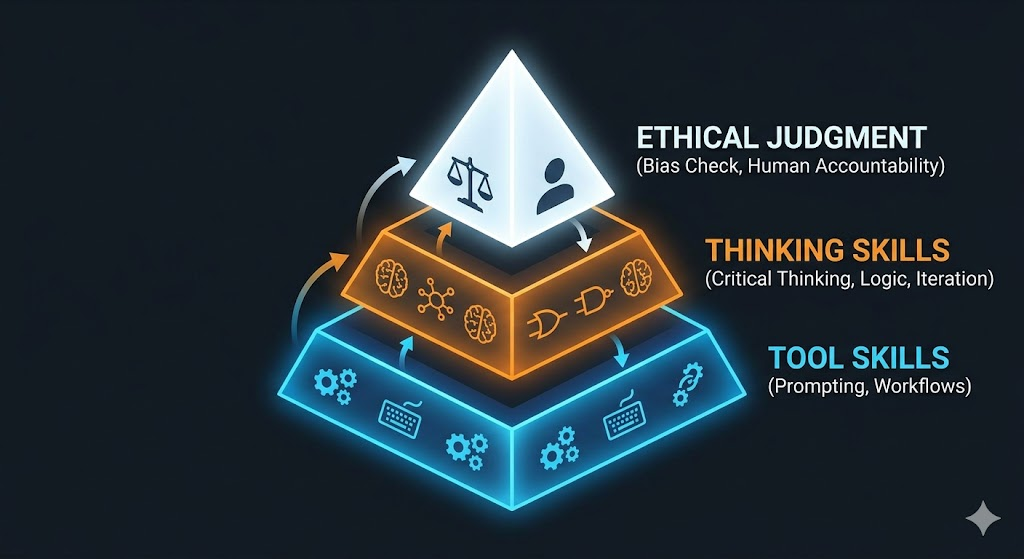
The Three Layers of Fluency
3. From One-Off Courses to Continuous AI Practice
By 2026, the traditional “AI 101” training model—where you attend a seminar, learn 50 prompts, and receive a certificate—is completely outdated. Why?
- Exponential Decay: The specific capabilities and limitations of models (e.g., Gemini 4.5 vs. Gemini 5.0) change so rapidly that prompt libraries become obsolete in months.
- Lack of Transfer: Knowing how to prompt an AI to write a marketing slogan doesn’t help you when you need to use it for data visualization or financial modeling.
Learning Loops vs. Learning Events
AI Fluency requires shifting from learning events to learning loops. A loop is a continuous cycle of experimentation:
- Hypothesis: “If I use AI to simulate a leadership critique of my proposal, I will find logical gaps I missed.”
- Experiment: Conduct the 15-minute simulation.
- Observation: “The AI identified that my data visualization (Graph 3) didn’t clearly support my main conclusion.”
- Integration: Adjust the graph and the text, and reflect on why I missed it initially.
Micro-Habits: Daily AI Practice Blocks
The most fluent users in 2026 don’t schedule “AI training.” They build small, intentional micro-habits (10-minute blocks) inside their existing workflows.
| Task | Fluency Micro-Habit (10 Minutes) | The “Why” |
| Email Review | Before sending a high-stakes email, paste it into AI: “Analyze the tone of this email. Is it passive-aggressive? Suggest three ways to make it more direct and supportive.” | Training self-awareness and emotional intelligence. |
| Code Debugging | When stuck on a bug, don’t ask for the fixed code. Prompt: “Look at this function. Don’t fix it. Explain the type of logical error I am making, and point me to the relevant documentation section I need to re-read.” | Learning the underlying logic, not just solving the immediate problem. |
| Report Draft | Paste the main thesis of your report. Prompt: “Act as a hostile competitor. Brainstorm five valid arguments against this thesis based on current market data.” | Developing intellectual humility and stronger strategic defense. |
4. Essential AI Learning Skills in 2026
To learn with AI, you must first build a foundational skill set. This doesn’t mean memorizing prompts; it means mastering the structure of communication and logic required by the models.
A. Mastering Socratic Prompting
Fluent users structure their interactions not as orders, but as a structured Socratic dialogue. A good prompt in 2026 always includes five components:
- Role: Define the AI’s persona (e.g., “Act as a demanding Python instructor with 20 years of experience”).
- Context: Provide all relevant background information, datasets, or constraints.
- Task: The specific action (e.g., “Create a 4-week learning path to master pandas data visualization”).
- Constraints: What the AI cannot do (e.g., “Do not suggest any video resources; only documentation and hands-on exercises”).
- Format: How you want the output (e.g., “As a markdown table”).
B. Verification: Defending Your Decisions Against the Machine
By 2026, models hallucinate less, but when they do, the errors are subtle, confident, and persuasive. You must develop the muscle memory to verify.
- Rule of Two Sources: For any critical claim (medical, legal, financial, or strategic), require the AI to provide two distinct, verifiable citations. Then, manually check at least one.
- Use AI to Audit AI: Prompt a different model: “Critique the preceding output for bias, logical fallacies, and factual inconsistencies.”
C. Turning Mistakes into Learning Moments: Error Analysis
When an AI gives a poor response, a digital iterate says: “This model is stupid.” An AI Fluent user says: “What about my prompt logic was ambiguous, or where did I assume too much context?”
- Error Analysis Reflection: After a failed interaction, take 60 seconds to copy your prompt and the AI’s bad answer. Analyze: Was the context too narrow? Did I fail to specify constraints? Was the instruction ambiguous? Rewrite the prompt and try again. This is the practice that builds fluency.
Boxed Section (Optional for Length): 5 Simple Exercises to Train Your AI Fluency This Week
- The “Explain Like I’m 5” Challenge: Choose a complex technical topic in your field (e.g., ‘Quantum Entanglement’, ‘Bayesian Statistics’). Use AI to explain it at four different expertise levels: 5-year-old, high school student, college undergraduate, and field expert. Notice how the metaphors and required detail change.
- The Hallucination Hunt: Give an AI a niche, fictional scenario (e.g., “Tell me about the 1998 Treaty of Geneva on Underwater Archaeological Preservation.”) and demand that it provide specific quotes and citation links. See how well it invents plausible-sounding information.
- The Dialogue Steering Test: Start a creative writing or business strategy simulation. When the AI introduces an irrelevant or contradictory element, don’t restart. Use prompts to guide the conversation back to the core topic, correcting the AI’s steering.
- The AI Audit: Copy 500 words of your own recent writing. Ask the AI: “Analyze this text for passive voice, jargon, and weak logical transitions. Suggest concrete replacements for three weak sections.” Critique the AI’s critique.
- The Skill-Gap Simulation: Describe your current job role and two future career goals. Ask the AI to act as an HR auditor. Have it simulate a 10-minute interview designed only to identify skills you currently lack to reach those goals.
5. AI as a Personal Learning Coach
By far the most powerful and underutilized aspect of AI fluency is using models as personalized intelligence-amplifiers, not just content-generators.
Building Personalized Learning Paths
Forget fixed syllabi. A fluent user utilizes AI to build dynamic, adaptive learning paths based on their current gaps and precise goals.
- Start with a Goal: “I need to understand fundamental blockchain architecture well enough to lead a product discussion next quarter.”
- Ask for Gaps: “Create a 15-question diagnostic quiz to identify my current knowledge gaps regarding blockchain protocols, consensus mechanisms, and smart contract security.”
- Generate the Path: Based on the quiz results, ask the AI to structure a personalized 4-week learning plan with specific hands-on modules and resources.
AI for Reflection: Challenging Your Own Thinking
AI is an exceptional mirror for your mind. It has no ego and can instantly recall a vast library of logical structures.
- Critique My Logic: Paste a memo or proposal. Prompt: “Act as a strict editor. Highlight three specific instances in this text where I am confusing correlation with causation, making a straw man argument, or failing to support a claim with evidence.”
- Debate Partner: Discuss a difficult decision or moral dilemma. Use the prompt: “Adopt the perspective of [historical figure or philosophical school] and critique my argument for [X].”
AI as Simulation Partner: Role-Playing Skills
Knowledge without practice is fragile. AI in 2026 excels at creating low-stakes, high-fidelity simulations for practicing communication and leadership skills.
- Negotiation Simulation: “Act as a tough vendor who just raised prices 15%. I am trying to negotiate a 5% increase instead. Start the simulation.”
- Difficult Conversation Practice: “Act as an employee who just found out their project was canceled. I am the manager who must deliver the news and keep you motivated. Begin the role-play.”
6. Skill Maps, Not Job Titles
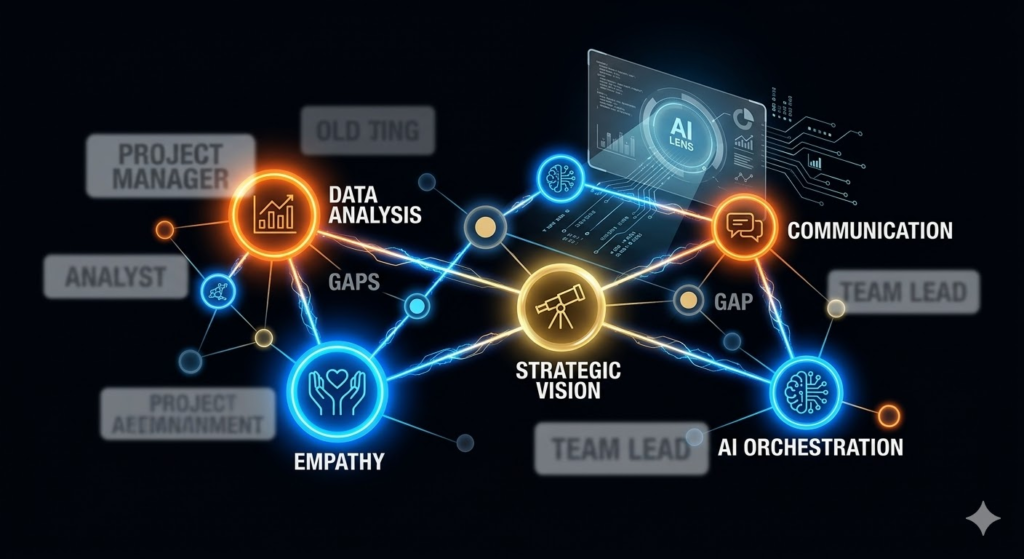
The structure of organizations is fundamentally changing in 2026. The concept of static job titles (“Marketing Director”) is giving way to dynamic Skill Maps (e.g., “strategic vision, data synthesis, empathetic communication, AI workflow orchestration”).
This is essential because jobs aren’t replaced; skills are automated or augmented. To remain competitive, you must move from defending your role to continuously mapping and developing your skills. AI is the tool to do this.
Concrete Example: Using AI to Build your Skill Map
Instead of writing a static CV, use AI to turn your career history into a dynamic learning plan:
- Paste your current CV/LinkedIn profile.
- Prompt: “Act as a dynamic career path auditor. Based only on my provided work history, build a comprehensive skill map of my current strengths. Then, look up the top five rising skills required for [your goal role/industry] in 2026. Identify my three critical skill gaps and structure a 6-month learning plan to bridge them using hands-on projects.”
This approach shifts you from passively defending your title to actively managing your human equity.
7. Practical Playbook: How to Learn with AI This Month
Developing AI fluency is a physical process of habit formation, much like learning an instrument or training for a sport. Commitment requires a structured plan.
Week 1: Explore (The “AI Audit”)
Commit to 15 minutes a day. Do nothing but list every repetitive, boring, or intellectually stuck moment in your work. Do not ask AI for solutions yet. Just gather data.
- Daily Action: Keep a notepad. Every time you think “I hate doing this” or “I don’t know where to start,” write it down. At the end of the week, circle the 3-5 tasks where you believe AI could act as a tutor or coach.
Week 2: Experiment (Daily 10-Minute AI learning Sprints)
Choose one high-value task from your Week 1 list (e.g., “understanding complex regulation documents”). For 10 minutes before you start the real work, conduct a Deliberate Practice loop with the AI.
- Daily Action: Prompt: “I am about to read this 10-page regulation PDF. Don’t summarize it. Instead, act as a demanding compliance auditor and ask me five questions that will force me to find the key regulatory impacts in the text. Score my answers.”
Week 3: Systematize (Create Personal Learning Workflows)
Analyze your Week 2 experiments. What specific prompts or constraints yielded the best learning outcomes? Codify them into a structured workflow you can repeat.
- Action: Create a Markdown file or Notion database called “My AI Playbook.” Save successful prompts, but structure them by logic (e.g., “Prompt Structure for Strategy Critique”, “Template for Learning Diagnostic Quiz”). Stop relying on public prompt libraries and build your internal knowledge base.
Week 4: Share (Teach to Deepen Mastery)
The highest level of fluency is the ability to teach. Teaching a colleague forces you to articulate the why behind your workflow.
- Action: In a team meeting or simple 1:1, share your Workflow/Playbook from Week 3. Explain how you structure your Socratic interactions. Teach one person how to use AI to diagnose their own knowledge gaps, rather than just delivering answers. This act of sharing is what cements your own cognitive command.
AI Fluency Challenge Checklist
[ ] Daily: 10 minutes of dedicated “Learning with AI” practice (Socratic dialogue, reflection simulation). [ ] Instinct: At least twice today, when stuck, prompt: “Explain the underlying logic of my error,” not “Give me the fix.” [ ] Audit: For every high-stakes AI output, demand and check two verifiable sources. [ ] Workflow: Add one new, personalized learning workflow (e.g., “Critical Proposal Critique”) to your personal AI Playbook. [ ] Sharing: Teach one colleague how to use AI for deep skill-mapping this week.
8. Risks, Limits, and Healthy Skepticism
The greatest risk of AI fluency in 2026 is Over-Reliance. We cannot afford to become an automated society of people who can perfectly operate the machine but can no longer define the purpose or evaluate the quality of its output.
Over-Reliance: The Crutch vs. The Coach
- Crutch (Dependence): When you only generate ideas with AI because you no longer trust your own creativity. Your expertise slowly erodes.
- Coach (Augmentation): When you use AI to critique your ideas or generate starting points, which you then manually refine with distinct, human context and nuance. Your expertise accelerates.
Hallucinations and Bias: Skepticism as a Feature
- Skepticism is Mandatory: Hallucination is not a bug; it is a fundamental feature of the probabilistic model. If an AI is creative, it must also be capable of being elegantly wrong. Scepticism is not a flaw in fluency; it is fluency.
- Bias Guardrails: AI fluent users constantly look for what is missing from an AI output. Is the solution too focused on efficiency at the expense of equity? Are the metaphors culturally exclusive? A fluent user utilizes AI to identify common biases, but remains the final moral agent.
Safe and Responsible AI Learning
- Assume everything you paste is public: Never paste PII (Personally Identifiable Information), confidential financial data, trade secrets, or client-specific information into any public LLM, unless your organization has explicit enterprise instances with data-privacy guarantees. Learn to work with Local, Secure AIs (on-device) for sensitive tasks.
9. Conclusion: Learning How to Learn with AI
In 2026, the digital literacy divide will close. The true chasm will be between the Digitally Augmented (who use AI to do more) and the Cognitively Augmented (who use AI to be more).
AI Fluency is not a technical certification; it is a mental posture of cognitive command. It is not about writing better prompts, but about developing better thinking.
Your challenge is simple but difficult: For one critical task today, don’t ask the AI for the output. Ask it to explain the logic, critique your thinking, or audit your assumptions. Then, iterate from there.