AI Marketing Tools for Marketing Teams in 2026
⏱ 15 min read · Category: AI Tools
Marketing has always been about reaching the right person with the right message at the right time. In 2026, AI doesn’t just help with that — it largely automates it. Campaigns that once required a team of specialists can now be orchestrated by a single marketer with the right AI stack. The numbers bear this out: AI-driven campaigns deliver an average 22% higher ROI, 32% more conversions, and 29% lower acquisition costs than traditional methods.
This guide covers the best AI marketing tools in 2026, broken down by function — content, SEO, email, social, advertising, and analytics — so you can build a stack that matches your team’s size, budget, and goals.
Table of Contents
- Why AI Marketing Has Hit an Inflection Point
- Category 1: AI Content Marketing Tools
- Category 2: AI SEO and Search Tools
- Category 3: AI Email and CRM Marketing
- Category 4: AI Social Media Tools
- Category 5: AI Advertising and Performance Tools
- Category 6: AI Analytics and Insights Tools
- Comparison Table: Best AI Marketing Tools at a Glance
- How to Build Your AI Marketing Stack
- Real-World Marketing Patterns That Work
- FAQ
Why AI Marketing Has Hit an Inflection Point
Marketing teams using AI are 44% more productive than those without it, with the average professional saving 11 hours per week on routine tasks. Across the industry, 95% of AI users report significant cost and time savings. But the more revealing statistic is this: only 17% of marketers receive proper training on AI tools — which means the majority are leaving substantial competitive advantage on the table.
The 2026 AI marketing landscape has several characteristics that make it different from what existed just two years ago:
Agentic campaigns: AI tools now chain tasks autonomously — generating a brief, writing ad copy variants, testing them, and reallocating budget to winners, all without a human between steps.
Personalisation at scale: Predictive models can now segment audiences dynamically and deliver individually personalised content across email, ads, and website — at the scale previously only available to enterprises with massive data teams.
Cross-channel orchestration: The best platforms in 2026 coordinate messaging across email, social, paid, and content so that every touchpoint reinforces the same narrative, adjusted in real time based on individual behaviour.

Key takeaway: AI marketing tools don’t just automate tasks — they enable strategies that weren’t previously possible without large teams.
Category 1: AI Content Marketing Tools
Content is the engine of most digital marketing strategies. AI content tools have moved from writing assistants to full campaign orchestrators.
Jasper AI
Jasper is the leading AI platform for marketing content at scale. Its brand voice system learns your company’s tone and style from your existing content, then applies it consistently across every asset — blog posts, email sequences, LinkedIn updates, ad copy, and video scripts.
In 2026, Jasper’s Campaign feature stands out: input a single campaign brief and receive a complete, matched suite of assets — hero article, social variants, email sequence, and Google/Meta ad copy — all in the same voice, ready for review. For product launches and seasonal campaigns, this compresses days of copywriting work into hours.
- Best for: Marketing teams producing content at scale; organisations with multiple writers who need consistent brand voice
- Pricing: Creator plan $39/month (annual); Pro $69/month (multi-seat, 3 brand voices, Surfer SEO integration); Business custom pricing
- Strategic tip: Feed Jasper 10–15 of your best existing pieces to train the brand voice before generating new content — the quality difference is significant.
Copy.ai
Copy.ai has evolved from a writing assistant into a Go-To-Market (GTM) workflow platform. Its agent workflows automate the full pipeline from lead enrichment through personalised outreach to social post generation and campaign briefs. Connect your CRM and Copy.ai can auto-generate personalised content for each prospect segment at scale.
The Workflows feature is particularly powerful for enterprise teams: define a multi-step content process once — brief → draft → SEO check → approval queue — and run it at any scale with minimal intervention.
- Best for: Sales-driven marketing teams; B2B content and outreach
- Pricing: Free plan available; paid from $49/month
Writesonic
Writesonic combines an AI writing assistant with Chatsonic (a real-time web-connected AI chat) and a landing page builder. Its Factual Article Writer mode pulls current information from the web as it generates, reducing the hallucination problem that plagues offline models.
- Best for: Content agencies, SEO-focused teams, high-volume article production
- Pricing: Free tier; paid from $16/month
Key takeaway: For brand-consistent campaign content, Jasper leads. For cost-effective high-volume content, Writesonic offers more flexibility per dollar.
Category 2: AI SEO and Search Tools
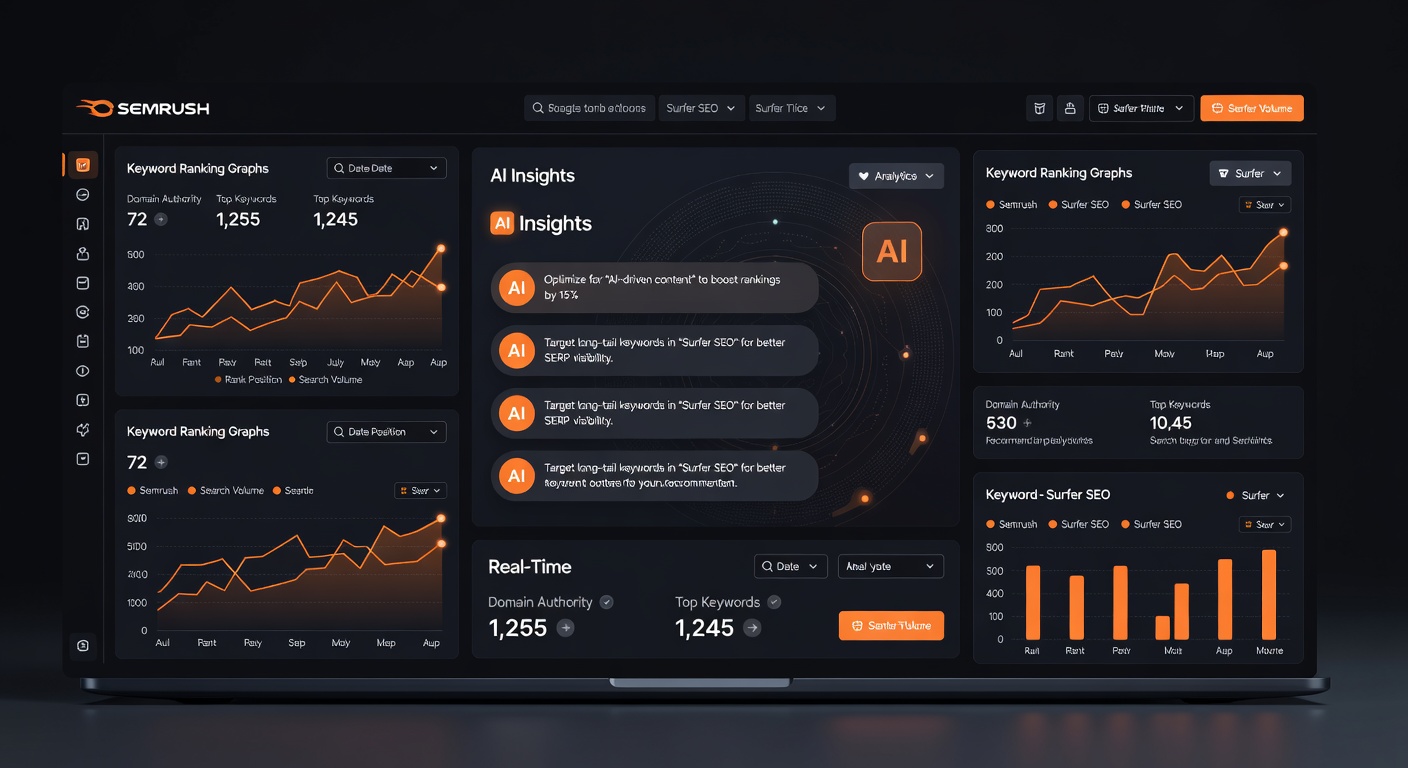
Search visibility is still a primary acquisition channel, and AI has transformed how marketers approach SEO — from reactive keyword targeting to proactive content gap analysis and real-time optimisation.
Semrush
Semrush is the most comprehensive AI-powered SEO platform in 2026. Its AI features span every stage of the SEO workflow: keyword research with competitive difficulty scoring, content gap analysis showing what topics competitors rank for that you don’t, content briefs generated from top-performing pages, and on-page optimisation suggestions delivered in real time as you write.
The ContentShake AI tool writes SEO-optimised first drafts directly from your keyword brief, incorporating all Semrush’s on-page recommendations automatically. For content teams running research-to-draft workflows, this significantly compresses the brief-to-publish timeline.
- Best for: SEO-focused content teams; digital marketing agencies; brands investing in organic growth
- Pricing: Pro $139.95/month; Guru $249.95/month (adds content marketing platform); Business $499.95/month
Surfer SEO
Surfer SEO is the go-to tool for on-page optimisation. It analyses the top 20 pages ranking for your target keyword and generates a structured content brief with recommended word count, heading structure, semantic keywords, and entity coverage. Write inside Surfer’s editor and you get a live optimisation score that updates as you add content.
- Best for: Writers and editors who want real-time SEO feedback as they write
- Pricing: Essential $89/month; Scale $129/month
Perplexity AI for Research
Perplexity’s Pro Search mode is increasingly used by marketers for competitive research and trend identification — finding what competitors are writing, what questions audiences are asking, and which claims have strong citation backing. Its sourced-answer format means every research output is ready to back up with references.
- Best for: Research phase of content marketing; competitive analysis; keeping up with industry trends
- Pricing: Free tier; Pro $20/month
Key takeaway: Semrush for strategy and competitive intelligence; Surfer for execution and on-page optimisation; both together for a complete SEO workflow.
Category 3: AI Email and CRM Marketing
Email marketing remains the highest-ROI digital channel, and AI has made personalisation at scale genuinely achievable for teams of any size.
Klaviyo
Klaviyo is the defining AI email and SMS marketing platform for e-commerce in 2026. Its predictive analytics model scores every customer on lifetime value, churn probability, and product affinity — and uses those scores to trigger personalised flows automatically. A customer browsing shoes twice gets a relevant email; a high-LTV customer who hasn’t bought in 90 days gets a win-back sequence.
The 2026 version adds AI-generated subject line and content suggestions personalised to each recipient segment. Send-time optimisation learns when each individual subscriber is most likely to open and adjusts delivery accordingly.
- Best for: E-commerce brands; DTC companies; any business with a significant product catalogue
- Pricing: Free for up to 250 contacts; scales by list size — 1,000 contacts from ~$20/month
HubSpot Marketing Hub
HubSpot brings marketing, CRM, and automation together in one platform. Its AI features in 2026 cover email personalisation, campaign performance prediction, lead scoring, social media scheduling, landing page generation, and SEO recommendations. The breadth makes it the platform of choice for B2B teams who need one tool to run the full funnel.
The AI assistant can suggest content based on what has performed well for your audience historically, generate email sequences, and recommend the next best action for each lead based on their behavioural data.
- Best for: B2B marketing teams; companies wanting a single unified platform; teams with HubSpot CRM already in place
- Pricing: Free CRM with basic tools; Starter from $20/month; Professional from $890/month; Enterprise from $3,600/month
Mailchimp AI
Mailchimp’s AI tools help smaller businesses with send-time optimisation, subject line recommendations, and audience segmentation. The content generator can draft email copy from a brief and a product description. For teams just getting started with email automation, Mailchimp’s AI layer is accessible and well-integrated.
- Best for: Small businesses and solo marketers; beginner-friendly automation
- Pricing: Free for up to 500 contacts; Essentials from $13/month
Key takeaway: For e-commerce, Klaviyo’s predictive personalisation delivers superior revenue per email. For B2B full-funnel, HubSpot’s breadth is unmatched.
Category 4: AI Social Media Tools
Buffer AI Assistant
Buffer’s AI assistant lives inside the scheduling platform. Generate post variations from a single piece of content, repurpose long-form articles into platform-specific social snippets, and schedule — all without leaving Buffer. The AI produces tailored variants for LinkedIn, X/Twitter, Instagram, Facebook, Threads, Pinterest, and TikTok captions from a single input, each tuned to platform norms.
- Best for: Solopreneurs and small teams managing organic social across multiple platforms
- Pricing: Free tier available; paid from $6/channel/month
Sprout Social
Sprout Social is the enterprise social media management platform with AI baked in across listening, publishing, and analytics. Its AI features include social listening that tracks sentiment across mentions, influencer identification, optimal posting time suggestions, and AI-generated performance reports. For teams managing social at brand level with multiple stakeholders, Sprout’s workflow features — approvals, content calendars, team tasking — are essential.
- Best for: Mid-market and enterprise social media teams; brands with active social customer care
- Pricing: Standard $249/seat/month; Professional $399/seat/month
OpusClip
OpusClip takes long-form video content (webinars, podcasts, YouTube videos) and automatically generates short vertical clips optimised for TikTok, Instagram Reels, and YouTube Shorts. Its AI assigns virality scores to clips based on engagement patterns, ensuring you’re cutting the highest-potential moments.
- Best for: Content teams with video assets to repurpose; podcasters; webinar hosts
- Pricing: Free tier; Pro $15/month
Key takeaway: Buffer for lean social management; Sprout Social for enterprise; OpusClip for maximising ROI from existing video content.
Category 5: AI Advertising and Performance Tools
Pixis
Pixis is an AI operating system for paid advertising. It connects to Meta and Google Ads and autonomously reallocates budget across ad sets, tests creative variants, and refines audience targeting based on live performance data. Marketing teams using Pixis report reducing manual campaign management time by 60–70% while improving ROAS.
- Best for: Performance marketing teams managing significant ad spend on Meta and Google
- Pricing: Enterprise pricing — contact for quote
Albert AI
Albert is an autonomous AI digital marketing platform that manages and optimises campaigns across Facebook, YouTube, Google, and Bing simultaneously. It functions as an always-on campaign analyst: testing audiences, rotating creatives, adjusting bids, and reporting on what’s working — without waiting for a human to review data.
- Best for: Brands with substantial multi-channel ad budgets who want autonomous optimisation
- Pricing: Enterprise pricing
Canva AI for Ads
For teams without dedicated designers, Canva’s Magic Design generates on-brand ad creatives, social cards, and landing page graphics from a text brief. The Brand Kit integration ensures every AI-generated asset uses your brand colours, fonts, and logo automatically.
- Best for: Small to mid-size marketing teams; fast-moving creative production without designers
- Pricing: Free plan; Pro ~$15/month
Key takeaway: Pixis and Albert are for serious ad budgets requiring autonomous optimisation. Canva AI solves the creative production bottleneck for resource-constrained teams.
Category 6: AI Analytics and Insights Tools
Brand24
Brand24 monitors mentions of your brand across news sites, social media, blogs, forums, and video platforms, applying sentiment analysis and trend identification in real time. It’s the first tool marketers should have running — you need to know what’s being said about your brand before you can manage it.
- Best for: Brand monitoring, reputation management, competitive intelligence
- Pricing: Individual $119/month; Team $159/month
Google Analytics 4 + AI Insights
GA4’s AI-powered insights automatically surface anomalies and opportunities in your traffic data: unusual spikes in specific pages, channels that are over- or under-performing, segments showing high conversion rates. The predictive metrics — purchase probability, churn probability — enable proactive audience targeting without building custom models.
- Best for: Any marketing team with a website; foundational traffic and conversion intelligence
- Pricing: Free
Key takeaway: Brand24 for external perception; GA4 for owned channel performance — both are essential baselines for any data-driven marketing team.
Comparison Table: Best AI Marketing Tools at a Glance
| Tool | Category | Best For | Pricing |
| Jasper AI | Content | Brand-consistent campaign content | From $39/month |
| Copy.ai | Content/GTM | B2B content and outreach workflows | Free + from $49/month |
| Writesonic | Content | High-volume SEO articles | Free + from $16/month |
| Semrush | SEO | Full-stack SEO strategy and research | From $139.95/month |
| Surfer SEO | SEO | On-page optimisation | From $89/month |
| Klaviyo | E-commerce email and SMS | Free + scales with list size | |
| HubSpot Marketing Hub | CRM/Email | B2B full-funnel marketing | Free + from $20/month |
| Buffer AI | Social media | Multi-platform social management | Free tier available |
| Sprout Social | Social media | Enterprise social + listening | From $249/seat/month |
| OpusClip | Video repurposing | Short-form video from long content | Free + $15/month |
| Pixis | Paid ads | Autonomous Meta/Google optimisation | Enterprise pricing |
| Canva AI | Creative | Ad and social creative production | Free + Pro $15/month |
| Brand24 | Analytics | Brand monitoring and sentiment | From $119/month |
How to Build Your AI Marketing Stack
Effective AI marketing stacks are built around your bottleneck, not around having every tool. Here’s how to approach it:
Step 1 — Identify your constraint. Is content creation your bottleneck? Or is it generating enough leads? Or converting them? Or understanding what’s working? Each constraint has different tool solutions. Start there.
Step 2 — Add the universals first. Google Analytics 4 (free), Brand24 (monitoring), and a single AI writing tool should be in every stack regardless of size. These give you baselines.
Step 3 — Layer in channel-specific tools. Once baselines are in place, add tools for your primary acquisition channels: Semrush + Surfer for SEO-led growth; Klaviyo for e-commerce email; HubSpot for B2B; Sprout Social for brands with significant social presence.
Step 4 — Automate the highest-volume tasks. Find the tasks your team does most often and is spending the most time on — social scheduling, email variant testing, content briefs — and automate those first. The ROI compounds fastest where volume is highest.
Step 5 — Measure and iterate. AI tools are only as good as your ability to evaluate their output. Set clear metrics (time saved per content piece, email open rate improvement, ad ROAS change) before deploying each tool so you can measure impact within 30 days.
Real-World Marketing Patterns That Work
The Content Engine Pattern
Weekly rhythm: Identify 2 target keywords → Semrush generates a content brief → Jasper drafts the article → Surfer checks on-page optimisation → Buffer AI creates social variants → schedule. One person can run this for 4–6 articles per week at high quality, producing organic content at the volume that previously required a full content team.
The E-commerce Personalisation Pattern
Klaviyo + GA4 + Canva AI: GA4 identifies your highest-converting product pages → Klaviyo segments customers by product affinity and purchase history → Canva AI generates personalised product creative → Klaviyo sends triggered emails with the right product to the right person at the right moment. Companies running this pattern consistently see 25–40% increases in email revenue per recipient.
The B2B Demand Generation Pattern
HubSpot + Copy.ai + Semrush: Semrush identifies the content topics your target accounts are searching for → Copy.ai generates personalised outreach sequences calibrated to each job title → HubSpot runs the nurture sequences and scores leads based on engagement → sales gets leads that have already consumed relevant content. This reduces sales cycle length and improves close rates.
The Brand Protection Pattern
Brand24 monitors all mentions → negative sentiment triggers an alert to a Slack channel → the marketing team responds within the hour. Most brand crises are manageable when caught early; Brand24 is the early warning system.
FAQ
What is the best AI tool for marketing in 2026?
There’s no single answer because the best tool depends on your primary use case. For content, Jasper leads. For SEO, Semrush. For e-commerce email, Klaviyo. For B2B full-funnel, HubSpot. For a comprehensive overview with no budget, start with the free tiers of HubSpot, Canva, Buffer, and GA4 — together they cover most of the fundamentals.
How much should a marketing team budget for AI tools?
A lean but effective stack for a 2–5 person marketing team runs $300–600/month and typically includes Jasper or Copy.ai ($39–69), Semrush or Surfer ($89–140), Klaviyo or HubSpot ($20–100 depending on list/database size), Canva Pro ($15), and Buffer ($18). That $300–600 investment routinely delivers 2–4× productivity multipliers on content and campaign work.
Are AI marketing tools worth it for small businesses?
Yes — arguably more so than for enterprises. Large companies have specialist teams for every marketing function; small businesses have one or two generalists trying to do everything. AI tools level the playing field by giving a solo marketer the capability to produce what previously required a full team. The free tiers of HubSpot, Buffer, Canva, and GA4 provide a solid foundation at zero cost.
How do AI marketing tools handle brand voice?
The best tools (Jasper, Copy.ai) allow you to upload examples of your existing content as training material and define explicit tone guidelines — formal vs. casual, technical vs. approachable, specific words to avoid. The more examples and guidelines you provide, the more consistent the output. For organisations with strong brand identity, this is the most important setup step.
Can AI tools replace a marketing team?
Not entirely. AI tools excel at mechanical tasks: writing drafts, testing variants, scheduling content, optimising bids, monitoring mentions. They don’t generate genuine strategic insight, understand your business context deeply, or build relationships with customers and partners. The highest-performing model in 2026 is AI for execution + humans for strategy, judgment, and relationship management.
What is the ROI of AI marketing tools?
Research consistently shows AI-driven marketing campaigns deliver 20–30% higher ROI than traditional approaches. Marketing teams report saving 11 hours per week per person. Organisations adopting AI marketing tools report an average 41% revenue increase and 32% reduction in customer acquisition costs over two years. That said, ROI depends heavily on implementation quality — tools only work if they’re used consistently and measured properly.
Conclusion
The marketing teams winning in 2026 have one thing in common: they’ve stopped treating AI as an experiment and started treating it as infrastructure. Their content engine runs continuously. Their email sequences self-optimise. Their ad campaigns adjust in real time. And their strategists spend their hours on strategy rather than production.
The path to this outcome isn’t buying every tool at once — it’s identifying your biggest constraint, solving it with one well-chosen tool, measuring the result, and layering in the next. Each solved bottleneck compounds.
Start with what slows you down most. If it’s content production, try Jasper. If it’s organic search, start with Semrush. If it’s email revenue, deploy Klaviyo. One tool, done well, can change the economics of your entire marketing operation.
Ready to go deeper? Explore the full Learn AI: The Complete Guide on learnAI.