


AI Productivity Automation Use Cases
⏱ 30 min read · Category: AI Automation
Generative AI is transforming how businesses automate routines and boost productivity. From automating customer support to streamlining supply chains, AI agents handle complex workflows with minimal human intervention. According to Gartner, 30% of enterprises will automate more than half of their network activities using AI-based analytics by 2026.
Table of Contents
- What is AI Productivity Automation
- Customer Support Automation
- Financial Operations & Invoice Processing
- Project Management & Resource Planning
- Supply Chain & Manufacturing Optimization
- HR & Talent Management Automation
- Compliance & Audit Automation
- Real-World Implementation Strategy
- FAQ
- Conclusion

What is AI Productivity Automation
AI productivity automation moves beyond simple task automation. It represents intelligent systems that can independently set goals, make decisions, and manage multi-step processes with minimal human intervention. Agentic AI—the ability for systems to autonomously pursue objectives—is the defining trend of 2026.
The difference between traditional automation and agentic AI is critical. Traditional RPA (Robotic Process Automation) follows rigid scripts: “If X occurs, do Y.” Agentic AI understands context, adapts to variations, and handles exceptions intelligently. When an invoice doesn’t match contract terms, an AI agent flags it for review rather than failing silently.
Companies implementing AI productivity automation see 35-45% productivity gains. Some organizations report cost reductions exceeding 40%. These aren’t minor improvements—they fundamentally change how businesses operate.
Key takeaway: Agentic AI automates not just tasks, but entire workflows and decision-making processes.
Customer Support Automation
In 2026, customer support is becoming AI-first. AI agents handle initial customer inquiries, route complex issues to humans, and manage follow-up interactions. The most effective approach puts AI on the front line while humans handle emotionally complex or unusual situations.
Cisco research on AI workplace transformation emphasizes that “Connected Intelligence”—where AI, data, and humans work together—is reshaping customer operations. An AI agent answering 80% of routine questions means human agents can focus on retention, upselling, and complex problem-solving.
Specific use cases include:
– AI chatbots answering FAQs and handling basic troubleshooting
– Intelligent routing sending complex cases to specialized human agents
– Sentiment analysis detecting frustrated customers who need immediate escalation
– Post-interaction follow-up and feedback collection
– Predictive support suggesting help before customers ask
Companies implementing AI-first customer support report 40-50% reduction in support costs combined with improved customer satisfaction. The key is balancing automation with human intervention: completely automated support frustrates customers; entirely human support wastes money on routine interactions.
Key takeaway: AI-first customer support automates routine interactions while humans handle complex, emotional situations.
Financial Operations & Invoice Processing
Financial operations teams spend enormous time on repetitive tasks: processing invoices, verifying amounts, matching transactions to contracts, and flagging exceptions. AI automates almost all of this work.
AI business process automation can:
– Process incoming invoices automatically
– Extract key data (vendor, amount, PO number, cost center)
– Match invoices to purchase orders and contracts
– Flag mismatches and missing information
– Approve routine invoices automatically
– Route exceptions to humans for review
Banks are using AI-powered automation to streamline KYC (Know Your Customer) processes, automate loan underwriting, and generate real-time financial reports. What previously took days now takes hours. What required 10 people now requires 3.

More advanced use cases include:
– Fraud detection analyzing transaction patterns
– Expense claim validation and approval
– Revenue recognition automation
– Cash flow forecasting
– Reconciliation of multiple ledgers
The ROI on financial process automation is typically highest among all automation opportunities. Companies implementing AI-powered AP and AR automation see payback in 6-12 months.
Key takeaway: Financial operations automation delivers measurable ROI quickly through invoice processing, fraud detection, and reconciliation.
Project Management & Resource Planning
Project managers spend significant time on coordination: assigning tasks, monitoring progress, identifying bottlenecks, and reporting status. AI agents increasingly handle this work.
AI-powered project management tools:
– Predict bottlenecks before they occur
– Automatically allocate resources based on workload and skills
– Escalate risks and dependencies to human managers
– Generate status reports and dashboards
– Identify which team members are overallocated
– Suggest process improvements based on historical data
The World Economic Forum research on AI workplace transformation highlights that “AI multi-agent systems” in 2026 coordinate complex workflows that previously required human project managers. This doesn’t mean project managers disappear—they shift from task coordination to strategy and exception handling.
Practical benefits include:
– Reduced project delay from 30% of projects to under 10%
– Better resource utilization (fewer idle workers, less bottleneck)
– Improved team morale through better workload distribution
– Earlier identification of schedule and budget risks
Key takeaway: AI agents handle project coordination, freeing human project managers for strategic oversight.
Supply Chain & Manufacturing Optimization
Manufacturing and supply chain optimization represents one of the highest-ROI automation opportunities. Production planning and scheduling is complex: thousands of variables, interdependencies, and constraints. AI handles this complexity better than humans.
Specific applications include:
– Production scheduling optimization
– Demand forecasting based on market signals
– Predictive maintenance using sensor data (temperature, vibration, pressure)
– Supplier relationship management and order optimization
– Quality control using computer vision
– Inventory optimization
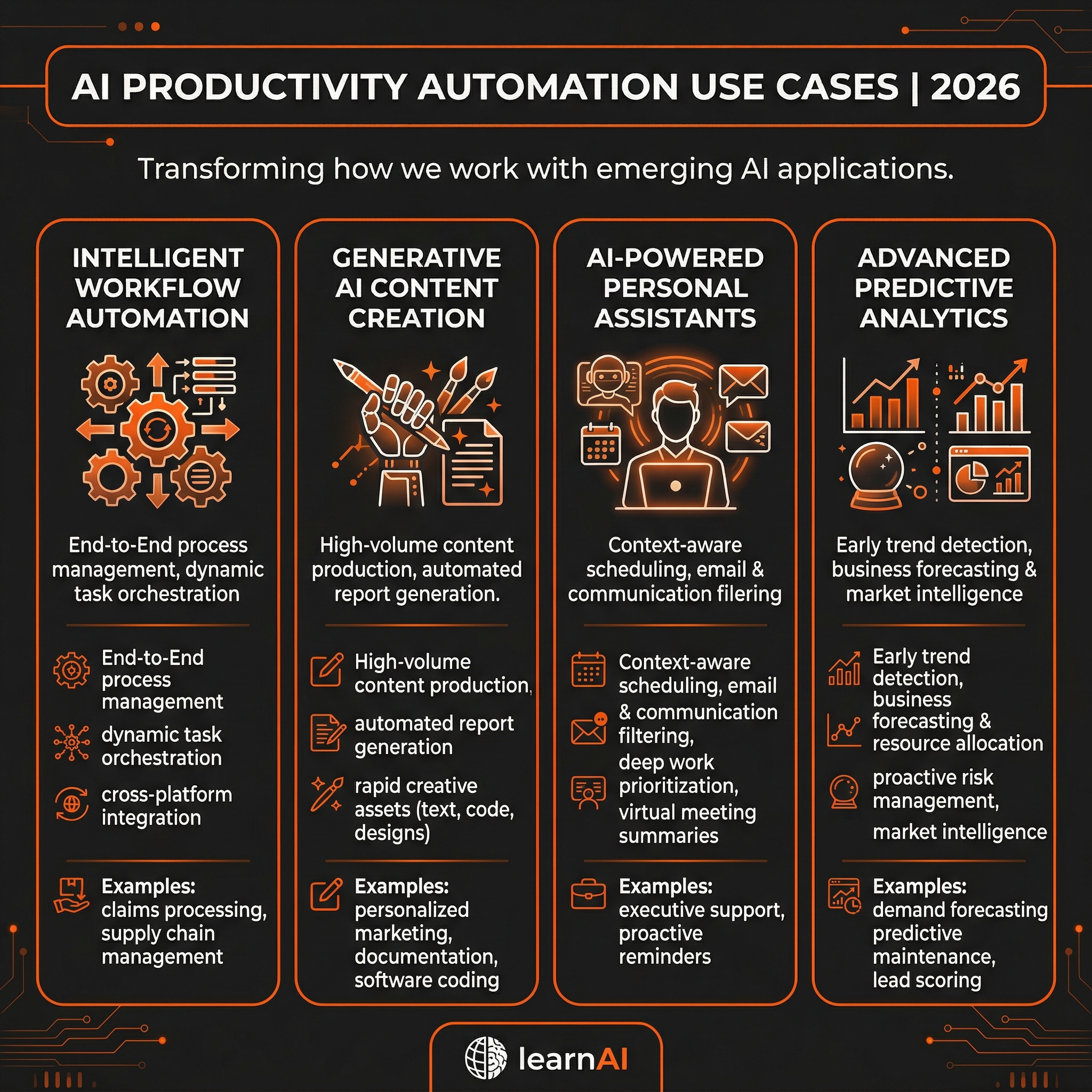
According to research, 49% of manufacturers have already automated production scheduling by 2026. Early adopters see 20-30% improvement in production efficiency. Predictive maintenance prevents machine failures before they occur, reducing downtime by 40-50%.
Advanced use cases involve connecting multiple agents:
– A demand-forecasting agent predicts customer orders
– A production-planning agent schedules manufacturing
– A procurement agent orders materials
– A quality-control agent monitors output
– A maintenance agent predicts equipment failures
These agents coordinate without human intervention, optimizing the entire supply chain.
Key takeaway: Manufacturing automation delivers 20-30% efficiency gains through intelligent scheduling and predictive maintenance.
HR & Talent Management Automation
Human Resources teams handle repetitive tasks: screening resumes, scheduling interviews, onboarding employees, tracking performance, and identifying flight risks. AI automates most of this work.
Applications include:
– Resume screening using AI to match candidates to job requirements
– Interview scheduling and initial interview assessment
– Onboarding task automation and employee document processing
– Performance analysis and engagement measurement
– Succession planning and flight-risk identification
– Compensation analysis and equity assessment
Eightfold AI and similar platforms analyze millions of employee and candidate profiles, matching them to roles and identifying training needs. What HR teams previously spent weeks on—finding qualified candidates—now takes hours.
More strategic uses emerge in 2026:
– Identifying internal candidates for roles before they’re posted
– Predicting which employees might leave and suggesting retention strategies
– Personalizing development paths based on career aspirations and skills
– Identifying skill gaps across the organization
– Recommending training and upskilling programs
Research shows that organizations using AI-powered talent management see 30-40% improvement in hiring velocity and 25-30% reduction in turnover among high performers.
Key takeaway: HR automation accelerates recruiting, improves retention, and enables better workforce planning.
Compliance & Audit Automation
Financial compliance, audit, and regulatory reporting require processing enormous amounts of documentation. AI automates much of this work, improving accuracy while reducing cost.
Specific applications:
– Contract analysis comparing transactions to terms
– Policy violation detection across transaction logs
– Regulatory reporting generation and filing
– Audit trail documentation
– Risk assessment and flag generation
– Investigation support and evidence gathering
AI NLP models can analyze contracts, identify key obligations, and compare them to actual transactions. If a contract specifies that payments must be made within 30 days, but a vendor consistently pays after 45 days, the AI flags this automatically.
For regulated industries (financial services, healthcare, insurance), compliance automation delivers enormous value:
– Reduced audit costs by 30-40%
– Faster regulatory reporting and filing
– Fewer compliance violations and associated penalties
– Better documentation and audit trails
– Improved risk identification
Key takeaway: Compliance automation improves accuracy while reducing audit and regulatory burden.
Real-World Implementation Strategy
Successfully implementing AI productivity automation requires thoughtful strategy, not just deploying technology:
1. Start With High-Impact, Well-Defined Processes
Begin with repetitive processes where AI can deliver clear value:
– High transaction volume
– Clear rules and decision criteria
– Measurable outcomes
– Significant cost reduction opportunity
Invoice processing and customer support are popular starting points because they meet all these criteria.
2. Ensure Quality Data and Process Design
AI only works well with clean data and well-designed processes. Before implementing AI:
– Map the current process thoroughly
– Identify where humans make decisions
– Ensure data quality and standardization
– Document decision rules and exceptions
– Establish clear success metrics
This upfront work prevents failed deployments.
3. Plan for Human-AI Collaboration
Effective automation isn’t 100% AI—it’s strategic collaboration. Where should humans stay involved?
– Handling exceptions and edge cases
– Making judgment calls on ambiguous situations
– Overseeing AI decisions
– Training and improving AI models
– Managing stakeholder communication
Design workflows where AI handles routine cases and humans review exceptions.
4. Measure ROI Rigorously
Define success metrics before implementation:
– Cost reduction (labor hours saved)
– Accuracy improvement (error rates)
– Speed improvement (processing time)
– Quality improvement (customer satisfaction)
– Employee satisfaction (less manual work, more strategic work)
Track these metrics continuously and adjust your approach based on results.
Key takeaway: Successful automation requires thoughtful process design, data quality, and human-AI collaboration planning.
FAQ
Q: Will AI automation eliminate jobs in my department?
AI automation eliminates repetitive tasks, not jobs. Workers shift from routine work to more valuable activities. A customer service representative might stop answering FAQs and focus on retaining valuable customers. An accountant might stop data entry and focus on financial analysis. The transition can be challenging, but properly implemented automation creates better jobs, not unemployment.
Q: What’s the typical ROI on AI productivity automation?
ROI varies by use case, but typically 6-18 months for financial process automation, 6-12 months for customer support automation, and 12-24 months for supply chain automation. The key is starting with high-impact processes where AI delivers clear value.
Q: How do we handle exceptions and edge cases?
Modern agentic AI handles exceptions by escalating them to humans. The AI agent routes complex or unusual situations to the right human for review. This combination of AI automation with human judgment is more effective than pure automation.
Q: What’s required to start with AI automation?
Start small. Pick one high-impact process. Ensure data quality. Map the process thoroughly. Define success metrics. Implement with vendor support. Measure results. Then expand. You don’t need massive investment or internal AI expertise—vendors provide the technology; you provide process knowledge.
Q: How does AI handle processes that change frequently?
Modern AI agents can adapt to process changes more easily than traditional automation. You can update decision rules and training data without reprogramming. However, constantly changing processes make automation difficult regardless of approach. Stabilize processes first, then automate.
Q: What about security and data privacy?
This is critical. Ensure AI systems have appropriate access controls. Only give AI agents access to data they need. Implement audit logging. Comply with regulations like GDPR. Work with vendors who take security seriously. Don’t automate processes involving sensitive data without careful planning.
Conclusion
AI productivity automation is no longer experimental—it’s mainstream in 2026. Companies implementing agentic AI to handle customer support, financial operations, supply chain, and compliance are seeing 30-40% productivity improvements and cost reductions exceeding 40%.
The most successful implementations treat AI as a collaborator, not a replacement. Humans handle judgment calls and exceptions; AI handles routine, well-defined work. This combination delivers both cost savings and employee satisfaction.
Your competitive advantage in 2026 comes from implementing AI productivity automation effectively. Start with your highest-impact process. Ensure data quality and process design. Measure results rigorously. Then expand to other areas.
Ready to transform your business with AI productivity automation? Join the learnAI community to learn how other leaders are implementing AI successfully → learnAI Skool Community
Sources:
– AI Workflow Automation Trends for 2026
– Strategic Predictions for 2026: How AI’s Underestimated Influence Is Reshaping Business
– The AI-driven workforce is here. How should your industry transform?
– How AI will transform the workplace in 2026