



Best AI Courses Online in 2026: Free and Paid Options Ranked
⏱ 10 min read · Category: AI Education
Artificial intelligence has become essential knowledge, not just for engineers but for business leaders, creators, and career-changers. In 2026, the landscape of AI education is more accessible than ever, with world-class instructors making cutting-edge material available globally. Whether you’re looking to understand how LLMs work, build AI products, or transition into an AI career, there’s a course for you—and you don’t need to break the bank to get started.
The challenge isn’t finding courses; it’s choosing the right one. This guide cuts through the noise and ranks the best AI courses available right now, covering everything from free foundational learning to paid specialized training.
Table of Contents
3. Best Paid Courses for Career Growth
6. Which Course Is Right for You?
7. Learning Tips to Maximize Your Investment
Best Overall Courses
fast.ai: Practical Deep Learning for Coders
Provider: fast.ai
Cost: Free
Duration: 7-10 weeks (part-time)
Skill Level: Intermediate (coding experience required)
What You’ll Learn: Deep learning, neural networks, computer vision, NLP, from top-down (practical to theory)
fast.ai remains the gold standard for practical deep learning. Jeremy Howard and Rachel Thomas teach you how to build state-of-the-art models without getting bogged down in mathematical proofs. The course uses a top-down approach—you’ll train models on day one and understand the theory later.
Pros:
- Completely free with exceptional instruction
- Hands-on Jupyter notebooks you can run immediately
- Teaches best practices used in production environments
- Active community and forums
- Focus on practical applications over theory
Cons:
- Requires prior coding experience (Python)
- Less structured than some paid alternatives
- No official certification
Best for: Developers transitioning into AI, people who learn by doing
DeepLearning.AI: AI for Everyone & Machine Learning Specialization
Provider: DeepLearning.AI (Andrew Ng)
Cost: Free (audit) or ~$39-49/month (with certificate)
Duration: 3-6 weeks per course (various specializations available)
Skill Level: Beginner to Intermediate
What You’ll Learn: ML fundamentals, neural networks, LLMs, AI applications
Andrew Ng’s DeepLearning.AI courses set the standard for AI education. His teaching style is remarkably clear, breaking complex topics into understandable chunks. “AI for Everyone” is the non-technical introduction everyone needs, while the “Machine Learning Specialization” provides hands-on depth.
Pros:
- Exceptionally clear explanations
- Free audit option available
- Affordable with certificate track
- Covers modern topics (transformers, LLMs, generative AI)
- Structured progression
Cons:
- Some content uses simplified frameworks (might feel dated next to cutting-edge research)
- Requires Coursera account
- Free option doesn’t include graded assignments
Best for: Career changers, business leaders wanting to understand AI, anyone new to the field

Best Free AI Courses
Google’s Machine Learning Crash Course
Provider: Google
Cost: Free
Duration: 15 hours self-paced
Skill Level: Beginner
What You’ll Learn: ML fundamentals, TensorFlow, neural networks, best practices
Google’s free crash course is remarkably comprehensive. It covers ML fundamentals, TensorFlow, and includes video lessons, interactive exercises, and real-world examples. This is your best entry point if you want a structured, free introduction.
Pros:
- Completely free
- Google’s production experience embedded
- Interactive visualizations
- Good pacing for beginners
- Covers TensorFlow fundamentals
Cons:
- Less deep than specialized courses
- No community support built in
- Doesn’t cover advanced topics
Best for: Beginners wanting structured learning, people learning TensorFlow
Hugging Face Course: NLP with Transformers
Provider: Hugging Face
Cost: Free
Duration: 4-6 weeks
Skill Level: Intermediate
What You’ll Learn: Transformers, NLP, fine-tuning models, working with the Hugging Face ecosystem
Hugging Face’s free course is essential if you’re interested in natural language processing and large language models. You’ll learn the theory behind transformers and get hands-on with their popular libraries. Given that transformers power ChatGPT, Claude, and modern LLMs, this knowledge is immediately valuable.
Pros:
- Free and comprehensive
- Updated regularly with new content
- Interactive notebooks with real models
- Practical focus on modern NLP
- Direct from the maintainers of crucial tools
Cons:
- Requires some ML background
- Less hand-holding than structured courses
- Community support is async (not live)
Best for: People interested in LLMs and NLP, developers who want to fine-tune modern models
Stanford’s CS 224N: NLP with Deep Learning (Lecture Videos)
Provider: Stanford University (free via YouTube)
Cost: Free
Duration: 20 lectures (~2-3 weeks intensive)
Skill Level: Advanced Intermediate
What You’ll Learn: Advanced NLP theory, attention mechanisms, sequence models, research-level understanding
Stanford’s lecture videos give you university-level instruction in NLP from leading researchers. This is less “how to apply” and more “how it works under the hood.”
Pros:
- Taught by leading NLP researchers
- Free access to lectures
- Rigorous academic approach
- Covers cutting-edge research
Cons:
- No assignments or feedback
- Dense material requires strong foundation
- No certificate
- Self-directed (no structure)
Best for: Researchers, ML engineers, those aiming for senior roles in AI companies
Best Paid Courses for Career Growth
Coursera: Various AI Specializations
Provider: Coursera (partnerships with universities and experts)
Cost: ~$39-49/month, specializations typically take 3-6 months
Duration: Varies
Skill Level: Beginner to Advanced
What You’ll Learn: Depends on specialization (deep learning, ML engineering, AI for healthcare, etc.)
Coursera offers hundreds of AI courses from top universities and instructors. The platform is particularly strong for structured specializations where you build multiple projects culminating in a capstone.
Pros:
- Wide variety of specializations
- Structured, with clear progression
- University-level instruction
- Certificates that employers recognize
- Affordable with learning subscription
Cons:
- Quality varies by instructor
- Can feel outdated in rapidly evolving AI field
- Requires paying for certificate (no free option for graded work)
- Time-intensive
Best for: Career changers, job seekers wanting credentials, those who need structure
Udemy: AI & Machine Learning Courses
Provider: Udemy (various instructors)
Cost: $15-100 per course (heavily discounted from listed price)
Duration: Varies (typically 20-40 hours)
Skill Level: Beginner to Advanced
What You’ll Learn: Depends on course
Udemy’s AI courses range from beginner Python to specialized PyTorch and reinforcement learning. Quality varies significantly by instructor, but the best ones are exceptional value at Udemy’s typical discount prices.
Pros:
- Extremely affordable (wait for sales)
- Lifetime access to materials
- Practical, project-based courses
- Large course selection
- Good for niche topics
Cons:
- Highly variable quality
- No instructor consistency
- Limited community interaction
- Outdated content in some courses
Best for: Learning specific tools, budget-conscious learners, project-based learners

Best Specialized Courses
DeepLearning.AI: Short Courses on AI & LLMs
Provider: DeepLearning.AI
Cost: Free (most courses), some advanced tracks ~$25-40
Duration: 1-2 hours per course
Skill Level: Beginner to Intermediate
What You’ll Learn: ChatGPT prompt engineering, vector databases, LangChain, building with LLMs
DeepLearning.AI’s short courses are perfect for rapid skill-building on hot topics. Courses like “Short Course on Prompt Engineering” and “Building Systems with LLMs” let you master specific applications in 1-2 hours. These are among the fastest ways to stay current with AI developments.
Pros:
- Free or extremely affordable
- Highly focused on current topics
- Perfect for busy professionals
- Hands-on with real APIs
- Up-to-date with latest tools
Cons:
- Very narrow scope
- Requires prior knowledge for context
- Not comprehensive learning path
- Some require API keys for practical exercises
Best for: Professionals wanting to stay current, people interested in prompt engineering and LLMs
Replit: AI Development Courses
Provider: Replit
Cost: Varies (some free, some paid)
Duration: Self-paced
Skill Level: Intermediate
What You’ll Learn: Building with AI APIs, LLMs, practical AI applications
Replit’s AI courses focus on building real applications with LLMs, combining coding with AI. You can run code directly in your browser.
Pros:
- Learn by building immediately
- No setup required (browser-based)
- Practical applications
- Active community
Cons:
- Limited course library
- Newer platform with less maturity
- Less comprehensive than alternatives
Best for: Developers wanting to build with AI immediately, those new to coding who want hands-on learning
LinkedIn Learning: AI Courses for Business
Provider: LinkedIn Learning
Cost: ~$30-40/month subscription
Duration: Varies (typically 2-4 hours)
Skill Level: Beginner to Intermediate
What You’ll Learn: AI applications, ethics, business impact, prompt engineering for non-technical roles
LinkedIn Learning excels at making AI accessible to non-technical professionals. Courses here focus on understanding impact, applications, and business strategy rather than implementation.
Pros:
- Designed for business professionals
- Explains context and applications clearly
- Bite-sized lessons
- Subscription includes many courses
- Certificates appear on LinkedIn profile
Cons:
- No coding or deep technical content
- Less rigorous than academic courses
- Content can be introductory
- Requires subscription
Best for: Business leaders, managers, non-technical professionals, career changers from other industries
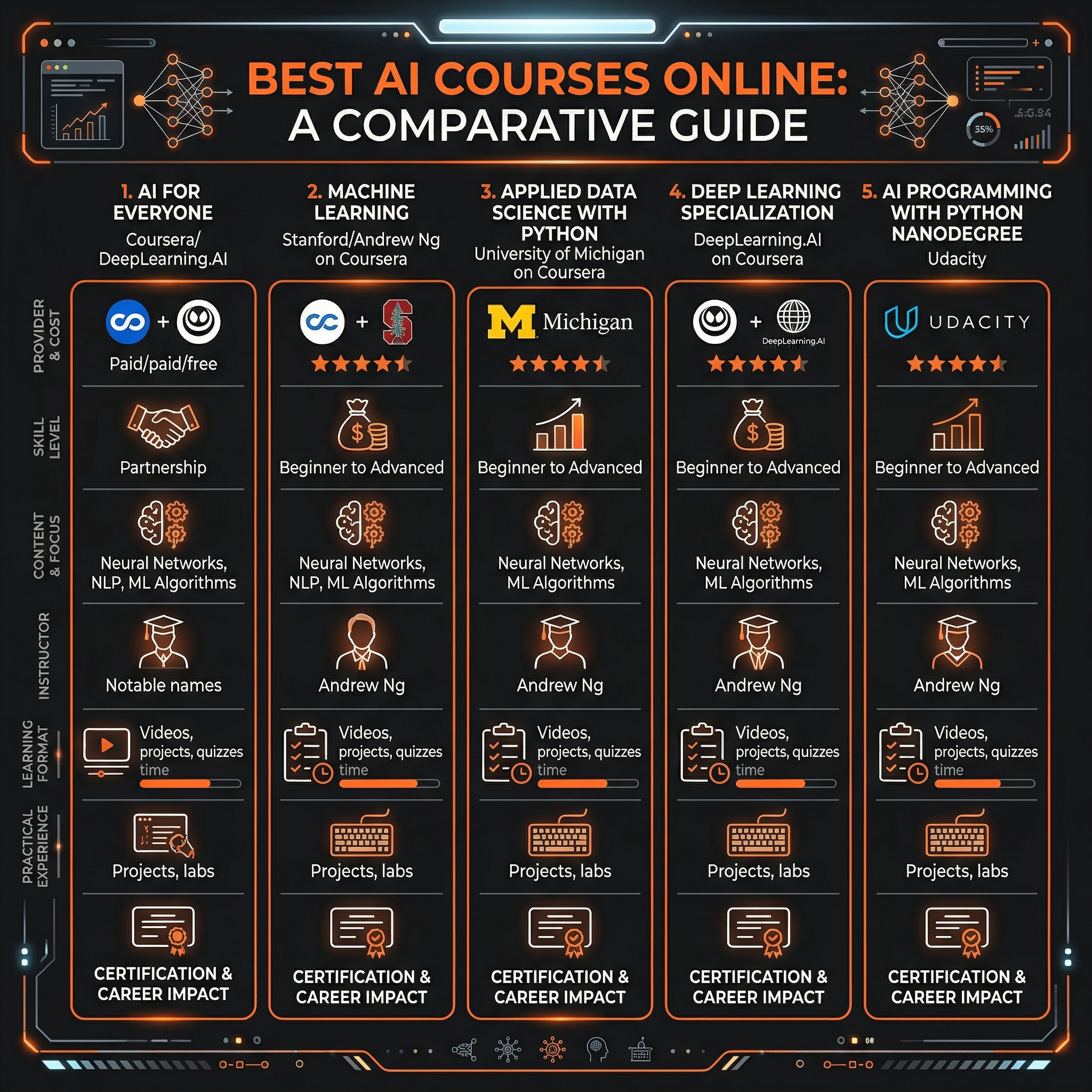
Comparison Table
| Course | Provider | Cost | Duration | Level | Best For |
|---|---|---|---|---|---|
| Practical Deep Learning | fast.ai | Free | 7-10 weeks | Intermediate | Developers, hands-on learners |
| ML Fundamentals | DeepLearning.AI | Free/Freemium | 3-6 weeks | Beginner | Career changers, fundamentals |
| ML Crash Course | Free | 15 hours | Beginner | Structured intro, TensorFlow | |
| NLP with Transformers | Hugging Face | Free | 4-6 weeks | Intermediate | LLM enthusiasts, NLP focus |
| CS 224N (Stanford) | Stanford | Free | 2-3 weeks | Advanced | Researchers, deep understanding |
| Coursera Specializations | Coursera | $39-49/mo | 3-6 months | Varies | Career growth, credentials |
| Udemy Courses | Udemy | $15-100 | Varies | Varies | Budget learners, specific skills |
| LLM Short Courses | DeepLearning.AI | Free/$25-40 | 1-2 hours | Beginner | Current topics, quick upskilling |
| AI for Business | LinkedIn Learning | $30-40/mo | 2-4 hours | Beginner | Non-technical professionals |
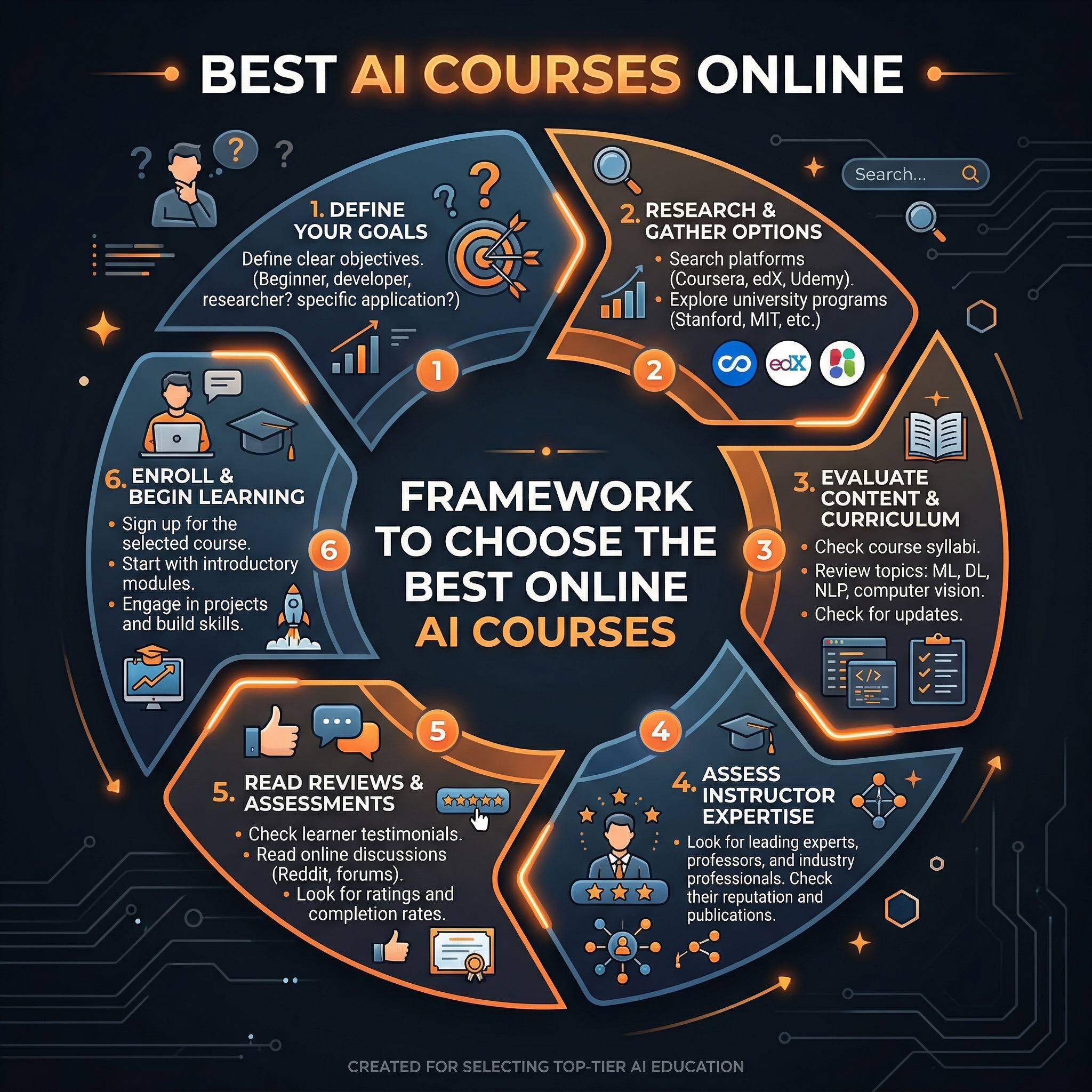
Which Course Is Right for You?
You’re completely new to AI and coding:
Start with Google’s ML Crash Course (free, 15 hours) to build intuition without overwhelming yourself. Follow with AI for Everyone (DeepLearning.AI) if you want more business context, or jump into fast.ai if you’re ready to code.
You’re a software engineer transitioning to AI:
Go straight to fast.ai for practical deep learning. Supplement with Hugging Face NLP course if LLMs interest you. Both are free and assume coding competence.
You want NLP and LLM skills:
Hugging Face NLP course + DeepLearning.AI’s short courses on prompt engineering and LangChain. This combination gives you theory, practice, and current applications. Cost: $0-40. Timeline: 4-8 weeks.
You’re transitioning careers and want credentials:
Coursera’s Machine Learning Specialization (DeepLearning.AI) or AI for Everyone specialization. Yes, you’ll pay, but employers recognize the credential and the structure helps. Timeline: 3-6 months.
You’re a business leader/manager:
AI for Everyone (free audit or $39/month) or LinkedIn Learning AI courses. Focus on understanding applications and implications rather than implementation. Timeline: 2-3 weeks.
You want to stay current with latest developments:
Subscribe to DeepLearning.AI’s short courses and follow their email list. Budget: $20-40/month. Time commitment: 2-4 hours/week.
You want deep, research-level understanding:
Stanford CS 224N (free via YouTube) + fast.ai + academic papers. This is self-directed and requires discipline. Timeline: 3-6 months of serious study.
Learning Tips to Maximize Your Investment
1. Build projects immediately
Don’t passively watch lectures. Recreate examples, then modify them. AI learning requires hands-on work to stick.
2. Combine courses strategically
Use free courses for foundations and specific paid courses for depth. A combination of fast.ai + specific Coursera specialization often beats a single expensive bootcamp.
3. Follow your genuine interest
If you’re bored by natural language processing but excited about computer vision, choose that path. Your interest drives completion and actual learning.
4. Join communities
fast.ai forums, Hugging Face discussions, and AI-focused Discord servers provide accountability and help when stuck. These communities are often more valuable than the course itself.
5. Set concrete goals
“Learn AI” is vague. “Build a chatbot using fine-tuned LLMs” or “Earn a Coursera certificate” gives you direction and measurable progress.
6. Allocate time realistically
If a course claims 20 hours but you need deep understanding, budget 40 hours. Account for experimentation, debugging, and re-reading challenging sections.
7. Supplement with hands-on practice
Complete exercises, but also build something on your own. Implement a project you care about using techniques from your course.
Final Recommendations
Best overall value: fast.ai + DeepLearning.AI short courses
This combination gives you rigorous practical deep learning plus current applications in LLMs, all for free. Cost: $0. Time: 8-12 weeks. You’ll be genuinely skilled.
Best for credentials: Coursera ML Specialization (DeepLearning.AI)
If you need a credential for a job or career transition, this is your choice. Well-structured, recognized by employers, and genuinely teaches fundamental skills. Cost: ~$200-400 total. Time: 4-6 months.
Best for career changers: AI for Everyone + Coursera Specialization
Start with the more accessible AI for Everyone to build intuition (3 weeks, free/paid). Follow with a specialization matching your interest—deep learning, ML engineering, or business applications. Cost: $200-500. Time: 4-6 months.
Best bang for your buck: Google ML Crash Course + Hugging Face NLP
Both free, comprehensive foundations. This combination gives you ML basics plus current NLP expertise. Cost: $0. Time: 6-8 weeks.
Best for staying current: DeepLearning.AI short courses on a subscription
New short courses drop frequently on LLMs, prompt engineering, RAG, and emerging techniques. Budget $20-40/month and spend 2-3 hours weekly. This is your lifeline in a rapidly changing field.
The AI field moves fast. Whatever course you choose, commit to continuous learning beyond it. Pick one from this list based on your goal, complete it thoroughly, and then focus on building real projects. That’s where learning becomes expertise.