Generative AI Impact on Jobs
⏱ 15 min read · Category: Future of Work
In 2026, the conversation around generative AI has shifted from “Will it eliminate jobs?” to “How can workers adapt?” According to Harvard Business Review research, 89% of senior HR leaders expect AI to impact jobs this year. Generative AI is reshaping work—not uniformly destroying it—by automating routine tasks while creating entirely new roles. Understanding this transformation is critical for anyone navigating the modern labor market.
Table of Contents
- How Generative AI Is Changing Work
- Jobs Most Affected by Generative AI
- Industries Experiencing Rapid Shifts
- The Skills Revolution: What Workers Must Learn
- New Job Opportunities in 2026
- Preparing Your Career for AI
- Understanding Task Reallocation vs Job Elimination
- FAQ
- Conclusion
How Generative AI Is Changing Work
Generative AI isn’t just a tool—it’s reshaping the fundamental nature of how work gets done. Rather than creating mass unemployment, research shows AI is reallocating tasks within jobs. Workers who once spent hours on repetitive writing, design, or analysis now focus on strategy and quality control.

The MIT Sloan research on AI’s impact on the labor market reveals a more nuanced picture. Job openings for routine, automation-prone roles fell 13% after ChatGPT’s launch. However, demand for analytical, creative, and strategic positions grew 20% during the same period. This signals a critical shift: routine work is declining, but high-value work is accelerating.
Companies aren’t laying off workers because AI works perfectly. They’re restructuring roles because AI changes what humans need to do. Early evidence suggests task reallocation, not mass replacement, is the dominant pattern through 2025–2026. Workers in 2026 find themselves redefining their roles around higher-value activities that only humans can do well.
The economic research on job displacement shows surprising results. Studies from 2024–2025 find no evidence of immediate economywide labor displacement. Instead, we see early adjustment through task reallocation, quality improvement, and within-firm productivity gains. This means companies are getting more done with existing headcount, not slashing payroll.
Key takeaway: Generative AI eliminates tasks, not necessarily jobs. Workers who adapt gain competitive advantage.
Jobs Most Affected by Generative AI
Certain roles face more direct exposure than others. Entry-level positions in administrative work, customer service, and basic content creation experience the most pressure. According to Goldman Sachs research, unemployment among 20- to 30-year-olds in tech-exposed occupations has risen by almost 3 percentage points since early 2025.
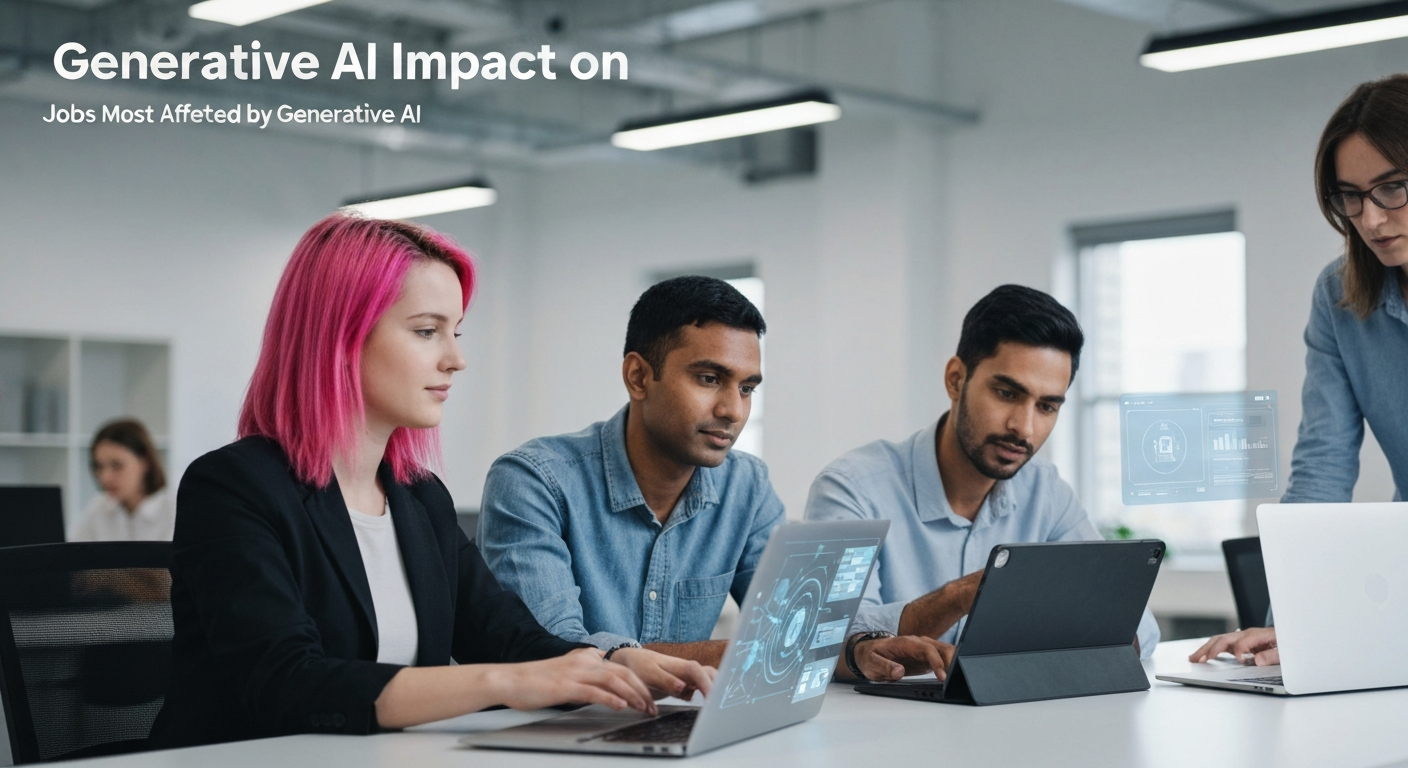
Marketing consulting, graphic design, and office administration are seeing employment growth below historical trend. Call center positions face similar pressures. These roles share a common trait: repetitive, rule-based, digitizable work. Workers in these fields perform tasks that AI can handle reasonably well without much human judgment.
However, within these fields, opportunities exist for workers who adopt AI tools. A marketer who uses ChatGPT and Surfer SEO to optimize content faster delivers more value than a marketer without these skills. A designer using generative AI to explore concepts works more efficiently than one stuck in manual iteration. The gap between AI-capable and non-capable workers is widening rapidly.
The risk of automation varies by demographics. According to International Labour Organization research, the risk of automation affects 4.7% of women in high-exposure roles, compared with 2.4% of men. This disparity matters because it suggests structural vulnerability in specific segments of the workforce.
Roles experiencing specific pressure include:
– Data entry clerks (almost entirely automated)
– Basic customer service representatives (increasingly handled by AI chatbots)
– Junior copywriters (AI-assisted or AI-generated copy is faster)
– Graphic designers (AI design tools accelerate creation)
– Administrative assistants (email, scheduling, document management are AI-native)
Key takeaway: Repetitive, automation-prone roles face pressure. Hybrid roles that combine AI and human judgment thrive.
Industries Experiencing Rapid Shifts
Tech companies, financial services, and digital marketing agencies are leading AI adoption. These sectors are restructuring fastest. Conversely, healthcare, construction, and skilled trades are experiencing slower disruption because AI struggles with physical-world tasks and specialized human judgment.

Gartner predictions suggest 20% of organizations will use AI to flatten organizational structures by 2026, eliminating more than half of middle management positions. This isn’t because AI is suddenly smarter—it’s because agentic AI (multi-step decision-making AI) can handle coordination tasks humans once owned. A project manager who previously spent time assigning tasks, checking status, and reporting results might find an AI agent handling much of that coordination.
Industries with high-touch, regulated work (healthcare, legal, financial advisory) show more resilience. Yet even these sectors are changing: paralegals use AI for document review, medical coders use AI for accuracy, and financial advisors use AI for client insights. These professions don’t disappear; they transform.
Sector-by-sector impact:
Finance & Banking: High AI integration. Loan processing, KYC compliance, fraud detection are increasingly automated. Financial analysts who can use AI for research and analysis stay competitive.
Marketing & Advertising: Fast AI adoption. Content creation, A/B testing, audience segmentation are AI-assisted. Creative directors and strategists still thrive; data entry and routine copywriting roles decline.
Legal Services: Moderate adoption. Document review, contract analysis, legal research accelerate with AI. Senior attorneys remain essential; junior research roles face pressure.
Healthcare: Slower adoption. Clinical judgment cannot be fully automated. Diagnostic support, administrative tasks, and data analysis improve with AI, but human expertise remains irreplaceable.
Manufacturing & Construction: Slowest adoption in professional roles. Physical tasks dominate, limiting AI impact. Engineering roles benefit from AI simulation and analysis.
Key takeaway: Digitizable, routine industries change fastest. Human-intensive, regulated sectors adapt more slowly.
The Skills Revolution: What Workers Must Learn
Workers with AI skills earn 56% more than peers without them, according to recent labor market research. This wage premium reflects scarcity: far fewer workers possess AI skills than the market demands. The skills gap is one of the defining economic facts of 2026.

The most valuable skills aren’t “knowing Python” or “knowing ChatGPT.” Instead, they are:
- Prompt engineering and AI tool mastery: The ability to extract maximum value from generative AI models through well-crafted instructions.
- Critical thinking to verify AI outputs: AI generates confident-sounding information that’s sometimes incorrect. Humans who fact-check and verify AI outputs become gatekeepers of quality.
- Creative problem-solving that AI cannot replicate: Abstract reasoning, novel combinations, and original thinking remain uniquely human.
- Domain expertise combined with AI fluency: The most valuable workers understand their field deeply AND can deploy AI within that field.
- Change management and adaptability: Industries and roles are shifting. Workers who adapt quickly gain resilience.
Employers increasingly expect workers to understand AI’s power and limitations. You need skills to extract maximum value from AI tools while recognizing hallucinations, biases, and failures. One in ten job postings in advanced economies now requires at least one new skill, with IT, management, and professional services seeing the most demand.
The International Labour Organization reports that 85% of employers plan to prioritize workforce upskilling by 2030. Yet an estimated 120 million workers are at medium-term risk because they’re unlikely to receive the reskilling they need. This creates both danger and opportunity: workers who self-educate gain outsized advantage.
Learning AI skills in 2026 is becoming non-negotiable. The question isn’t whether to learn—it’s how quickly you can gain competency. Workers who delay learning will find themselves in increasingly precarious positions.
Key takeaway: AI skills command significant wage premiums. Invest in learning now—the gap between skilled and unskilled workers will widen.
New Job Opportunities in 2026
While some roles contract, new roles emerge. AI prompt engineers, AI trainers, AI ethics specialists, and AI-integration consultants are growing fields. Gartner predicts 40% of enterprise applications will embed AI agents by end of 2026, up from less than 5% in 2025. This acceleration creates immediate demand for people who can design, deploy, and maintain AI systems.
McKinsey research estimates that while 92 million jobs might be eliminated by 2030, 170 million new roles will be created because of AI. The net gain: 78 million jobs. This doesn’t minimize the real challenge—job transitions hurt people in the near term—but it indicates long-term economic growth, not contraction.
What new roles look like in 2026:
AI Operations Specialist: Managing workflows where AI agents handle multi-step processes. These roles coordinate human oversight of agentic AI, ensuring quality and catching failures.
Prompt Engineer: Crafting AI instructions that generate valuable business outcomes. Top prompt engineers at major tech companies earn six-figure salaries in 2026.
AI Trainer: Fine-tuning models with domain-specific data. This role requires deep understanding of both AI and a specific industry.
AI-Human Experience Designer: Optimizing human-AI collaboration. How do you design workflows where humans and AI agents work together effectively? This emerging discipline matters deeply.
Chief AI Officer: Governance and strategy. As AI adoption accelerates, organizations need senior leaders responsible for AI policy, risk, and alignment with business strategy.
AI Ethics Specialist: Ensuring AI systems don’t discriminate or cause harm. As regulation tightens, companies need people who understand ethics and can implement safeguards.
These roles don’t exist in every company yet. But as AI adoption accelerates, demand is accelerating faster than supply. Early adopters of these career paths are finding abundant opportunity.
Key takeaway: New AI-adjacent roles are emerging faster than traditional roles disappear. Early adopters of AI skills gain first-mover advantage.
Preparing Your Career for AI
The most practical preparation involves three concrete actions:
1. Start Using AI Today
Don’t wait for perfection. Use ChatGPT, Gemini, or Claude for real work. Write prompts that generate useful output. Learn the tools’ strengths and limits through hands-on practice. Experiential learning beats theoretical knowledge.
Spend at least 30 minutes per week using generative AI on tasks within your role. Notice what works and what doesn’t. Build intuition about prompt crafting. After one month of daily use, you’ll understand AI capabilities better than 80% of workers.
2. Develop Critical Judgment
AI generates confident-sounding output that’s sometimes wrong. Learn to fact-check, verify, and scrutinize AI results. This human skill—skepticism and verification—is increasingly valuable as AI becomes more persuasive.
When AI generates a statistic, research it. When it claims something factual, verify the source. When it produces content, read it critically. This habit of verification keeps you sharp and catches AI failures before they become problems.
3. Combine AI With Your Domain Expertise
Your deepest advantage isn’t competing with AI directly. It’s combining AI’s capabilities with your specific domain knowledge. A lawyer using AI for document review, a marketer using AI for content creation, a designer using AI for ideation—these combinations create outsized value.
Your domain expertise is your moat against AI displacement. The way to protect and amplify that moat is learning to deploy AI strategically within your field. This creates a powerful combination: human judgment + AI speed = outsized competitive advantage.
Career preparation in 2026 means treating yourself as an AI-first professional. That doesn’t mean becoming a programmer. It means becoming fluent with AI tools in your domain and understanding how to amplify human judgment with AI assistance.
Key takeaway: Don’t fear AI—deploy it strategically in your role. The workers who gain most are those who master human-AI collaboration.
Understanding Task Reallocation vs Job Elimination
A crucial distinction shapes how we should think about AI’s impact: the difference between task elimination and job elimination. Most AI impact falls into the first category, not the second.
When AI handles data entry, the task of data entry disappears. But the job of the person who did data entry doesn’t disappear—it reallocates to other work. That person might spend more time on analysis, client communication, or quality control.
Historical evidence from previous technology revolutions supports this. ATMs replaced bank tellers for the task of cash distribution. Did banking jobs disappear? No—employment in banking remained stable or grew, but teller roles became more consultative. Similar patterns played out with word processors, spreadsheets, and email.
This doesn’t mean transitions are painless. Workers displaced from routine tasks sometimes struggle to transition to new roles. Retraining takes time and effort. Some workers face genuine career disruption.
But the economic data through 2025–2026 suggests broad-based job displacement isn’t occurring. Instead, jobs are evolving. Workers who can evolve with them thrive. Workers who resist change face greater risk.
Key takeaway: AI is changing job content, not eliminating jobs at scale. Understanding this distinction shapes your career strategy.
FAQ
Q: Will generative AI eliminate my job in 2026?
Most likely not in one year. Generative AI eliminates tasks faster than jobs. Workers who adopt AI tools and reskill are more secure than those who resist change. The transition takes years; immediate displacement is less common than gradual role evolution. However, if your role consists almost entirely of routine tasks AI can handle, you face elevated risk.
Q: What skills should I prioritize if I’m worried about AI disruption?
Start with prompt engineering and AI tool literacy. Then combine that with critical thinking and domain expertise. The workers who thrive will be those who see AI as a collaborator, not a competitor. Develop judgment about when AI adds value and when it fails.
Q: Are there industries where AI has minimal impact?
Yes—healthcare, construction, and skilled trades face slower disruption because they require physical presence or specialized human judgment. However, even these fields are incorporating AI at the margins. A surgeon might use AI-assisted diagnostics; a plumber might use AI for estimation and scheduling.
Q: How much salary premium comes with AI skills?
Workers with AI skills earn 56% more than peers without those skills, according to 2026 labor market research. This premium is likely to persist because demand significantly outpaces supply. As more workers gain AI skills, the premium may compress—but early adopters enjoy outsized returns.
Q: What’s the best way to learn AI skills in 2026?
Hands-on practice beats formal education for speed. Use free tools like ChatGPT, Claude, or Gemini. Apply them to real work. Take targeted courses in prompt engineering, AI ethics, or specific tools. The learnAI community offers structured learning paths for professionals transitioning into AI-first roles. Combine formal learning with daily practice.
Q: Will my industry be disrupted by AI?
All industries will be affected by AI. The question is timing and extent. Digitizable industries (marketing, finance, legal services) face faster disruption. Physical-world industries (healthcare, construction, trades) face slower disruption. But even slow-changing industries are being transformed at the margins.
Conclusion
Generative AI is transforming work in 2026, but not uniformly destroying it. Jobs that are routine, digitizable, and logic-based face pressure. Roles that combine human judgment, creativity, and domain expertise gain strength. The real threat isn’t AI itself—it’s falling behind workers who master AI.
The future belongs to AI-first professionals: people who understand AI’s power, recognize its limits, and deploy it strategically within their expertise. Start learning today. Your career in 2026 depends on how you respond to AI, not what AI does to you.
The workers who will look back on 2026 with satisfaction are those who took action now. Don’t wait for AI adoption to become mandatory in your organization. Become an early adopter yourself. Learn the tools, develop judgment, combine AI with your expertise, and position yourself as someone who can work effectively alongside AI systems.
Ready to master AI and future-proof your career? Join the learnAI community → learnAI Skool Community
Sources:
– Research: How AI Is Changing the Labor Market
– How Will AI Affect the Global Workforce?
– AI will impact jobs in 2026, say 89% of HR leaders
– How artificial intelligence impacts the US labor market