Mega Prompt Guide: How to Write the Perfect AI Prompt in 2026
Reading Time: 25 minutes
Introduction
The difference between a mediocre AI response and an exceptional one often comes down to a single thing: how you ask the question. According to recent research, well-structured prompts can improve AI output quality by up to 40%, making the difference between useful insights and wasted time.
The problem is clear: most people still treat AI prompts like casual questions. They write vague requests, leave out critical context, and then wonder why the results disappoint. This approach leaves massive value on the table.
But here’s the promise: master the techniques in this guide, and you’ll unlock AI’s full potential. You’ll get better code, sharper writing, deeper analysis, and more creative solutions—all by learning how to ask the right way.
This comprehensive guide covers everything you need to know about prompt engineering in 2026, from foundational principles to advanced multi-turn workflows. Whether you’re using ChatGPT, Claude, Gemini, or any other large language model, these techniques will transform how you interact with AI.
Table of Contents
- Why Prompt Engineering Matters in 2026
- The Anatomy of a Perfect Prompt
- Technique 1: Chain-of-Thought Prompting
- Technique 2: Few-Shot Prompting
- Technique 3: System Prompts and Persona Assignment
- Technique 4: Tree of Thought and Self-Consistency
- Technique 5: Role-Playing and Character Prompts
- Advanced: Prompt Chaining and Multi-Turn Workflows
- 50 High-Performance Prompt Templates
- Common Prompting Mistakes and How to Fix Them
- FAQ: Prompt Engineering Questions Answered
Why Prompt Engineering Matters in 2026
Prompt engineering has evolved from a nice-to-have skill into a critical competency. In 2026, the models are more powerful than ever, but that power is only accessible if you know how to direct it properly.
The Quality Difference
Consider two scenarios:
Bad prompt: “Write a blog post about AI”
Good prompt: “Write a 1,200-word blog post for marketing managers about AI productivity tools. Include a hook about ROI improvement, organize with 5 subheadings covering use cases, implementation, ROI, challenges, and best practices. Use a professional but conversational tone. Include 3 real statistics with sources. End with a CTA to download a free AI evaluation template.”
The difference in output quality is night and day. The good prompt takes the same model and produces something publishable, strategic, and aligned with actual business needs.
Real-World Impact
- Content teams report 3x faster output cycles with structured prompts
- Software developers save hours per week with well-crafted coding prompts
- Marketing professionals get higher conversion rates with AI-generated copy that follows specific formulas
- Business analysts extract deeper insights from data using perspective-shifting techniques
- Customer support teams resolve issues faster with persona-based response templates
Why Structure Matters More Than Length
One critical insight from 2026 research: structure beats length, every time. A well-organized 200-word prompt with clear formatting will outperform a rambling 1,000-word prompt lacking structure. The models in 2026 have learned to parse structured information more effectively than conversational prose.
Key Takeaway: Prompt engineering is no longer optional—it’s the difference between extracting 20% of an AI model’s potential versus 80%.
The Anatomy of a Perfect Prompt
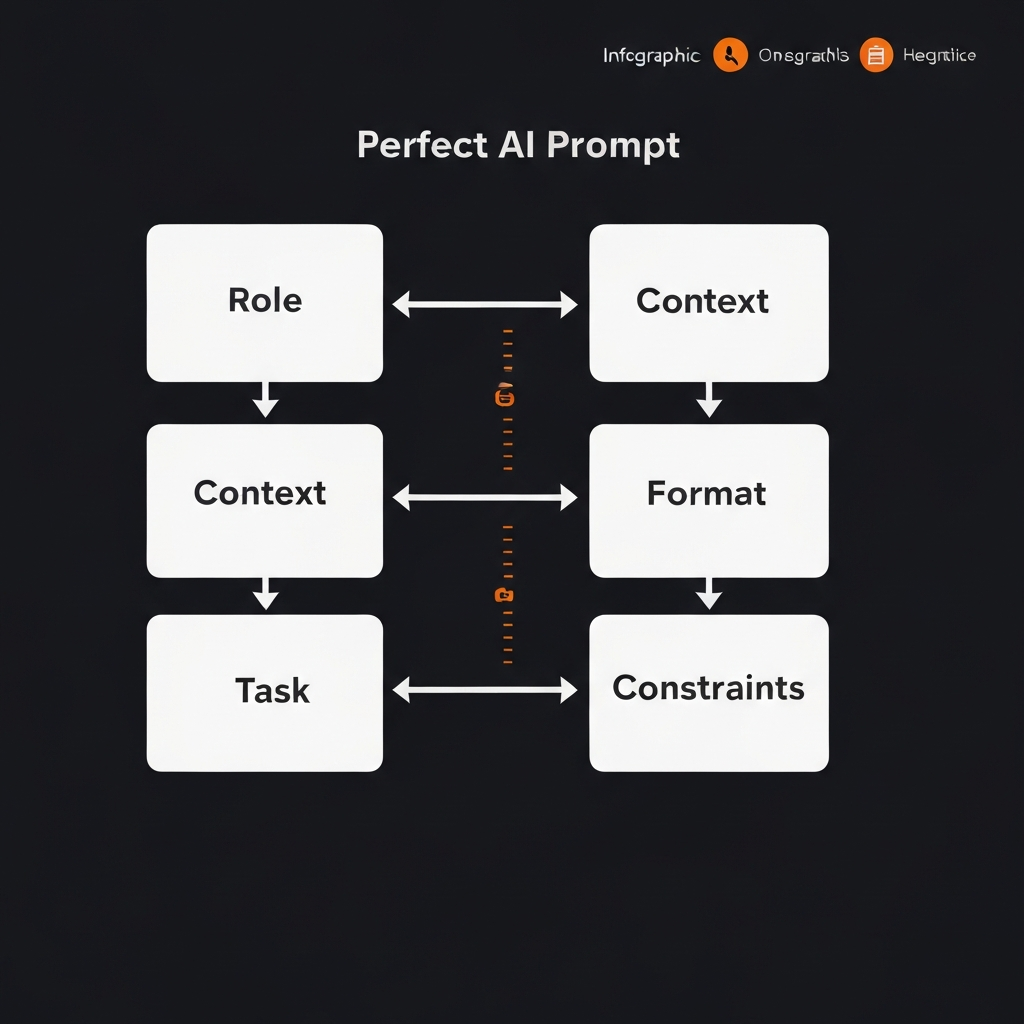
Every high-performing prompt contains five core elements. Understanding and implementing each one dramatically improves your results.
Element 1: Role
Define who the AI should act as. This provides context about the expertise level and perspective the model should adopt.
You are a senior marketing strategist with 15 years of experience in B2B SaaS companies.You are a Python developer specializing in backend systems and database optimization.You are an experienced financial analyst for a venture capital firm evaluating growth companies.The role sets the foundation for how the model approaches the task. A CEO will answer differently than a junior analyst, and specifying the role ensures you get the right perspective.
Element 2: Context
Provide the background information and constraints the model needs to understand the situation.
Context: Our company sells project management software to teams of 5-50 people. We're competing against Asana, Monday.com, and Jira. Our main differentiator is ease of use for non-technical teams. Our typical customer spends $50-200/month.Context prevents generic responses. It anchors the model to your specific situation and helps it make relevant, actionable recommendations.
Element 3: Task
State exactly what you want the model to do. Be specific about the output you need.
Task: Write a value proposition statement for our homepage that emphasizes ease of use and emphasizes how we save project managers 5+ hours per week.Task: Review this Python function and identify any performance bottlenecks. Suggest specific optimizations that would improve runtime by at least 20%.Vague tasks produce vague results. “Help me with marketing” is too broad. “Write a 150-word value proposition” is actionable.
Element 4: Format
Specify exactly how you want the output structured.
Format: Return as a bulleted list with no more than 8 items. Each item should be 1-2 sentences maximum.Format: Return the output as a JSON object with the following structure: {"title": "...", "summary": "...", "keyPoints": [...], "actionItems": [...]}Format: Use markdown formatting with H2 headers for each section. Include 2-3 paragraphs per section.Format specifications prevent the model from overwhelming you with too much text or organizing information in an unhelpful way.
Element 5: Constraints
Set boundaries on what the model should and shouldn’t do.
Constraints: Do not use marketing jargon. Assume the reader has no prior knowledge of our industry. Keep language simple and conversational.Constraints: Stay under 500 words. Focus only on the technical aspects—avoid business strategy. Write in a tone suitable for documentation.Constraints filter out unwanted outputs and guide the model toward your specific needs.
The Complete Structure
Here’s how these five elements come together in a professional prompt:
Role: You are a content strategist specializing in SaaS companies with expertise in conversion optimization.

Context: Our AI writing tool helps content teams write better blog posts 3x faster. We want to attract marketing directors at companies with 20-500 employees. Our competitors are Copy.ai and Jasper. Our primary differentiation is superior AI model quality and better editing interface.

Task: Write a 400-word value proposition that explains why our tool is better for marketing directors than our competitors. Focus on time savings, output quality, and ease of use.

Format: Use a headline (under 10 words), followed by 3 body paragraphs of roughly equal length, ending with a 1-sentence CTA.

Constraints: Use conversational language. No marketing hype or superlatives. Include one specific statistic about time savings. Keep readability at 8th-grade level.
Key Takeaway: Every prompt should contain these five elements. Even one missing element significantly reduces output quality.
Technique 1: Chain-of-Thought Prompting
Chain-of-Thought (CoT) prompting forces the model to show its work. Instead of jumping straight to a conclusion, it breaks reasoning into step-by-step intermediate steps. This technique dramatically improves accuracy for complex reasoning tasks.
How It Works
Chain-of-Thought prompting leverages a simple insight: when you force a model to explain its reasoning process, it makes fewer logical errors. It’s the difference between a student blurting out an answer versus working through a math problem on paper.
Zero-Shot Chain of Thought
The simplest version is zero-shot CoT. You don’t need to provide examples—just ask the model to think step-by-step.
Problem: If you have 12 apples and you eat 3, then buy 8 more, but your friend takes half of what you have, how many apples do you have left?

Please solve this step-by-step.
Without CoT, some models might jump straight to an answer. With the step-by-step instruction, the model produces:
Step 1: Start with 12 apples
Step 2: Eat 3 apples → 12 - 3 = 9 apples remaining
Step 3: Buy 8 more apples → 9 + 8 = 17 apples
Step 4: Friend takes half → 17 ÷ 2 = 8.5 apples

Final answer: 8.5 apples (or you could round to 8 or 9 depending on how you split)
The magic phrase in zero-shot CoT is: “Let’s think step-by-step.”
Few-Shot Chain of Thought
Few-shot CoT includes examples of the reasoning process you want.
Example 1:
Question: A store sells apples at $2 each. If you have $10, how many apples can you buy?
Answer: Let me work through this. I have $10 total. Each apple costs $2. So I can buy 10 ÷ 2 = 5 apples.

Example 2:
Question: If a recipe serves 4 people and uses 2 cups of flour, how much flour do you need for 12 people?
Answer: I need to figure out how to scale the recipe. The recipe is for 4 people. I need it for 12 people. So I need to multiply by 12 ÷ 4 = 3x the ingredients. Original flour is 2 cups, so 2 × 3 = 6 cups of flour.

Now, solve this:
Question: A project takes 5 people and 20 days to complete. If you have only 2 people, how many days will it take?
By showing the model the step-by-step reasoning pattern first, you establish the style and depth you want.
Chain of Thought for Complex Analysis
CoT works exceptionally well for business analysis, strategy decisions, and complex problem-solving.
You are a business analyst evaluating whether to acquire a competitor.

Context: Our company generates $50M in annual revenue. We're considering acquiring a competitor that generates $8M in revenue but has a very loyal customer base. The acquisition price is $120M.

Task: Analyze this acquisition decision step-by-step. Consider financial impact, market position, and risk factors.

Please provide your analysis in the following structure:
Step 1: Calculate the financial metrics (payback period, revenue impact, etc.)
Step 2: Analyze the strategic benefits
Step 3: Identify risks and challenges
Step 4: Provide a recommendation with reasoning
Key Takeaway: Chain-of-Thought prompting improves accuracy for reasoning tasks by forcing the model to show intermediate steps. Use “Let’s think step-by-step” for zero-shot CoT, or provide examples for few-shot CoT.
Technique 2: Few-Shot Prompting
Few-shot prompting provides examples of the input-output pattern you want. Instead of just describing what you want, you show the model what you want.
Why Few-Shot Works Better Than Zero-Shot
Consider a task: extracting key information from customer support tickets.
Zero-shot approach:
Extract the customer issue, sentiment, and urgency from this support ticket:

"Hi team, I can't log into my account. It just keeps saying 'invalid credentials' but I'm sure my password is correct. I need this fixed ASAP as I have a presentation in 2 hours."
The model might extract this correctly, but it might also miss nuances about what constitutes “urgency” or interpret “sentiment” differently than you need.
Few-shot approach:
Here are examples of how to extract information from support tickets:

Example 1:
Ticket: "Your product deleted my spreadsheet! This is unacceptable. I spent 3 days building it."
Extraction:
- Issue: Data loss / file deleted
- Sentiment: Angry
- Urgency: Critical

Example 2:
Ticket: "Just wondering if there's a way to export my data in CSV format?"
Extraction:
- Issue: Feature request / data export
- Sentiment: Neutral
- Urgency: Low

Now extract information from this ticket:
"Hi team, I can't log into my account. It just keeps saying 'invalid credentials' but I'm sure my password is correct. I need this fixed ASAP as I have a presentation in 2 hours."
The few-shot examples establish the exact format, tone, and interpretation you want. The model now knows precisely what “urgency: critical” means because it saw examples.
Few-Shot for Content Generation
Few-shot is particularly effective for content generation, where style, tone, and format matter.
You are a social media expert writing LinkedIn posts for a tech CEO.

Here are examples of posts that performed well:

Example 1:
"After 10 years in this industry, I've learned that good product > good marketing. We spent 6 months perfecting our UI before spending a dime on ads. Best decision we ever made. What matters most in your business? 🔥"
(Stats: 2.3K likes, 180 comments, strong engagement from target audience)

Example 2:
"Hot take: Most 'networking' is a waste of time. But meaningful conversations about real problems? Gold. Had coffee with 3 founders this week. One led to a partnership. The other two became good friends. Quality > quantity, always. ☕"
(Stats: 4.1K likes, 320 comments, attracted high-quality responses)

Now write a LinkedIn post for our CEO about the importance of customer feedback in product development. Keep the same conversational tone, include a hot take or contrarian opinion, and end with a question to drive engagement.
Few-Shot for Code Generation
Few-shot prompts are incredibly powerful for coding tasks.
You are an expert Python developer.

I need you to write functions that follow this pattern:

Example 1 - Function: Calculate average of a list
def calculate_average(numbers):
    """Calculate the average of a list of numbers."""
    return sum(numbers) / len(numbers) if numbers else 0

Example 2 - Function: Check if a string is a palindrome
def is_palindrome(text):
    """Check if a string is a palindrome (ignoring spaces and case)."""
    cleaned = text.lower().replace(" ", "")
    return cleaned == cleaned[::-1]

Now write a function that:
- Name: find_duplicate_numbers
- Description: Takes a list of integers and returns a list of numbers that appear more than once
- Include proper docstring
- Handle edge cases
- Keep the same code style as the examples above
Few-Shot Prompt Template Structure
You are a [ROLE].

Context: [BACKGROUND INFORMATION]

Here are examples of [TASK TYPE]:

Example 1:
[INPUT]
[OUTPUT]

Example 2:
[INPUT]
[OUTPUT]

Example 3:
[INPUT]
[OUTPUT]

Now [PRIMARY TASK]. Follow the pattern from the examples above.
Key Takeaway: Few-shot prompting uses examples to establish the exact pattern, style, and format you want. It’s particularly effective for content generation, data extraction, and code generation—anywhere style matters.
Technique 3: System Prompts and Persona Assignment
System prompts define the behavior and constraints of an AI throughout a multi-turn conversation. They’re different from individual prompts because they persist across multiple messages.
How System Prompts Work
In ChatGPT, Claude, and other modern AI interfaces, system prompts set the foundational instructions that guide all subsequent responses in a conversation. Think of it as giving the AI a job description.
Designing Effective System Prompts
A strong system prompt includes:
- Role/Persona: Who is the AI acting as?
- Behavioral guidelines: What should it prioritize?
- Tone and style: How should it communicate?
- Constraints: What should it avoid?
- Domain expertise: What specific knowledge should it apply?
Example System Prompts by Use Case
For a Customer Support Agent:
You are a helpful, patient customer support representative for a SaaS project management tool. Your goal is to resolve customer issues quickly while maintaining a friendly, professional tone.

Guidelines:
- Always empathize with the customer's frustration first
- Offer 2-3 specific solutions before escalating to a specialist
- If you don't know the answer, be honest and offer to find out
- Use plain language—avoid technical jargon
- End every response with a follow-up question to ensure the issue is resolved

Constraints:
- Do not make promises about features in development
- Do not offer refunds—suggest contacting billing@ourcompany.com
- If the customer is extremely frustrated, offer a personal call with a specialist
For a Content Writer:
You are a professional content writer specializing in B2B SaaS marketing. Your writing is clear, persuasive, and backed by evidence.

Style Guidelines:
- Write in active voice
- Use short sentences and paragraphs (2-3 sentences maximum)
- Include specific statistics and data points where relevant
- Use subheadings to break up long sections
- End with a clear call-to-action

Tone: Professional but conversational, like talking to a knowledgeable colleague

Domain Knowledge:
- You understand SaaS business models, customer acquisition costs, and ROI metrics
- You know the target audience is marketing directors and growth leaders
- You're familiar with our competitors and our differentiation
For a Technical Documentation Writer:
You are a technical documentation expert writing for software developers.

Your goals:
1. Explain complex concepts in the simplest possible terms
2. Provide working code examples for every major concept
3. Anticipate common questions and answer them proactively
4. Use clear formatting with code blocks, bullet points, and examples

Requirements:
- Every concept should have at least one code example
- Use consistent terminology throughout
- Avoid marketing language—focus on technical accuracy
- Include information about dependencies, requirements, and compatibility
Persona Assignment for Role-Playing
Beyond standard system prompts, you can assign specific personas for role-playing scenarios.
You are a venture capitalist evaluating a startup pitch. You have invested in 20+ companies, you're skeptical but fair, and you focus on market size, team quality, and defensibility.

When evaluating pitches:
- Ask tough questions about unit economics
- Push back on overly optimistic market projections
- Praise good market insights and team experience
- Be direct and concise in your feedback

The founder is pitching their company to you. Respond as if you're in a real pitch meeting.
Key Takeaway: System prompts establish persistent behavioral guidelines for multi-turn conversations. They’re essential for maintaining consistency, tone, and expertise across dozens or hundreds of interactions.
Technique 4: Tree of Thought and Self-Consistency
While Chain-of-Thought (CoT) forces step-by-step reasoning, Tree of Thought (ToT) and Self-Consistency techniques go deeper by exploring multiple reasoning paths and evaluating which is strongest.
Tree of Thought Prompting
Tree of Thought prompting asks the model to consider multiple solution paths and evaluate them.
You are a strategic business consultant.

Task: Recommend a go-to-market strategy for a new AI productivity tool targeting marketing teams.

Please approach this by:

1. First, identify 3 different possible go-to-market strategies:
   - Strategy A: [Consider and describe]
   - Strategy B: [Consider and describe]
   - Strategy C: [Consider and describe]

2. For each strategy, evaluate:
   - Pros (3-4 key advantages)
   - Cons (3-4 key challenges)
   - Resource requirements
   - Timeline to market
   - Revenue impact (estimated)

3. Finally, recommend which strategy is best and explain your reasoning

This approach helps you explore multiple possibilities rather than settling on the first idea.
Self-Consistency Prompting
Self-consistency prompting asks the model to solve a problem multiple ways and then synthesize the best answer.
Problem: A coffee shop has regular customers. On Monday, 40% bought coffee. On Tuesday, 60% bought coffee. On Wednesday, 50% of those who bought on Tuesday, plus 20% of those who didn't buy on Tuesday. Estimate the total percentage of the customer base who bought coffee on Wednesday.

Please solve this problem THREE different ways:

Method 1: [Solve using percentages]
Method 2: [Solve using actual customer numbers (assume 100 customers total)]
Method 3: [Solve using a different mathematical approach]

After solving three ways, compare your answers. Which approach seems clearest? What's the most reliable answer?
This technique helps catch errors—if different approaches give different answers, it signals confusion that needs resolution.
Self-Consistency for Complex Analysis
You are a data analyst evaluating whether a marketing campaign was successful.

Context: We spent $50,000 on a Facebook ad campaign. We generated 5,000 new email subscribers. Our conversion rate from email to paying customer is typically 2%. Our average customer lifetime value is $1,200.

Evaluate the campaign's ROI using these three different frameworks:

Framework 1: Direct ROI Calculation
[Calculate: Expected revenue - Campaign cost / Campaign cost]

Framework 2: Attribution Analysis
[Consider: What percentage of these 5,000 subscribers might have come anyway from organic sources?]

Framework 3: Long-term Value
[Consider: Some of these subscribers might convert later. What's the realistic long-term value?]

After analyzing all three frameworks, what's your honest assessment of this campaign?
Key Takeaway: Tree of Thought and Self-Consistency techniques improve complex reasoning by forcing the model to explore multiple solution paths and evaluate their validity.
Technique 5: Role-Playing and Character Prompts
Role-playing prompts ask the AI to fully inhabit a character or role, enabling creative brainstorming, perspective-shifting, and innovative problem-solving.
Perspective-Shifting Through Roles
I'm launching a new online course on AI prompt engineering. I want to understand potential objections from different stakeholder perspectives.

Please respond to this course launch from these five different perspectives:

1. A busy marketing director (skeptical about new tools, focused on ROI)
2. A freelance writer (concerned about job security from AI)
3. An HR manager (concerned about team training costs)
4. A curious entrepreneur (excited but cost-conscious)
5. A technology skeptic (doubts AI quality)

For each role, provide:
- Initial reaction (positive, negative, or neutral)
- Main concern or objection
- What would change their mind
Character-Based Brainstorming
I need to brainstorm creative marketing campaign ideas for a new coffee brand.

Please brainstorm as if you are these three different creative directors:

1. A minimalist designer (focused on simplicity, elegant design, understated marketing)
2. A data-driven marketer (focused on metrics, targeting, measurable results)
3. A rebellious creative (focused on shock value, breaking norms, viral potential)

For each perspective, suggest 3 campaign ideas that fit their style and philosophy.
Expert Interviewing
I'm writing an article about the future of remote work. Interview me as if you are:

1. A Fortune 500 HR executive with 20 years of experience
2. A Gen-Z remote worker who's never worked in an office
3. A real estate developer concerned about office space demand

For each role, ask 3-4 probing questions about remote work, productivity, company culture, and the future of offices. Your tone should match each role's perspective.
Creative Role-Playing
My product is a project management tool for remote teams. Help me pitch it from these perspectives:

Role 1: A slick startup founder (use startup jargon, emphasize disruption, focus on growth)
Role 2: A professional enterprise sales director (emphasize security, compliance, reliability)
Role 3: A frustrated project manager switching from another tool (focus on pain points it solves)

For each role, write a 3-sentence pitch.
Key Takeaway: Role-playing prompts unlock perspective-shifting and creative problem-solving by forcing you to see your situation through different eyes.
Advanced: Prompt Chaining and Multi-Turn Workflows
The most sophisticated prompting technique is prompt chaining—breaking a complex task into multiple sequential prompts where each output becomes the input for the next.
What Is Prompt Chaining?
Prompt chaining works like an assembly line. Instead of asking the model to do everything at once, you feed it tasks sequentially, using each output to inform the next prompt.
Example: Blog Post Creation Workflow
Instead of asking for a complete blog post in one prompt, you chain multiple focused prompts:
Step 1 – Outline Generation:
Create a detailed outline for a blog post with this requirement:
- Topic: How AI is changing marketing in 2026
- Target audience: Marketing directors at B2B SaaS companies
- Length: 2,000 words
- Format: Include 5-6 main sections with 2-3 subsections each

Provide only the outline, with brief descriptions of what each section should cover.
Step 2 – Research Prompting:
Based on this outline: [PASTE OUTLINE FROM STEP 1]

List the 5 most important statistics, case studies, or research findings I should include in this post to make it credible and authoritative. For each one, provide the topic and type of evidence needed.
Step 3 – Section Writing:
Write the introduction section for this blog post about AI and marketing.

Outline: [PASTE RELEVANT SECTION FROM OUTLINE]
Research points to include: [PASTE RELEVANT FINDINGS FROM STEP 2]
Tone: Professional but conversational
Length: 300-400 words
Goal: Hook the reader with the promise that AI will save them 10+ hours per week

Include a statistic about AI adoption in marketing.
Step 4 – Editing and Optimization:
Review this blog post section:

[PASTE CONTENT FROM STEP 3]

Improve it by:
1. Making the language more conversational
2. Adding a subheading that breaks up the text
3. Adding an internal link to [LINK TO OTHER ARTICLE]
4. Ensuring the CTA is clear at the end

Provide the improved version.
Multi-Turn Workflow Pattern
Turn 1 - Request draft:
"Write a cold email to a marketing director at a B2B SaaS company about our AI writing tool."

Turn 2 - Refine based on feedback:
"The email is good but too long. Reduce it to exactly 50 words. Emphasize the time-saving benefit. Include a specific statistic."

Turn 3 - Personalization:
"Now create 3 variations of this email for these different scenarios:
1. Target has an existing AI tool (positioning as better)
2. Target is skeptical about AI (emphasizing safety and quality)
3. Target is a very busy CEO (emphasizing ROI and results)"

Turn 4 - Performance optimization:
"Which variation is most likely to get opened and clicked? Explain your reasoning. Should we A/B test these, or focus on one?"
Data Processing Workflow
For complex data tasks, prompt chaining is incredibly effective:
Step 1: Parse data
"Analyze this customer feedback data and identify the 5 most common themes."

Step 2: Quantify impact
"For each theme, estimate what percentage of customers reported this issue."

Step 3: Prioritize
"Rank these issues by impact (number of customers affected × severity)."

Step 4: Generate recommendations
"For the top 3 issues, recommend specific product changes or improvements."

Step 5: Create action plan
"Create a 30-60-90 day plan to address the top issue, including specific milestones."
Key Takeaway: Prompt chaining breaks complex projects into sequential steps where each output informs the next. This produces better results than trying to do everything in one massive prompt.
50 High-Performance Prompt Templates
Here are 50 battle-tested prompt templates organized by use case. Copy, modify, and use them immediately.
Writing & Content (10 templates)
Template 1 – Blog Post Outline
Create a detailed outline for a blog post:
- Topic: [YOUR TOPIC]
- Target audience: [WHO READS THIS]
- Word count: [TARGET LENGTH]
- Goal: [WHAT SHOULD READER DO/KNOW AFTER READING]

Format the outline with H2 headers, H3 subheaders, and 2-3 sentence descriptions for each section.
Template 2 – Sales Email
Write a cold sales email:
- Target: [TITLE] at [COMPANY TYPE]
- Product: [YOUR PRODUCT]
- Main benefit: [PRIMARY VALUE PROP]
- CTA: [DESIRED ACTION]

Make it under 100 words, personalized, and conversational. Include one specific statistic about ROI or efficiency gains.
Template 3 – Product Description
Write a product description for an e-commerce listing:
- Product: [NAME]
- Target customer: [WHO BUYS THIS]
- Key features: [3-4 MAIN FEATURES]
- Price: $[PRICE]
- Main use case: [PRIMARY PROBLEM IT SOLVES]

Format: 2-3 sentences of hook, then 3 bullet points of key features, then 1-2 sentences about why customers love it.
Template 4 – Social Media Post
Write a social media post for [PLATFORM]:
- Topic: [TOPIC/ANNOUNCEMENT]
- Goal: [GET LIKES/SHARES/COMMENTS/SALES]
- Tone: [CASUAL/PROFESSIONAL/HUMOROUS]
- Hashtags: [YES/NO]

Keep it under [X] characters. Make it scroll-stopping and include a clear CTA.
Template 5 – Video Script
Write a [LENGTH]-second video script:
- Topic: [WHAT'S THE VIDEO ABOUT]
- Goal: [WHAT SHOULD VIEWER DO]
- Tone: [HOW SHOULD IT FEEL]
- Key points: [2-3 THINGS TO COMMUNICATE]

Format: Hook (first 2 seconds), body (main content), CTA (last 10 seconds).
Template 6 – Newsletter Headline
Generate 5 newsletter subject line options:
- Newsletter topic: [MAIN TOPIC]
- Target audience: [WHO READS IT]
- Goal: [OPEN RATE/CLICK-THROUGH/CONVERSIONS]
- Tone: [CASUAL/URGENT/EDUCATIONAL]

For each option, provide the subject line and explain why it would work.
Template 7 – FAQ Section
Create a FAQ section for [PRODUCT/SERVICE]:
- Most common customer questions: [LIST 5-7 QUESTIONS]
- Tone: [PROFESSIONAL/HELPFUL/CASUAL]
- Goal: [REDUCE SUPPORT TICKETS/INCREASE CONFIDENCE]

Format each answer as 2-4 sentences maximum. Include a CTA when appropriate.
Template 8 – Case Study Outline
Create a case study outline:
- Company/Client: [NAME]
- Challenge: [MAIN PROBLEM]
- Solution: [WHAT YOU PROVIDED]
- Results: [METRICS/OUTCOMES]

Structure: Challenge, Solution, Implementation, Results, Key Insights, Future Plans.
Template 9 – Customer Testimonial Extraction
Transform this customer feedback into a compelling testimonial:

[PASTE CUSTOMER FEEDBACK]

Requirements:
- Keep authentic language/tone
- Extract the most compelling insight
- Include the customer's role/title
- Keep under 100 words
- Make it suitable for marketing website
Template 10 – Press Release
Write a press release for:
- News: [WHAT'S THE ANNOUNCEMENT]
- Company: [YOUR COMPANY]
- Key benefit: [WHY CUSTOMERS SHOULD CARE]
- Call-to-action: [WHAT'S NEXT]

Include: Headline, summary paragraph, 2-3 supporting paragraphs, boilerplate about the company.
Business & Strategy (10 templates)
Template 11 – Competitive Analysis
Analyze our competitive position:
- Our product: [NAME]
- Key competitors: [LIST 3-4]
- Our differentiator: [WHAT MAKES US DIFFERENT]
- Target market: [WHO WE SERVE]

Provide: Strengths vs competitors, weaknesses vs competitors, market opportunity, recommendation.
Template 12 – Customer Persona Development
Create a detailed customer persona:
- Industry: [INDUSTRY]
- Role: [JOB TITLE]
- Company size: [EMPLOYEE COUNT]
- Annual salary: $[RANGE]
- Main pain points: [3-5 KEY PROBLEMS]

Include: Background, goals, challenges, objections, what success looks like, communication preferences.
Template 13 – Pricing Strategy
Recommend a pricing strategy:
- Product: [PRODUCT NAME]
- Target customer: [CUSTOMER TYPE]
- Production cost: $[COST]
- Market positioning: [PREMIUM/MID-MARKET/BUDGET]
- Competitors' pricing: $[RANGE]

Provide: Recommended price, pricing model (subscription/one-time/freemium), justification.
Template 14 – Market Entry Analysis
Analyze entering this market:
- Market: [MARKET NAME]
- Our product: [PRODUCT NAME]
- Target countries/regions: [WHERE]
- Barriers to entry: [KNOWN CHALLENGES]

Evaluate: Market size, growth rate, customer acquisition strategy, competitive threats, 12-month action plan.
Template 15 – Business Model Canvas
Fill out a Business Model Canvas for [COMPANY/PRODUCT]:

Structure:
- Value Propositions
- Customer Segments
- Channels
- Customer Relationships
- Revenue Streams
- Key Resources
- Key Activities
- Key Partnerships
- Cost Structure

Provide a 1-2 sentence description for each element.
Template 16 – Decision-Making Framework
Help me make this decision: [DECISION TO MAKE]

Analyze using these frameworks:
1. Pros and cons analysis
2. Impact vs effort matrix (high impact/low effort wins)
3. Risk assessment
4. Financial analysis (ROI, payback period)
5. Strategic alignment with our goals

Provide a clear recommendation with reasoning.
Template 17 – OKR Definition
Create OKRs (Objectives and Key Results) for [DEPARTMENT/TEAM]:

Time period: [QUARTER/YEAR]
Main goal: [OVERALL OBJECTIVE]

For each objective, provide:
- Objective: [WHAT WE WANT TO ACHIEVE]
- Key Results: [3-4 MEASURABLE OUTCOMES]
- Owner: [WHO'S RESPONSIBLE]
- Timeline: [DEADLINE]
Template 18 – Risk Assessment
Assess risks for: [PROJECT/INITIATIVE]

Identify the top 10 risks considering:
- Technical risks
- Market risks
- Financial risks
- Operational risks
- Competitive risks

For each risk, provide: Description, probability (high/medium/low), impact (high/medium/low), mitigation strategy.
Template 19 – Expansion Strategy
Recommend an expansion strategy:
- Current market: [CURRENT FOCUS]
- Proposed expansion: [NEW MARKET/PRODUCT]
- Current revenue: $[ANNUAL]
- Resources available: [BUDGET/TEAM SIZE]

Provide: Market opportunity assessment, competitive landscape, required resources, 18-month roadmap, risks.
Template 20 – Stakeholder Communication Plan
Create a communication plan for: [PROJECT/CHANGE]

Key stakeholders:
- [STAKEHOLDER 1]
- [STAKEHOLDER 2]
- [STAKEHOLDER 3]

For each stakeholder, provide:
- What they care about
- Communication frequency
- Key message
- Success metrics
Marketing & Sales (10 templates)
Template 21 – Campaign Brief
Create a marketing campaign brief for: [CAMPAIGN NAME]

Campaign objective: [WHAT DO WE WANT]
Target audience: [WHO ARE WE REACHING]
Main message: [CORE IDEA]
Budget: $[AMOUNT]
Timeline: [START - END DATE]

Include: Key messages, channels, creative assets needed, success metrics, timeline.
Template 22 – Value Proposition Statement
Write a value proposition for: [PRODUCT]

- Target customer: [WHO]
- Main pain point: [PROBLEM]
- Solution: [HOW YOU SOLVE IT]
- Differentiation: [WHY YOU'RE DIFFERENT]
- Proof point: [STATISTIC/CASE STUDY]

Create a 1-sentence, 1-paragraph, and 1-page version.
Template 23 – Messaging Framework
Develop messaging for: [PRODUCT/SERVICE]

Create messaging for these audiences:
1. [AUDIENCE TYPE 1]
2. [AUDIENCE TYPE 2]
3. [AUDIENCE TYPE 3]

For each audience, provide:
- Core message (1 sentence)
- 3 supporting messages
- Tone and language style
- Key proof points
Template 24 – Sales Objection Handler
Create responses to these sales objections:
- Objection 1: [CUSTOMER SAYS THIS]
- Objection 2: [CUSTOMER SAYS THIS]
- Objection 3: [CUSTOMER SAYS THIS]

For each objection:
- Acknowledge their concern (empathy)
- Address the concern (logic)
- Reframe positively
- Propose next step
Template 25 – Content Calendar
Create a content calendar for: [CHANNEL]

Time period: [MONTH]
Publishing frequency: [POSTS PER WEEK]
Topics: [YOUR CONTENT TOPICS]
Goal: [AWARENESS/ENGAGEMENT/SALES]

Provide: Week-by-week content ideas with topics, formats, and CTAs.
Template 26 – Influencer Outreach
Create an influencer outreach email:
- Influencer type: [WHO/SIZE]
- Our product: [PRODUCT NAME]
- Collaboration type: [SPONSORSHIP/PARTNERSHIP/REVIEW]
- Budget: $[AMOUNT]

Write: Personalized subject line, hook (why it matters to them), value prop, CTA, and signature.
Template 27 – Partnership Proposal
Write a partnership proposal for: [POTENTIAL PARTNER]

- Partnership type: [AFFILIATE/INTEGRATION/CO-MARKETING]
- Our product: [PRODUCT NAME]
- Their product: [THEIR PRODUCT NAME]
- Target audience: [WHO BENEFITS]

Provide: Executive summary, why partnership makes sense, mutual benefits, proposed terms, timeline.
Template 28 – Lead Scoring Model
Create a lead scoring model for: [PRODUCT/SERVICE]

Scoring factors:
- Company fit: [CRITERIA]
- Contact fit: [CRITERIA]
- Engagement: [CRITERIA]
- Timeline: [CRITERIA]

For each factor, assign point values and explain the scoring logic. Determine the threshold for "sales-ready" lead.
Template 29 – Customer Retention Strategy
Create a retention strategy for: [PRODUCT/SERVICE]

Current churn rate: [PERCENTAGE]
Main churn reason: [WHY CUSTOMERS LEAVE]
Retention goal: [TARGET]

Provide:
- Early warning signals of at-risk customers
- Proactive retention tactics (by customer stage)
- Win-back strategy for churned customers
- Loyalty/expansion tactics for happy customers
Template 30 – Demand Generation Plan
Create a demand generation plan for: [PRODUCT/LAUNCH]

Target audience: [WHO]
Time period: [3-6 MONTHS]
Budget: $[AMOUNT]
Goal: [# OF LEADS/OPPORTUNITIES]

Channels: [LIST CHANNELS]

For each channel: Tactics, expected cost per lead, timeline, success metrics.
Product & Development (10 templates)
Template 31 – Feature Request Analysis
Analyze this feature request:
- Feature: [WHAT]
- Requested by: [WHO]
- Problem it solves: [WHY]
- Affected users: [HOW MANY]

Provide: Customer impact (high/medium/low), development effort (high/medium/low), strategic fit (yes/no/maybe), recommendation.
Template 32 – Product Roadmap
Create a product roadmap for: [PRODUCT]

Time horizons: Q2 2026, Q3 2026, Q4 2026

For each quarter, provide:
- Main focus area
- Key features/improvements
- Success metrics
- Customer value
- Dependencies
Template 33 – API Documentation
Create API documentation for: [ENDPOINT NAME]

- Method: [GET/POST/PUT]
- Endpoint: [/api/...]
- Purpose: [WHAT IT DOES]
- Required parameters: [LIST]
- Response format: [JSON STRUCTURE]

Include: Description, example request, example response, error codes, rate limits.
Template 34 – Bug Report Analysis
Analyze this bug report:
[PASTE BUG REPORT]

Provide:
- Severity (critical/high/medium/low)
- Affected features
- Likely cause
- Reproduction steps
- Recommended fix priority
- Proposed solution
Template 35 – Tech Stack Recommendation
Recommend a tech stack for: [PROJECT]

Requirements:
- Scalability: [EXPECTED USERS]
- Performance: [REQUIREMENTS]
- Timeline: [LAUNCH DATE]
- Team size: [DEVELOPERS]

Provide: Recommended technologies, rationale for each choice, pros/cons of the stack, implementation timeline.
Template 36 – Database Schema Design
Design a database schema for: [APPLICATION]

Main entities:
- [ENTITY 1]
- [ENTITY 2]
- [ENTITY 3]

Create: Entity relationship diagram (in text format), table definitions with columns and types, relationships and foreign keys, example queries.
Template 37 – Performance Optimization
Optimize this code/system:
[PASTE CODE OR DESCRIBE SYSTEM]

Analysis:
- Current performance: [METRICS]
- Bottleneck: [WHERE'S IT SLOW]
- Goal: [DESIRED PERFORMANCE]

Provide: Root cause analysis, specific optimizations, implementation difficulty, expected performance improvement.
Template 38 – Security Audit
Audit security for: [SYSTEM/APPLICATION]

Focus areas:
- Authentication
- Data encryption
- API security
- User permissions
- Vulnerability risks

Provide: Key vulnerabilities identified, risk level (critical/high/medium/low), recommended fixes, timeline.
Template 39 – User Testing Plan
Create a user testing plan for: [FEATURE]

Objectives: [WHAT DO YOU WANT TO LEARN]
Target users: [WHO TO TEST WITH]
Timeline: [WHEN]

Provide: Test scenarios, success metrics, sample questions, sample size, analysis approach.
Template 40 – Migration Plan
Create a migration plan from [OLD SYSTEM] to [NEW SYSTEM]:

Current state: [CURRENT SETUP]
Desired state: [NEW SETUP]
Timeline: [WHEN TO COMPLETE]

Provide:
- Pre-migration tasks
- Step-by-step migration process
- Rollback plan (if something goes wrong)
- Post-migration validation
- Communication plan
Data & Analysis (10 templates)
Template 41 – Data Analysis Request
Analyze this dataset:
[DESCRIBE THE DATA]

Analysis questions:
1. [QUESTION 1]
2. [QUESTION 2]
3. [QUESTION 3]

Provide: Key findings, trends, anomalies, visualizations (described in text), actionable recommendations.
Template 42 – Dashboard Specification
Design a dashboard for: [PURPOSE]

Audience: [WHO USES IT]
Key metrics: [WHAT TO TRACK]
Update frequency: [HOW OFTEN]
Goal: [WHAT DECISIONS DOES THIS SUPPORT]

Provide: Recommended metrics, visualization types, layout, drill-down capabilities, alerts.
Template 43 – Cohort Analysis
Perform a cohort analysis:
- Cohort grouping: [HOW TO GROUP USERS]
- Time period: [DATE RANGE]
- Metrics to track: [WHAT TO MEASURE]

Provide: Cohort breakdown, trends over time, what each cohort tells us, actionable insights.
Template 44 – Funnel Analysis
Analyze this funnel:
- Stage 1: [FIRST STAGE] - [# USERS]
- Stage 2: [SECOND STAGE] - [# USERS]
- Stage 3: [THIRD STAGE] - [# USERS]

Provide:
- Conversion rates between stages
- Drop-off analysis (where people leave)
- Bottleneck identification
- Optimization recommendations
Template 45 – Correlation Analysis
Analyze the correlation between:
- Variable A: [VARIABLE]
- Variable B: [VARIABLE]
- Dataset: [SIZE/CHARACTERISTICS]

Provide:
- Correlation strength
- Direction (positive/negative)
- Potential causes
- Limitations/confounding factors
- Next steps for investigation
Template 46 – Experiment Design
Design an A/B test for: [HYPOTHESIS]

Hypothesis: [WHAT DO YOU EXPECT TO HAPPEN]
Control: [CURRENT EXPERIENCE]
Variant: [PROPOSED CHANGE]
Expected impact: [% IMPROVEMENT]

Provide:
- Sample size needed
- Test duration
- Success metrics
- Statistical significance threshold
- Analysis plan
Template 47 – Attribution Model
Design an attribution model for: [REVENUE/CONVERSIONS]

Touchpoints in customer journey:
- [CHANNEL 1]
- [CHANNEL 2]
- [CHANNEL 3]

Provide:
- Recommended attribution model (first-touch/last-touch/linear/custom)
- Rationale
- Implementation approach
- Metrics to track
- Regular review process
Template 48 – Key Metrics Definition
Define KPIs for: [DEPARTMENT/PRODUCT]

Business goal: [WHAT WE WANT TO ACHIEVE]
Time period: [MEASUREMENT WINDOW]

For each KPI:
- Name and definition
- How it's calculated
- Target/goal
- Current state
- Owner
- Review frequency
Template 49 – Forecasting Model
Create a forecast for: [METRIC]

Historical data: [TIME PERIOD AND TREND]
Assumptions: [KEY FACTORS AFFECTING FORECAST]
Time horizon: [FORECAST LENGTH]

Provide:
- Forecasted values
- Confidence intervals
- Key assumptions and sensitivities
- Risks to forecast
- Update frequency
Template 50 – Reporting Framework
Create a reporting framework for: [STAKEHOLDER]

Stakeholder: [WHO GETS THE REPORT]
Frequency: [HOW OFTEN]
Decision focus: [WHAT DECISIONS DO THEY MAKE]

Provide:
- Key metrics to include
- Report structure
- Visualization recommendations
- Cadence (daily/weekly/monthly)
- Escalation triggers
Common Prompting Mistakes and How to Fix Them
Even experienced prompt engineers make these mistakes. Here’s how to identify and fix them.
Mistake 1: Vague Task Definition
Wrong: “Write me something about AI”
Problem: The model doesn’t know length, tone, format, or audience. Results are likely generic and unusable.
Fix: “Write a 300-word email to a busy CFO explaining how AI can reduce accounting department costs by 30%. Include one specific statistic. Use a professional tone. Start with a hook about time savings, and end with a CTA to schedule a 15-minute demo.”
Mistake 2: Missing Context
Wrong: “Analyze this customer complaint and suggest a response.”
Problem: The model doesn’t know your company, the product, the customer’s value, or your service standards.
Fix: “We’re a $10M SaaS company with a 2% churn rate. This is a 3-year customer who spends $5K/year. Analyze this complaint, consider their value to us, and suggest a response that retains them. [COMPLAINT DETAIL]”
Mistake 3: No Output Format Specification
Wrong: “Give me ideas for our marketing campaign.”
Problem: You might get a paragraph, a list, a table, or scattered ideas. You won’t know until you see it.
Fix: “Give me 5 marketing campaign ideas in bullet-point format. For each idea, provide: Campaign name, target audience, main message, estimated cost, expected ROI.”
Mistake 4: Forgetting Constraints
Wrong: “Write a product description.”
Problem: The description might be too long, too technical, include claims you can’t make, or miss key differentiators.
Fix: “Write a product description under 200 words. Avoid technical jargon—assume the reader is non-technical. Include: What it does, who it’s for, why it’s different, one statistic about results. Tone: friendly and authoritative.”
Mistake 5: Asking Multiple Things at Once
Wrong: “Brainstorm campaign ideas, write copy for one, and design the visuals.”
Problem: The model tries to do too much and does each part superficially.
Fix: Break into three separate prompts:
1. “Brainstorm 10 marketing campaign ideas. For each: name, target audience, main message.”
2. “For idea #5 [PASTE IDEA], write a 150-word copy draft.”
3. “Design a visual concept for [CAMPAIGN]. Describe the visual elements, color scheme, and imagery style.”
Mistake 6: Ignoring Model Personality
Wrong: Using the same prompt structure for GPT-4o, Claude, and Gemini
Problem: Each model has different strengths. GPT-4o excels at creative writing, Claude at structured analysis, Gemini at speed and efficiency.
Fix: Tailor prompts:
– For Claude: Use XML tags for structure (e.g., <task>...</task>)
– For GPT-4o: Use clear conversational formatting
– For Gemini: Keep prompts concise and direct
Mistake 7: Not Providing Enough Examples
Wrong: “Write in the style of our brand.”
Problem: The model doesn’t know your brand’s actual voice.
Fix: “Write in the style of [YOUR BRAND]. Here are three examples of our writing: [EXAMPLE 1], [EXAMPLE 2], [EXAMPLE 3]. Now write [YOUR REQUEST].”
Mistake 8: Asking for Content You Can’t Use
Wrong: “Write product copy for a feature that doesn’t exist yet.”
Problem: You get content you can’t publish, or you accidentally publish false claims.
Fix: “We’re planning a feature. Here’s what we think it will do: [DESCRIPTION]. Write copy assuming this launches June 1. We’ll update it once the feature is finalized.”
Mistake 9: Inconsistent Prompting
Wrong: Asking the same task 5 different ways and expecting identical results
Problem: Slight wording changes produce different results. You don’t know which approach is best.
Fix: Standardize your prompts. Once you find a structure that works, use it consistently and only adjust specific parameters.
Mistake 10: Not Iterating
Wrong: Accepting the first output and moving on
Problem: You might get 80% of what you need with 1 iteration away from perfect output.
Fix: Always do 1-2 refinement rounds: “Good start. The tone is off—make it more conversational. Also, shorten the intro by half.”
Key Takeaway: Most prompting mistakes come from vagueness. The more specific you are about context, task, format, and constraints, the better your results.
FAQ: Prompt Engineering Questions Answered
Q1: Should I use different prompting strategies for different models?
A: Yes. Different models have different strengths and processing styles. According to 2026 research, Claude performs best with XML-based structure, GPT-4o excels at creative tasks with conversational prompts, and Gemini prefers concise, direct instructions.
For the same task:
Claude: Use XML tags
<role>You are a data analyst</role>
<task>Analyze this dataset and find anomalies</task>

GPT-4o: Use conversational structure
You're a data analyst. Analyze this dataset for anomalies. What stands out?

Gemini: Keep it direct and concise
Analyze this data. Find and list any anomalies with severity ratings.
Q2: How many examples do I need for few-shot prompting?
A: Generally, 2-4 examples work well. One is insufficient (the model might miss the pattern), while more than 5 provides diminishing returns. The sweet spot for most tasks is 3 examples—enough to establish a clear pattern without overwhelming the model’s context window.
For complex tasks with very specific formatting requirements, 4-5 examples work better. For simple tasks, even 1-2 well-chosen examples suffice.
Q3: Can I reuse the same system prompt across different conversations?
A: Absolutely. System prompts are designed for reuse. If you’ve crafted an excellent customer support system prompt, use it consistently across all support conversations. The model will maintain consistency in tone, approach, and constraints.
However, periodically review and update your system prompts. As your product evolves, your system prompt should too.
Q4: What’s the optimal prompt length?
A: There’s no perfect length—it depends on task complexity. Research shows:
- Simple tasks (100-200 words): Short, clear prompts work best
- Medium complexity (200-500 words): Add context and examples
- High complexity (500+ words): Use prompt chaining instead of one massive prompt
Generally, if your prompt exceeds 1,000 words, consider breaking it into multiple sequential prompts. Long prompts aren’t inherently better—structure matters more than length.
Q5: How do I know if my prompt is good?
A: Evaluate prompts on three dimensions:
- Clarity: Did the model understand what you wanted?
- Quality: Is the output useful without extensive editing?
- Consistency: Do you get similar quality results when you run the prompt again?
A good prompt produces output that requires minimal editing—maybe 10-20% revisions, not 50%+ rewrites. If you’re heavily editing every output, your prompt needs refinement.
Conclusion
You now have everything you need to master prompt engineering in 2026. You understand the five essential elements of effective prompts, you know advanced techniques like Chain-of-Thought and Few-Shot prompting, and you have 50 battle-tested templates for nearly any task.
The final insight: prompt engineering isn’t magic—it’s a systematic skill. The better your inputs, the better your outputs. By being clear about context, task, format, and constraints, you unlock the full potential of modern AI.
Start with the foundational techniques in this guide. Refine your prompts through iteration. Document what works. Share successful prompts with your team. Over time, you’ll develop the intuition to craft exceptional prompts automatically.
Your next step: Pick one technique from this guide and practice it today. Try Chain-of-Thought on a complex problem. Experiment with Few-Shot on a task you do regularly. The best way to master prompt engineering is to start using these techniques immediately.
Ready to unlock AI’s full potential? Enroll in our comprehensive prompt engineering course at learnai.sk/goto/skool/learnai to go deeper into advanced techniques, work through real-world projects, and join a community of prompt engineering experts.
Sources
Key research and guides referenced in this article:
- Prompt Engineering Guide – promptingguide.ai
- OpenAI Prompt Engineering Best Practices (2026)
- The Ultimate Guide to Prompt Engineering 2026 – Lakera
- Claude Prompt Engineering Best Practices (2026)
- Prompt Engineering for AI – Google Cloud
- How to Write ChatGPT Prompts: Your 2026 Guide – Coursera
- Chain of Thought Prompting – Codecademy
- Chain-of-Thought Prompting Guide – Prompt Engineering Guide
- Best AI Prompts in 2026 – 75 Tested Templates
- Best ChatGPT Prompt Templates for 2026