In the fast-paced digital landscape of 2026, the question is no longer “Will AI change my life?” but “How well am I steering the AI that already runs it?” We have moved past the initial hype of generative models into an era of Agentic AI—systems that don’t just talk, but act.
Whether you are looking to future-proof your career, scale a business, or simply remain relevant in a world driven by algorithmic decision-making, learning AI is essential in 2026. This guide breaks down the shift from AI awareness to AI mastery, providing you with a roadmap to thrive in the automated economy.
1. The 2026 Job Market: Why AI Literacy is the New “Computer Literacy”
In the 1990s, “knowing how to use a computer” was a competitive advantage. By 2010, it was a baseline requirement. In 2026, AI literacy has reached that same critical threshold. Employers are no longer looking for “AI prompt engineers” as a niche role; they are looking for accountants, marketers, and teachers who use AI to do 10x the work in half the time.
The Shift from Generative to Agentic AI
In 2023, we asked AI to write an email. In 2026, we task AI Agents to “Manage the Q3 marketing budget, optimize ad spend across five platforms, and report back with the ROI.”
- The Skills Gap: Those who cannot manage these agents are becoming bottlenecks in their organizations.
- Salary Premiums: Data shows that professionals with verified AI workflow skills command 35% higher salaries than those without.
Internal Link Suggestion: [Link to your “Future of Work” category or a post about “Top 10 AI Tools for 2026”]
2. Productivity Redefined: Mastering the AI-Human Workflow
Productivity in 2026 isn’t about typing faster; it’s about orchestration.$

Hyper-Personalized Productivity
By 2026, the concept of “One size fits all” software is dead. Learning AI allows you to build custom GPT-Agents or Local LLMs that know your specific writing style, your company’s data, and your personal preferences.
- Automation of Mundane Tasks: Data entry, scheduling, and basic research are now 100% automated for those who know how to set up the pipelines.
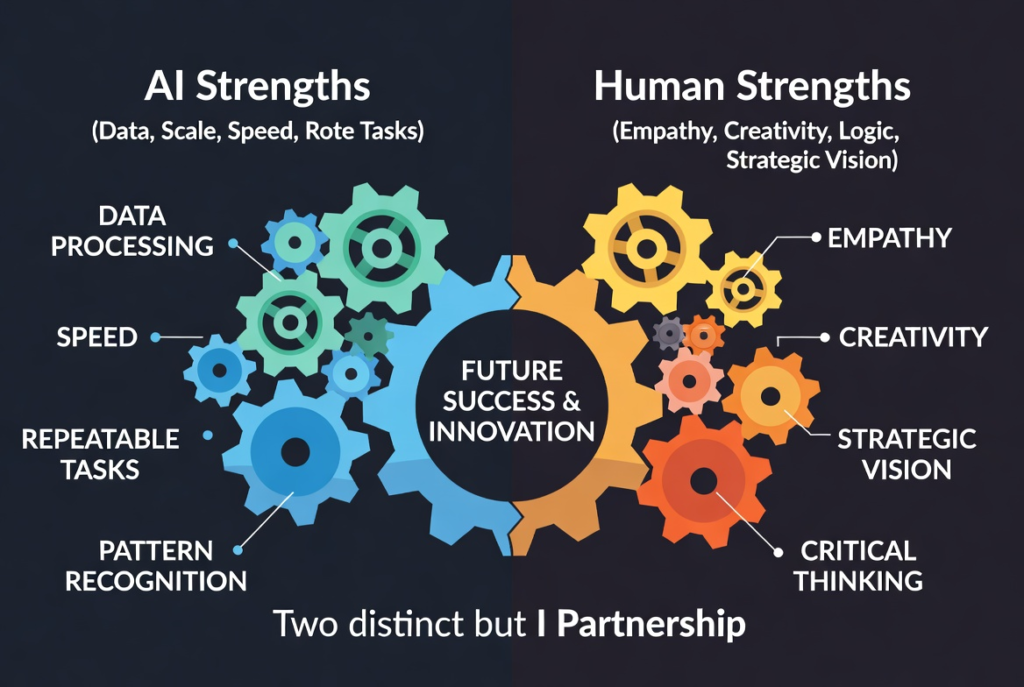
- Focus on High-Value Creativity: By offloading the “doing” to AI, humans are free to focus on the “deciding.”
3. The Democratization of Expertise: Coding, Designing, and Analyzing for Everyone
One of the most essential reasons to learn AI in 2026 is the breakdown of traditional skill barriers.
Natural Language as the New Coding Language
You no longer need to spend four years learning Python to build an app. In 2026, Natural Language Programming allows anyone to describe a solution and watch the AI build the architecture.
- Case Study: An entrepreneur with zero technical background launching a SaaS platform in a weekend using AI-driven No-Code tools.
- Visual Content: Using text-to-video tools (like Veo or Sora descendants) to create Hollywood-quality marketing materials for a fraction of the cost.
4. Why Small Businesses Must Adopt AI to Survive
For small and medium enterprises (SMEs), 2026 is the year of “Adapt or Disappear.” Large corporations have already integrated AI into their supply chains. For a small business, learning AI is the only way to level the playing field.
Competitive Advantages for SMEs:
- 24/7 Customer Service: AI avatars that provide empathetic, accurate support in 50+ languages.
- Predictive Analytics: Knowing what your customers want before they do, based on local data trends.
- Cost Reduction: Replacing expensive agency retainers with in-house AI-augmented teams.
5. Security, Ethics, and the “Human Guardrail”
As AI becomes more powerful, the risks of Deepfakes, AI-driven phishing, and algorithmic bias increase. Learning AI is essential for your personal and professional safety.
Becoming an AI Auditor
In 2026, one of the most valuable skills is being able to “fact-check” an AI.
- Hallucination Management: Knowing when an AI is confident but wrong.
- Ethics & Privacy: Understanding how to use “Local AI” (on-device) to protect sensitive company data from leaking into public training sets.

6. Practical Roadmap: How to Start Learning AI in 2026
If you’re starting today, don’t try to learn everything. Follow this tiered approach:
Phase 1: Foundations (Month 1)
- Understand the difference between LLMs (Large Language Models) and LMMs (Large Multimodal Models).
- Master Advanced Prompting (Chain-of-Thought, Few-Shot, and System Instructions).
Phase 2: Tool Integration (Month 2-3)
- Learn to use AI in your specific niche (e.g., AI for Legal, AI for Healthcare, AI for Marketing).
- Explore AI-Enhanced Hardware (AI PCs and wearable AI).
Phase 3: Agent Orchestration (Month 4+)
- Learn to connect tools via Zapier, Make.com, or AutoGPT frameworks to create autonomous workflows.
7. FAQ: Common Questions About Learning AI in 2026
Q: Is it too late to start learning AI in 2026? A: Absolutely not. We are still in the early stages of the “Agentic Era.” Starting now puts you ahead of 80% of the population who are only using AI superficially.
Q: Do I need a math or coding background? A: No. In 2026, the most important skill is Logic and Communication. If you can explain a task clearly to a human, you can explain it to an AI.
Q: Which AI tools should I learn first? A: Focus on the “Big Three” ecosystems: Google Gemini (for integration with Docs/Gmail), OpenAI (for versatile reasoning), and Anthropic (for long-form technical tasks).
8. Conclusion: The Best Investment of 2026
The “AI Revolution” isn’t a single event; it’s a permanent shift in how reality is processed. Those who embrace AI literacy in 2026 will find themselves with more time, more wealth, and more creative freedom. Those who wait will find the gap increasingly difficult to bridge.
The future belongs to the curious.
Ready to dominate the AI era? Join our learnAI.skool Community. We provide hands-on workshops, the latest AI Venture Kits, and a network of entrepreneurs who are building the future, one prompt at a time. Don’t just watch the future happen—build it.